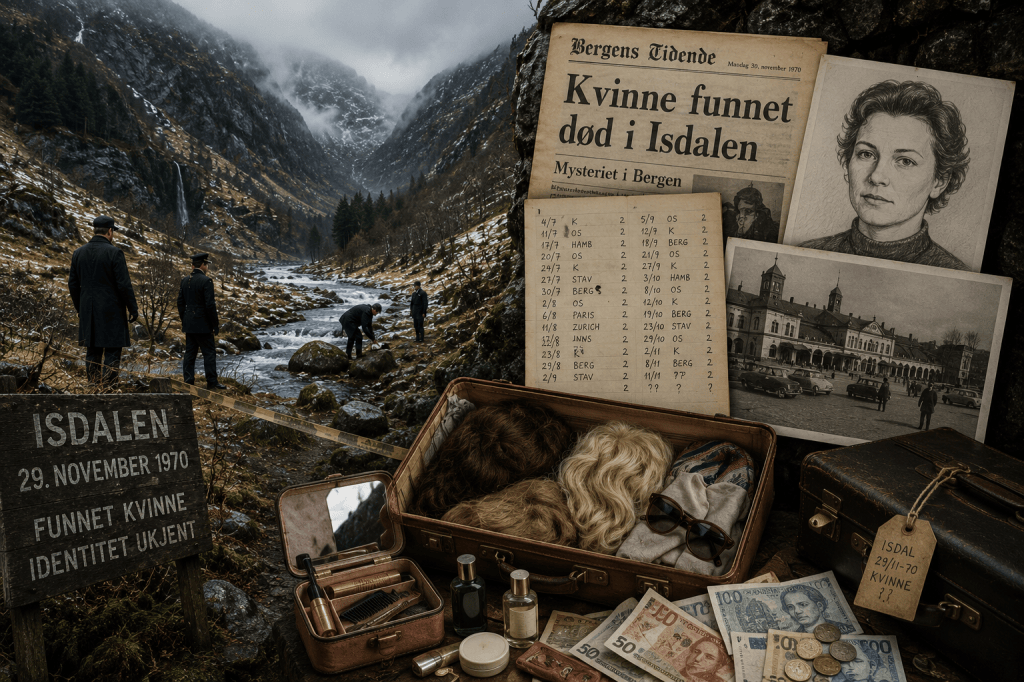
This article describes a real historical death and an unresolved investigation. The account is based on publicly available police information, forensic research and reputable reporting. AI-generated images are used for illustration and are not authentic photographs or evidence from the investigation.
On 29 November 1970, the partially burned body of an unidentified woman was found in Isdalen, a wooded valley outside Bergen, Norway.
She carried no identification.
Labels had been removed from her clothing. Objects that might reveal where she had come from had been altered or stripped of identifying marks.
Police eventually reconstructed parts of her journey across Europe and Norway—but not her true name.
More than half a century later, the central questions remain unanswered:
Who was the Isdal Woman?
And did she die by her own hand—or because someone wanted her silenced? (uib.no)
The Body in Ice Valley
Isdalen means Ice Valley.
The area lies beneath Mount Ulriken, close to Bergen but hidden among steep slopes, rocks and trees. The valley already had a dark local reputation because several people had previously died there.
The woman’s body had been badly burned. Sleeping medication was found in her stomach, and her jewellery had not been stolen but was scattered near her body.
Investigators also noticed something unusually deliberate: labels and identifying details had been cut, scraped or rubbed from her clothes and personal belongings.
The woman appeared not merely unidentified.
It appeared that someone—possibly the woman herself—had taken steps to make identification difficult. (Karolinska Institutet)
Two Suitcases at the Station
Police soon traced two suitcases stored at Bergen railway station to the dead woman.
Inside were clothes, cosmetics, wigs, spectacles, travel information and several kinds of European currency. A pair of sunglasses carried fingerprints matching the woman.
The clothing in the cases had also been stripped of identifying labels.
Investigators found a notebook containing rows of letters and numbers. At first, the entries looked like a secret code.
When deciphered, however, they appeared to record dates and destinations from the woman’s travels rather than intelligence messages. The notes helped police connect her with hotel stays in Norway and elsewhere in Europe. (The Guardian)
A Traveller with Many Names
Hotel records showed that the woman had used several different names and personal histories.
Among the identities linked to her were names such as Geneviève Lancier, Claudia Tielt, Claudia Nielsen, Alexia Zorne-Merchez and Fenella Lorck.
She often claimed connections to Belgium, but the addresses and other details she supplied could not be verified.
Witnesses remembered a well-dressed and guarded woman who spoke several languages or accents, paid in cash and sometimes changed rooms.
She may have used false travel documents, but no passport was recovered. Later stories claiming that police found seven or eight false passports appear to have exaggerated what was actually established in the investigation. (Hearst Networks EMEA)
Why would an ordinary traveller need so many names?
The aliases could suggest espionage—but they could also indicate fraud, smuggling, fear of another person or a private determination to disappear.
Secrecy alone does not reveal its purpose.
The Final Days
Using hotel forms, witness statements and the coded notebook, police reconstructed much of the woman’s movement during 1970.
She travelled between cities including Oslo, Bergen, Stavanger and destinations elsewhere in Europe. She appeared to know how to move without leaving a simple trail.
But there were gaps.
After leaving her final confirmed hotel in Bergen, her movements became uncertain. How she reached Isdalen, whether she went willingly and whether she met anyone there were never established beyond doubt.
The woman had left investigators many traces of movement—but almost nothing that explained her intention.
It was as though she had carefully recorded where she went while removing every clue to who she was.
Suicide, Murder—or Something Else?
Norwegian police concluded that the death was a suicide.
The sleeping medication, the fire and the absence of clear evidence identifying an attacker supported that interpretation.
But the conclusion never ended the debate.
Why had the woman removed labels from so many possessions?
Why had she used multiple identities?
Why were her suitcases left at the railway station?
And why had she travelled to a secluded valley without identification?
Others have argued that she may have been murdered. Some have suggested that a person with access to intelligence methods could have staged the scene or forced her to take medication.
Yet no publicly known evidence conclusively proves that another person was present when she died.
The evidence is unusual enough to create suspicion—but not strong enough to establish a killer. A University of Bergen review warns that the case has attracted confident theories that go far beyond what the surviving material can actually prove. (uib.no)
The Spy Theory
The idea that the Isdal Woman was a spy became the case’s most famous theory.
Norway occupied a strategically important position during the Cold War. The woman’s false names, wigs, coded travel notes, foreign money and careful movements looked like details from an intelligence operation.
Some writers have tried to connect her travels with military activity and weapons testing.
But resemblance is not proof.
No intelligence service has publicly acknowledged her. No handler, mission, secret documents or confirmed operational contact has been identified.
Even the mysterious notebook turned out to be largely a record of travel dates and places.
A spy remains possible.
But the evidence also fits other lives built around secrecy: a courier, a criminal associate, a woman escaping an abusive relationship or someone experiencing a serious psychological crisis.
The strange details tell us that she was hiding something.
They do not tell us what. (uib.no)
What Her Teeth Revealed
Decades after the original investigation, preserved teeth offered new information.
Researchers used radiocarbon analysis and changes in amino acids within the teeth to estimate her age. The results suggested that she was approximately 36 to 44 years old when she died and had probably been born around 1930, several years earlier than investigators had originally believed. (Karolinska Institutet)
Stable-isotope studies also suggested that she probably spent her early life in continental Europe. Reported interpretations pointed towards south-eastern Germany—possibly around Nuremberg—and movement farther west during childhood, perhaps towards France or the French-German border.
These findings narrowed the search.
They did not provide a name. (Norwegian American)
DNA profiling and renewed international attention have likewise failed to produce a publicly confirmed identification. The forensic evidence has made the woman slightly less invisible—but not enough to return her identity. (Karolinska Institutet)
The Woman Behind the Mystery
The case is often described through its strangest objects:
The wigs.
The coded notebook.
The false names.
The missing labels.
The foreign money.
But behind those clues was a real woman.
She had undergone extensive dental work. She travelled confidently across borders. She could communicate in several languages. She selected clothes and cosmetics carefully and carried enough money to move independently.
Someone may have known her as a friend, colleague, customer, neighbour or relative.
Perhaps they believed she had begun a new life elsewhere.
Perhaps the names she used in Norway were only slight variations of identities she had used for years.
Or perhaps the person who knew the truth understood exactly why she would never return.
A Death Without a Final Story
The official conclusion was suicide.
The most popular theory is espionage.
The darkest possibility is murder.
None explains every detail.
Suicide does not easily explain the elaborate destruction of identifying information.
Espionage explains the atmosphere of secrecy but lacks direct evidence of an intelligence operation.
Murder explains why someone might erase her identity—but there is no conclusive proof of another person’s involvement.
The case remains powerful because the evidence seems to promise an answer while refusing to provide one.
We know approximately when she was born.
We know some of the cities she visited.
We know the false names she gave to hotel staff.
We know what she carried in her suitcases.
But we still do not know the name given to her as a child.
Until that name is found, she remains the Isdal Woman—the traveller who crossed Europe under borrowed identities and died alone in a Norwegian valley, leaving behind almost everything except herself.
Sources
- University of Bergen: Kronikk om Isdalsaken
- Karolinska Institutet: They Solve Cold Cases
- Analysis of 14C, 13C and Aspartic Acid Racemization in Teeth and Bones to Facilitate Identification of Unknown Human Remains
- Swedish National Board of Forensic Medicine: analysis of the Isdal Woman’s teeth
- BBC World Service and NRK: Death in Ice Valley
- Bergens Tidende: reporting on stable-isotope analysis
If the mystery of the Isdal Woman intrigued you, continue with these true cases:
 Dark Stories
Responses
[…] The Isdal Woman: The Stranger Who Died Without a NameAn unidentified woman, false names, coded travel notes—and a death that still has no clear explanation. […]
LikeLike
[…] The Isdal Woman: The Stranger Who Died Without a NameFalse identities, coded notes and an unidentified woman found dead in a remote Norwegian valley. […]
LikeLike
[…] Read: The Isdal Woman—The Stranger Who Died Without a Name […]
LikeLike
[…] The Isdal Woman: The Stranger Who Died Without a Name […]
LikeLiked by 1 person
[…] The Isdal Woman: The Stranger Who Died Without a NameFalse identities, coded notes and a mysterious death in a Norwegian valley. […]
LikeLike