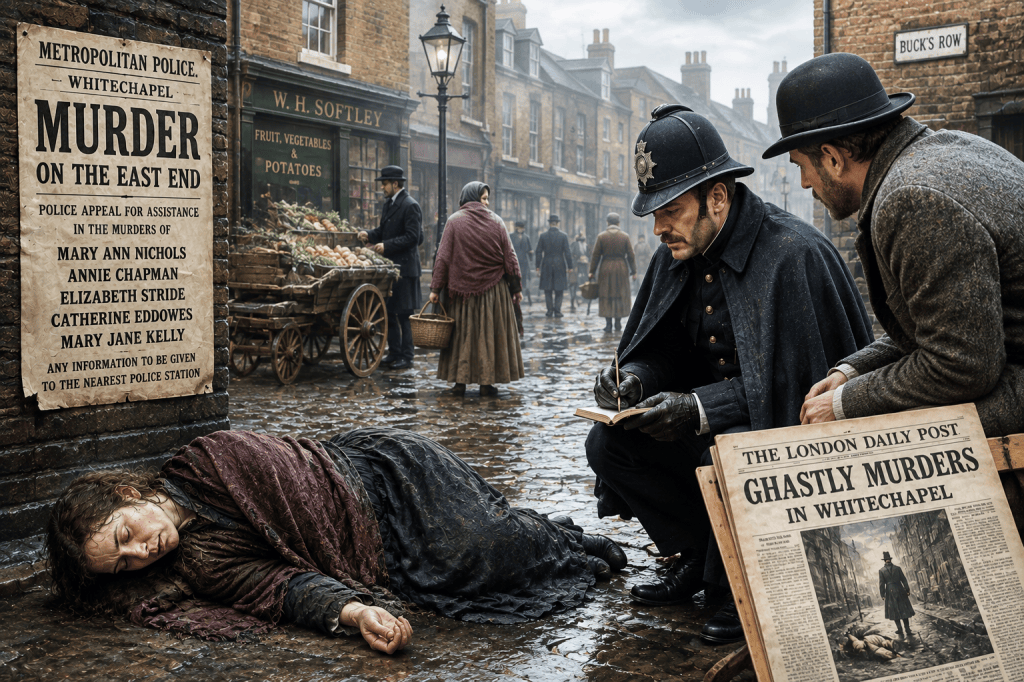
This article describes real historical murders. The account is based on surviving police records and modern historical research. AI-generated images are used for illustration and are not authentic photographs or evidence from the investigation.
In the early hours of 31 August 1888, a man walking to work through Whitechapel noticed what looked like a bundle lying beside a stable gate.
It was the body of Mary Ann Nichols.
Within ten weeks, four more women would be killed in or near London’s East End. Newspapers turned the unknown murderer into a terrifying public figure. Letters arrived claiming to come from the killer. Police searched lodging houses, questioned suspects and patrolled the streets.
But the murderer was never identified.
The name written beneath one of the letters became more famous than any of the victims:
Jack the Ripper.
Whitechapel in 1888
Whitechapel was one of London’s poorest and most overcrowded districts. Cheap lodging houses offered a bed—or merely a place on a bench—to people who could pay for one night at a time.
Many residents survived through casual labour, cleaning, selling small goods or seasonal work. A bad week, illness or separation from a partner could leave someone without food or shelter.
The five women most commonly linked to the same murderer were Mary Ann Nichols, Annie Chapman, Elizabeth Stride, Catherine Eddowes and Mary Jane Kelly. All were living in poverty and unstable housing when they died. Although later accounts frequently described all five simply as prostitutes, surviving evidence about how each woman earned money is less clear and more complicated.
Their vulnerability made them easy to overlook while they were alive—and easy for newspapers to reduce to characters in the murderer’s story after their deaths.
The First Two Murders
Mary Ann Nichols, known as Polly, was found dead in Buck’s Row on 31 August.
Just over a week later, on 8 September, Annie Chapman was discovered in the yard behind a house in Hanbury Street.
The similarities between the attacks convinced investigators that one person might be responsible. Fear spread through the East End, particularly among women who depended on the streets and lodging houses for survival.
Police increased patrols and questioned residents, but Whitechapel was a difficult place to investigate. Its narrow streets, courtyards and passageways were busy at almost every hour. A stranger could disappear into a lodging house, market or crowd within minutes.
The Metropolitan Police had no fingerprint bureau in 1888; that would not be established until 1901. Modern blood analysis and DNA identification did not exist. Detectives depended heavily on witnesses, observation and traditional questioning.
The killer had chosen an environment where darkness, poverty and constant movement worked in his favour.
The Double Event
On 30 September, two women were killed during the same night.
Elizabeth Stride was found in Dutfield’s Yard. Her injuries differed from those of the other victims, leading some later researchers to question whether she was killed by the same man.
Less than an hour later, Catherine Eddowes was discovered in Mitre Square, within the City of London police district.
The two deaths became known as the Double Event.
Now two separate police forces were involved: the Metropolitan Police and the City of London Police. Officers searched streets and buildings, followed information from the public and examined anything that might connect the attacks.
But there was still no reliable description of the murderer.
He appeared to approach women without causing immediate alarm. He could move through the area at night without attracting attention. He may not have looked frightening at all.
That possibility made the panic worse.
The Name in the Letter
Police and newspapers began receiving letters from people claiming to be the killer.
Some contained threats. Others mocked investigators or promised further murders.
One letter was signed “Jack the Ripper.”
The name was memorable, and newspapers repeated it until it became inseparable from the case. Yet there is no strong evidence that this letter—or the hundreds of similar messages sent during the investigation—was written by the murderer.
Many were almost certainly hoaxes.
The letters wasted police time, encouraged public hysteria and helped transform an unknown criminal into a theatrical figure. The National Archives still holds numerous examples among surviving police and Home Office records.
The murderer may never have called himself Jack at all.
The Room at Miller’s Court
The final victim generally accepted as part of the same series was Mary Jane Kelly.
Unlike the others, she had a small rented room. Her body was discovered there on 9 November 1888.
The indoor location gave the killer more time and privacy than the streets had provided. The crime shocked even investigators who had already seen the earlier scenes.
After Kelly’s death, the series appeared to stop.
Other women were murdered in Whitechapel before and after these events, and investigators considered whether some might have been victims of the same person. But the five women—Nichols, Chapman, Stride, Eddowes and Kelly—became the group most commonly linked to one killer.
No confession was verified.
No suspect was convicted.
No physical evidence survived that could now establish the murderer’s identity with certainty.
A City Searching for a Face
Police examined many possible suspects.
Doctors, butchers, sailors, local labourers, immigrants and men with histories of violence all attracted attention. Later generations added artists, aristocrats and members of the royal family.
More than a hundred names have been proposed over the years.
Some were plausible suspects. Others were connected to the crimes only through coincidence, prejudice or a writer’s imagination.
Modern claims involving DNA have also attracted headlines, but questions about the origin, handling and contamination of old objects make definitive conclusions difficult. No theory has gained universal acceptance among historians and forensic specialists.
The truth may be much less dramatic than the legends.
The murderer may have been an ordinary local man whose name never appeared prominently in the investigation—or whose connection to the killings was recognised only after the surviving evidence had disappeared.
The Women Behind the Mystery
The murderer’s invented name became internationally famous.
The women’s names did not.
Mary Ann Nichols had been married and was the mother of five children.
Annie Chapman had also been married and had children before illness, separation and poverty transformed her life.
Elizabeth Stride was born in Sweden and had supported herself through various forms of work.
Catherine Eddowes had recently returned from seasonal hop picking in Kent.
Mary Jane Kelly remains the most difficult to document, because much of what is known about her comes from stories she told others.
They were not merely figures found at crime scenes. They had families, occupations, relationships, illnesses, disappointments and periods of relative stability before poverty left them exposed to danger.
Their killer took their lives.
The mythology surrounding him nearly took their identities as well.
The Man Who Disappeared
Jack the Ripper was never caught because there was no single dramatic mistake, no reliable witness and no piece of evidence capable of identifying him.
The police were investigating an unknown offender in a densely populated neighbourhood, using methods that belonged to an age before modern forensic science.
The hoax letters created noise rather than clarity. Newspaper competition encouraged exaggeration. Suspicion often followed social prejudice instead of evidence.
Then the murders stopped.
Perhaps the killer died.
Perhaps he was imprisoned for another crime, entered an institution or left London.
Perhaps the final murder frightened even him.
Or perhaps one of the later Whitechapel deaths was his work, and investigators simply failed to recognise it.
More than a century later, the answer remains hidden.
Five women entered history because someone murdered them.
The murderer entered legend because nobody knew his name.
Sources
- The National Archives: Hoax Letter Signed by “Jack the Ripper”
- The National Archives: Whitechapel
- London Museum: Jack the Ripper
- Metropolitan Police: Timeline of Met History
- National Geographic History: Jack the Ripper Murders Still Unsolved After a Century
 Dark Stories
Responses
[…] Jack the Ripper: The Killer Who Vanished into WhitechapelFive women were murdered in Victorian Londo… […]
LikeLike
[…] Jack the Ripper: The Killer Who Vanished into WhitechapelFive women were murdered in Victorian London, but the killer was never identified. […]
LikeLike
[…] Jack the Ripper: The Killer Who Vanished into WhitechapelA series of murders terrified Victorian London, but the killer’s identity was never established. […]
LikeLike
[…] Jack the Ripper: The Killer Who Vanished into Whitechapel […]
LikeLike