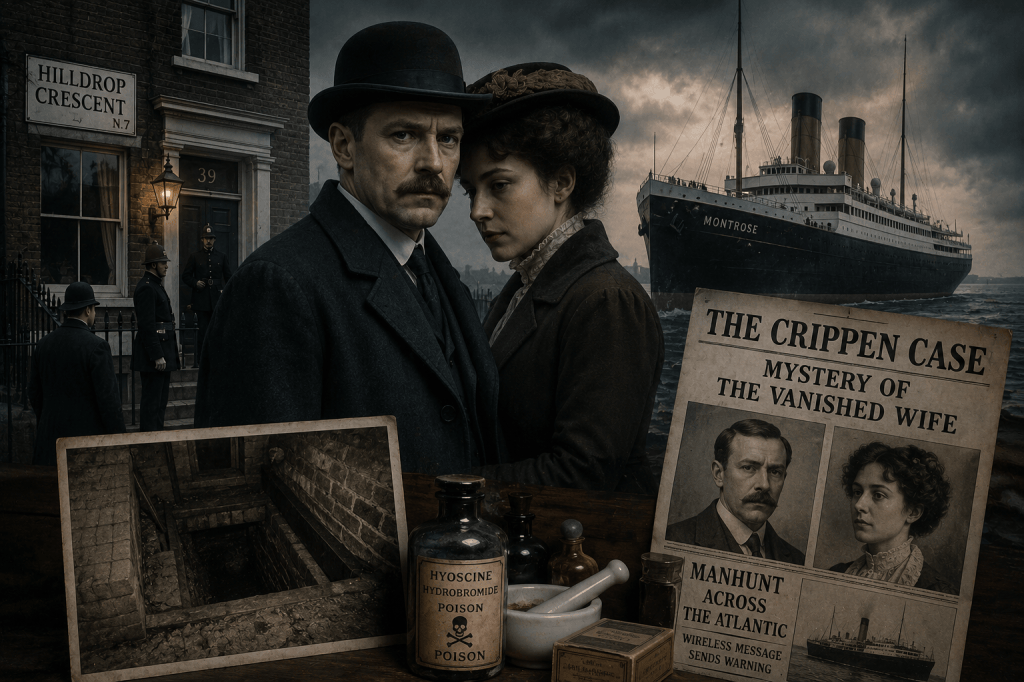
This article recounts a real historical murder case. Some aspects of the evidence have later been disputed. The narrative follows documented events and does not invent dialogue. AI-generated images may be used for illustration and are not authentic photographs or evidence.
For several weeks in 1910, the house at 39 Hilldrop Crescent in North London appeared perfectly ordinary.
Its owner, Dr Hawley Harvey Crippen, continued going to work. His young secretary, Ethel Le Neve, moved into the house and began wearing clothes and jewellery that had belonged to Crippen’s wife.
Only one person was missing.
Cora Crippen—better known by her stage name, Belle Elmore—had vanished.
Her husband claimed she had gone to America.
Then he said she had died there.
Neither story was true.
An Unhappy Marriage
Hawley Harvey Crippen was an American who had moved to London with Cora in the late 1890s. He was frequently described as a doctor, although much of his work involved homeopathic products, patent medicines and treatments of questionable medical value.
Cora was very different.
She was lively, sociable and ambitious. She performed as Belle Elmore and built friendships within London’s music-hall community. The marriage was troubled, and Crippen eventually began a secret relationship with his young secretary, Ethel Le Neve.
Ethel was quiet and much younger than Cora. She worked beside Crippen every day, and their professional relationship became an affair.
Crippen now lived between two women.
One was his wife, whose presence dominated their home and social life.
The other was the woman he wanted to be with.
At some point, the situation became impossible to maintain.
The Dinner Party
At the end of January 1910, Cora and Hawley Crippen entertained friends at their London home.
Soon afterwards, Cora disappeared.
Crippen told her friends that she had been called unexpectedly to the United States. Later, he announced that she had become ill and died while abroad.
There was no funeral in London.
No death certificate arrived.
No convincing details were provided about the illness, the hospital or the place where Cora had supposedly been buried.
Then Ethel Le Neve moved into the house.
She wore some of Cora’s jewellery and appeared publicly with Crippen. To Cora’s friends, this seemed indecently quick. Their grief gradually turned into suspicion.
Where was Cora?
And why did her husband seem so eager to replace her?
Friends Who Refused to Forget
Cora belonged to a network of music-hall performers who noticed her absence.
Among them were Lil Hawthorne and her husband, John Nash. They made inquiries and found no reliable evidence that Cora had travelled to America or died there.
Eventually, they contacted Scotland Yard.
Detective Inspector Walter Dew questioned Crippen at Hilldrop Crescent.
Crippen’s explanation changed again.
He admitted that Cora had not died. He now claimed she had left him for another man and that he had invented the story of her death because he felt humiliated.
It was an extraordinary admission, but it was not proof of murder.
Dew searched the house and found nothing that immediately justified an arrest. Crippen remained free, and the investigation appeared close to ending.
Crippen could still have survived the scandal.
Instead, he ran.
The Lovers Disappear
When Inspector Dew returned to ask further questions, Crippen and Ethel were gone.
Their flight transformed suspicion into alarm.
Police searched the house again, this time with greater care. In the cellar, beneath a brick floor, investigators found human remains wrapped in material and covered with quicklime.
The remains were incomplete. There was no head, no skeleton and no clear face by which the victim could be identified.
But investigators believed they had found what remained of Cora Crippen.
A toxic substance called hyoscine was detected, and records showed that Crippen had purchased a substantial quantity shortly before his wife disappeared. A piece of tissue was also interpreted as showing a scar consistent with an operation Cora had undergone. These findings became central to the prosecution’s case.
Britain now had a suspected murderer—but no suspect.
Crippen and Ethel had escaped to continental Europe.
From there, they boarded a ship bound for Canada.
The Boy Who Was Not a Boy
The couple travelled aboard the Montrose under false identities.
Crippen presented Ethel as his teenage son. She cut her hair, wore a boy’s clothing and stayed close to him during the voyage.
But their behaviour attracted the attention of the ship’s captain, Henry Kendall.
The supposed father and son appeared unusually affectionate. The older man resembled newspaper descriptions of the missing doctor. The younger passenger seemed to be a woman in disguise.
Kendall had access to a relatively new technology: wireless telegraphy.
From the middle of the Atlantic, he secretly sent a message to the authorities in Britain.
It was one of the earliest celebrated uses of wireless communication in an international criminal pursuit.
Inspector Dew boarded a faster vessel.
While Crippen and Ethel continued towards Canada, believing they had escaped, the detective raced across the Atlantic to arrive before them.
Newspapers followed the pursuit almost hour by hour.
For the public, it became the great ocean chase.
For Crippen and Ethel, the sea itself had become a trap.
The Arrest at Sea
Dew reached Canada ahead of the Montrose.
On 31 July 1910, he boarded the ship near Father Point in the St Lawrence River with Canadian officers.
Crippen recognised him.
The voyage was over.
The lovers were arrested and returned to Britain to face separate trials. The same wireless system that had carried ordinary maritime messages had enabled police to capture two fugitives before they could disappear into North America.
The public had already decided what the story meant:
A husband had murdered his wife so that he could begin a new life with his mistress.
The court still had to prove it.
A Body Without a Name
Crippen’s trial began at the Old Bailey in October 1910.
The prosecution had no eyewitness to the killing.
It could not establish precisely how Cora died.
The remains from the cellar could not be identified through a face, fingerprints or bones.
The case was therefore largely circumstantial.
But the circumstances were powerful.
Cora had disappeared.
Crippen had repeatedly lied about what happened to her.
He had bought hyoscine shortly before the disappearance.
Human remains were discovered beneath his cellar.
His mistress had taken Cora’s place in the house.
And when the police began asking questions, the lovers fled in disguise.
After a trial lasting several days, the jury found Crippen guilty of murdering his wife. He was sentenced to death. Contemporary reporting described the prosecution’s case as circumstantial but convincing to the jury.
Ethel Le Neve was tried separately as an accessory after the murder.
She was acquitted.
The court did not find it proven that she knew Cora had been murdered or that she had deliberately helped conceal the crime.
Love—or Escape?
Crippen never confessed.
He continued to deny murdering Cora and showed greater concern for Ethel’s fate than for his own.
On 23 November 1910, Hawley Harvey Crippen was hanged at Pentonville Prison.
Ethel eventually created a new life under another name. She married, had children and rarely spoke publicly about the case.
But what had their relationship truly been?
Was Ethel an innocent young woman manipulated by an older man?
Did she suspect what had happened but choose not to ask?
Or did she understand far more than the prosecution could prove?
Her acquittal answered the legal question.
It did not answer the human one.
The Evidence Is Challenged
Nearly a century later, scientists examined material preserved from the tissue used during Crippen’s trial.
A study published in 2010 reported that the tested tissue did not share the maternal DNA profile expected from Cora’s relatives. The researchers also reported evidence that the tissue was biologically male.
They concluded that the tested sample was not from Cora Crippen.
The finding did not formally overturn Crippen’s conviction.
Questions remained about the sample’s history, preservation and whether the tested material was unquestionably the same evidence presented at the original trial.
Even so, it reopened the case’s most disturbing question:
Whose body was beneath the cellar floor?
The House at Hilldrop Crescent
The Crippen case contained everything the newspapers of 1910 could desire:
An unhappy marriage.
A younger mistress.
A missing performer.
A body hidden beneath a respectable London house.
A woman disguised as a boy.
And a detective racing a suspected killer across the Atlantic.
Yet beneath the sensation was the death of a woman whose husband first claimed she had travelled abroad, then claimed she had died, and finally claimed she had abandoned him.
Cora Crippen never returned to contradict him.
The jury believed her remains had been found beneath the home she shared with him.
Modern science introduced doubt about the identification—but offered no alternative explanation for Cora’s disappearance.
More than a century later, Hawley Crippen remains one of Britain’s most famous convicted murderers.
And the love affair for which he may have killed ended not with a new life in Canada, but with a wireless signal travelling silently across a dark Atlantic Ocean.
More True-Crime Mysteries
The Journalist Who Left for Work—and Never Arrived
A Polish investigative reporter vanished on his way to work, leaving behind a murder investigation that continues decades later.
The Isdal Woman: The Stranger Who Died Without a Name
False identities, coded notes and an unidentified woman found dead in a remote Norwegian valley.
Jack the Ripper: The Killer Who Vanished into Whitechapel
A series of murders terrified Victorian London, but the killer’s identity was never established.
Discover more true crimes and fictional mysteries at Dark Stories.
 Dark Stories
Leave a comment