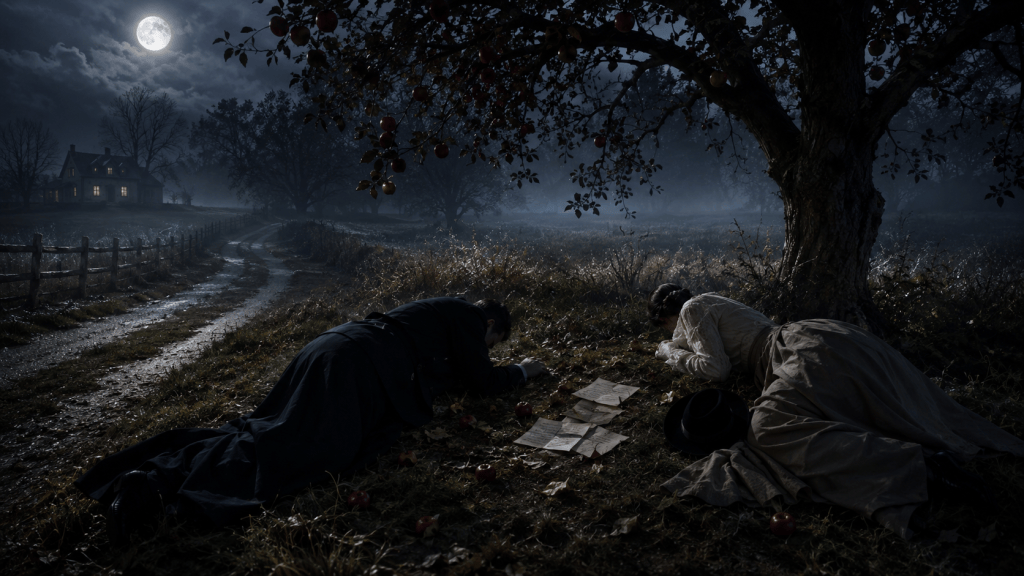
This article describes a real unsolved double murder. The known facts are separated from accusations, disputed testimony and later theories. No person was ever convicted of the killings. AI-generated images may be used for illustration and are not authentic photographs or evidence.
On the evening of September 14, 1922, two married people left their homes in New Brunswick, New Jersey.
Neither returned.
One was Reverend Edward Wheeler Hall, rector of St. John the Evangelist Episcopal Church.
The other was Eleanor Reinhardt Mills, a singer in his church choir.
To their families and congregation, they were respectable members of the community.
But they shared a secret.
They were in love.
Two days later, their bodies were found beneath a crabapple tree.
And between them lay the evidence of the relationship someone may have killed them to end.
Their love letters.
The Priest and the Choir Singer
Edward Hall was married to Frances Stevens Hall, a woman from a wealthy and socially prominent family.
Eleanor Mills was married too. Her husband, James Mills, worked as a church sexton.
Edward and Eleanor met through the church.
Somewhere between services, choir rehearsals and ordinary conversations, their relationship changed.
They began exchanging letters.
The correspondence made clear that this was not simply flirtation. The two expressed deep affection for one another and apparently discussed a future together.
But there was a problem.
Both already had spouses.
And in the America of 1922, an Episcopal priest abandoning his wife for a married choir singer would have meant scandal.
For Edward and Eleanor, secrecy was essential.
For someone else, however, discovering the affair might have provided a motive for murder. Their relationship was later documented through letters and Hall’s diary material preserved among the case records.
Thursday Night
On Thursday, September 14, Hall left his home.
Eleanor also went out.
Neither was seen alive by their families again.
At first, there was uncertainty rather than panic.
Perhaps the pair had run away together.
It was not an unreasonable possibility.
Their relationship was secret, their marriages unhappy enough to generate speculation, and disappearance could have offered an escape from lives they no longer wanted.
But they had not escaped.
They had travelled only a short distance.
Somewhere near an abandoned farm outside New Brunswick, the secret lovers met someone—or several people.
What happened next has never been established.
Saturday Morning
Two days later, a young couple walking near an isolated lovers’ lane discovered something beneath a crabapple tree.
Edward Hall lay dead.
Beside him was Eleanor Mills.
The scene was so strange that it looked almost staged.
The bodies had been placed close together, creating the appearance of intimacy. Hall’s hat had been positioned over his face.
And scattered between them were letters.
Love letters.
Someone had murdered the lovers and apparently left behind the very evidence that exposed their affair to the world.
The secrecy was over.
Within days, much of America would know about Edward and Eleanor.
The Violence
Hall had been shot in the head.
Eleanor had been shot several times.
She had also suffered a severe wound to her throat.
The contrast disturbed investigators.
Hall appeared to have been killed relatively quickly.
The attack on Eleanor was more violent.
Was that difference meaningful?
Did the killer hate Eleanor more?
Was the murder driven not merely by a desire to stop an affair, but by personal rage?
Investigators could ask the questions.
The crime scene could no longer answer them reliably.
Because almost immediately, one of the most important murder scenes in America became a public attraction.
The Crowd Beneath the Tree
Police failed to secure the area properly.
Reporters arrived.
Then curious residents.
Then crowds.
People walked through the ground where investigators should have been looking for footprints and other evidence.
Some reportedly removed pieces of bark from the famous crabapple tree as souvenirs.
The murder scene effectively became a tourist destination.
Years later, investigators would be forced to reconstruct a case whose physical evidence had been compromised almost from the beginning.
And that failure would haunt every attempt to solve the murders.
The Obvious Question
Who knew about the affair?
And who had the strongest reason to want it stopped?
Suspicion quickly turned toward the people closest to the victims.
Edward’s wife, Frances Hall, became a central figure in public speculation.
Her family was wealthy.
Her brothers were protective of her.
The prosecution would eventually argue that jealousy and family honour could have provided a motive.
But suspicion is not evidence.
Frances Hall denied involvement.
And in 1922, prosecutors could not build a case strong enough to take her to trial.
A grand jury heard dozens of witnesses and returned no indictments.
For a time, it appeared that the murders would remain forever unexplained.
Then a woman appeared with an extraordinary story.
The Woman in the Fields
Her name was Jane Gibson.
She lived near the place where the bodies were found and raised livestock. Newspapers gave her the rather cruel nickname “the Pig Woman.”
Gibson claimed she had been outside on the night of the murders because she was watching for people stealing crops.
From a distance, she said, she saw several people near the crabapple tree.
Then she heard arguments.
Shots.
A woman screaming.
And according to Gibson, some of the people she saw were members of Frances Hall’s family.
It sounded like the breakthrough investigators needed.
There was just one problem.
Her story changed.
Details varied between different versions, and even officials at the time questioned whether, in the darkness, she could reliably identify the people she claimed to have seen.
The murder mystery now had an eyewitness.
But nobody knew how much of her story could be trusted.
Four Years of Silence
The case slowly faded.
No one was convicted.
Then, almost four years after the killings, the Hall-Mills murders exploded back into the newspapers.
New information and relentless tabloid coverage pushed New Jersey authorities to reopen the investigation.
This time prosecutors acted.
Frances Hall was arrested.
So were her brothers Henry Stevens and William “Willie” Stevens. A cousin, Henry Carpender, was also accused, although his case was handled separately.
The prosecution’s theory was explosive.
The wealthy Hall family, it suggested, had confronted Edward and Eleanor because of their affair.
The confrontation ended in murder.
America prepared for a sensational trial.
The Trial Everyone Wanted to See
The proceedings began in November 1926.
Newspapers treated the case almost like theatre.
The courtroom was packed.
Edward and Eleanor’s intimate letters were discussed publicly.
And then came the moment reporters had been waiting for.
Jane Gibson was seriously ill.
So ill that she could not enter court normally.
She was brought into the courtroom on a hospital bed.
From there, facing the jury, she accused Frances Hall and members of her family of being at the murder scene.
It was spectacular testimony.
It was also deeply disputed.
Her changing accounts gave the defence plenty of ammunition.
Even contemporary observers questioned whether she could be trusted.
The prosecution had drama.
What it lacked was certainty.
The Fingerprint
There was one piece of physical evidence that appeared more promising.
A fingerprint had reportedly been found on one of Edward Hall’s calling cards recovered from the murder scene.
The prosecution said it belonged to Willie Stevens.
That could have placed one of Frances Hall’s brothers close to the bodies.
But the defence attacked the evidence.
Its experts disputed the identification.
Questions were also raised about how the card had been handled and whether the evidence presented in 1926 was unquestionably the same item collected four years earlier.
The fingerprint that might have solved the case instead created another argument.
And after four years, witnesses’ memories had weakened while evidence had been lost or mishandled.
The jury was being asked to decide whether suspicion could become proof.
Five Hours
The trial lasted about a month.
Then the jury withdrew.
For five hours, the defendants waited.
So did the reporters.
So did much of America.
Finally the jurors returned.
Not guilty.
Frances Hall was acquitted.
Henry Stevens was acquitted.
Willie Stevens was acquitted.
The remaining charges were eventually dismissed.
The verdict meant something important.
The jury had not concluded that another person committed the murders.
It had concluded that prosecutors had failed to prove these defendants guilty beyond a reasonable doubt.
Whoever had killed Edward Hall and Eleanor Mills was still unknown.
The Letters Left Behind
There is one detail that makes the case particularly haunting.
Why were the love letters left with the bodies?
A killer trying to hide the crime could have destroyed them.
Instead, the letters exposed the affair.
Perhaps that was deliberate.
Perhaps the murderer wanted everyone to know why Edward and Eleanor had died.
The bodies themselves may have been arranged to emphasise their relationship.
A secret love had become a public accusation.
But an accusation against whom?
A jealous spouse?
A protective relative?
Someone else who knew about the affair?
Or was the apparent symbolism of the scene misleading investigators from the beginning?
There is no answer.
A Murder Without an Ending
More than a century has passed.
Edward Hall and Eleanor Mills are long dead.
So are the principal suspects and witnesses.
Rutgers University preserves investigation records including correspondence, autopsy material and other documents connected to the case. Researchers studying those archives have noted that important material disappeared over the years, including testimony that might once have helped resolve the mystery.
No later discovery has established the identity of the killer.
The case remains unsolved.
Yet the outline is painfully clear.
A married priest fell in love with a married choir singer.
They met in secret.
Someone discovered—or already knew—the truth.
One September night, the lovers went to a secluded place.
They never returned.
Two days later they were found beneath a crabapple tree.
And lying between their bodies were the letters they had written when they believed nobody else was reading.
What Do You Think?
Was the secret affair the direct motive for the murders?
Did someone close to Edward or Eleanor follow them that night?
Was the crime planned—or did a confrontation suddenly turn violent?
And most mysterious of all:
Why did the killer leave the love letters behind?
More than one hundred years later, the Hall-Mills murders still have no proven answer.
More Unsolved Stories from Dark Stories
The Journalist Who Left for Work—and Never Arrived
A Polish investigative journalist disappeared on his way to the newsroom. His body has never been found.
The Men Who Waited for a Signal
Two electronics technicians climbed a Brazilian hill with strange instructions and lead masks. Both were found dead.
The Isdal Woman: The Stranger Who Died Without a Name
False identities, coded notes and a mysterious death in a Norwegian valley.
D.B. Cooper: The Hijacker Who Vanished into the Night
A hijacker took a ransom, jumped from an aircraft and disappeared.
Discover more true mysteries and dark fiction at Dark Stories.
Sources
The Hall-Mills case is extensively documented in the Rutgers University Libraries Hall-Mills collection, which includes investigation material, autopsy records and correspondence. Rutgers University Press has also published a detailed historical account of the murders and 1926 trial. Contemporary and later reporting in The New Yorker documents both the crime scene and the extraordinary media spectacle surrounding the case.
 Dark Stories