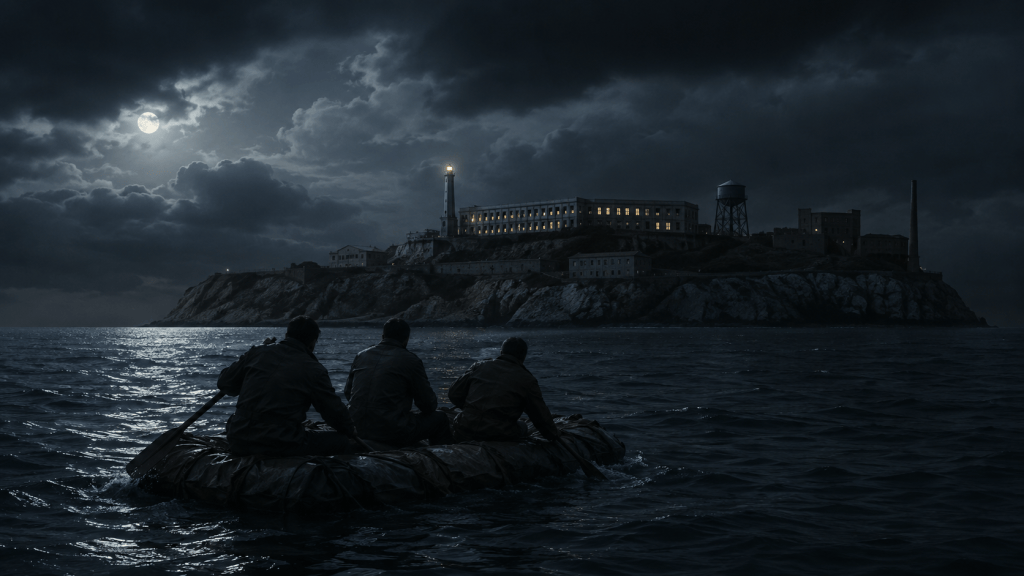
This article describes a real criminal case. The account is based on publicly available sources. AI-generated images are used for illustration and are not authentic photographs or evidence from the investigation.
On the morning of June 12, 1962, guards at Alcatraz Federal Penitentiary began their routine inspection.
Three prisoners appeared to be asleep in their cells.
But when a guard reached through the bars and touched one of the heads on a pillow, it rolled onto the floor.
It was not a human head.
It was a carefully made dummy.
Frank Morris and the brothers John and Clarence Anglin were gone.
More than six decades later, nobody has conclusively established whether the three men drowned in San Francisco Bay—or completed one of the most daring prison escapes in history. (FBI)
The Prison Known as “The Rock”
Alcatraz stood on an island in San Francisco Bay, surrounded by cold water and powerful currents.
It had operated as a maximum-security federal prison since 1934 and housed inmates regarded as dangerous, troublesome or likely to escape from other institutions.
The prison relied on reinforced bars, guard towers, strict routines and repeated prisoner counts. From 1934 until Alcatraz closed in 1963, 36 men participated in 14 known escape attempts. Most were captured or did not survive. (FBI)
The prison authorities believed the island itself was part of the security system.
Even if a man escaped from the building, he would still have to cross the waters of the bay.
The Four Men Behind the Plan
Frank Morris arrived at Alcatraz in January 1960. He had convictions for bank robbery, burglary and other crimes, as well as a history of attempting to escape from prisons.
John Anglin arrived later that year, followed by his brother Clarence in early 1961.
The three men knew one another from earlier periods in prison and were assigned to nearby cells.
A fourth prisoner, Allen West, joined the plan.
According to the FBI, Morris played a leading role in organising the escape. (FBI)
Digging Through the Walls
The men began preparing months in advance.
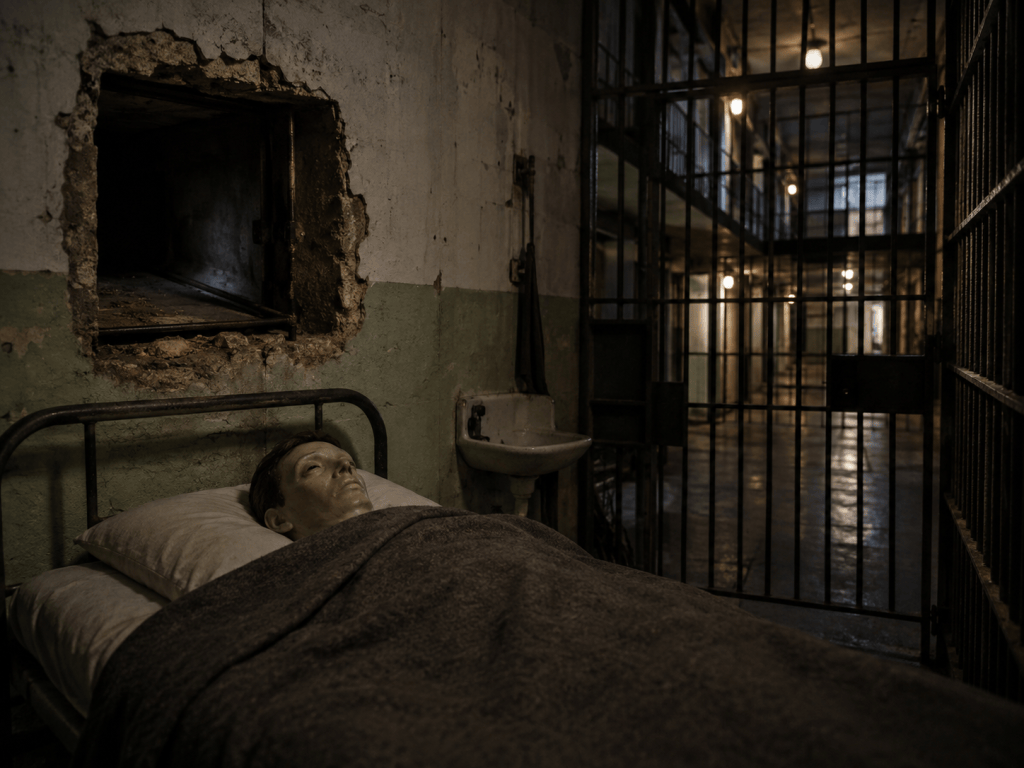
Behind each cell was an air vent leading into an unguarded utility corridor. The prisoners gradually enlarged the openings around their vents using crude tools.
One of their homemade drills was constructed using the motor from a broken vacuum cleaner.
They worked during periods when noise elsewhere in the prison could conceal the sound. After each session, they covered the damaged areas with cardboard, suitcases or other objects so that guards would not notice. (FBI)
Once the openings were large enough, the men could crawl into the corridor behind the cells.
From there, they climbed to an unused area above the cell block.
It became their secret workshop.
A Raft Made from Raincoats
Inside the hidden workshop, the prisoners collected and modified materials needed for the escape.
They obtained more than 50 raincoats and used them to construct life preservers and a rubber raft measuring approximately six by fourteen feet.
The seams were stitched and sealed using heat from prison pipes.
They also made wooden paddles and adapted a musical instrument so it could be used to inflate the raft. (FBI)
The work required patience, secrecy and cooperation.
At the same time, they searched for a route from the utility area to the roof.
They eventually climbed a network of pipes and loosened a ventilator covering an opening above them. To keep it appearing secure before the escape, they reportedly fashioned a false bolt from soap. (FBI)
The Dummy Heads
The prisoners also had to make the guards believe that they were sleeping after they had left their cells.
They created realistic dummy heads using materials including cardboard, plaster or cement fragments, paint and human hair collected from the prison barbershop.
The heads were placed on the pillows beneath blankets.
From outside the cells, particularly in poor night-time lighting, they looked convincing enough to fool the guards during routine checks. (FBI)
This gave the men several hours before anyone realised they were missing.
The Night of the Escape
On the evening of June 11, 1962, the plan was put into action.
Morris and the Anglin brothers crawled through the openings behind their cells and entered the utility corridor.
Allen West was supposed to join them, but he was unable to remove the covering from his cell opening in time.
The other three continued without him.
They collected their equipment, climbed through the roof ventilator and reached the top of the prison building.
They then descended near the bakery, crossed the prison grounds, climbed over a fence and reached the northeast shore of the island.
There, according to the reconstructed plan, they inflated their makeshift raft and entered the bay. (FBI)
After that, their movements are unknown.
The Empty Cells
The escape was discovered during the morning inspection on June 12.
The prison was locked down, and a major search began.
The FBI, the Coast Guard, prison authorities and other agencies searched the island, the water and nearby shoreline.
Allen West, who had been left behind, provided investigators with information about the plan and the preparations. (FBI)
Investigators found evidence believed to be connected to the escape.
Within two days, a rubber-sealed packet containing personal letters was recovered.
Pieces of wood resembling paddles and fragments of rubber were found in the water. A homemade life vest washed ashore at Cronkhite Beach.
However, the three men themselves were not found. (FBI)
Could They Have Crossed the Bay?
The central question was whether the raft survived the cold water, currents and winds of San Francisco Bay.
According to information given by West, the men intended to reach Angel Island and then cross towards Marin County.
The FBI’s investigation at the time concluded that the men probably did not survive.
Investigators noted that the water was cold and the currents dangerous. They also found no confirmed theft of clothing or a vehicle on the mainland, although the escape plan reportedly included obtaining both.
During the FBI’s 17-year investigation, no credible evidence conclusively demonstrated that the men were living in the United States or abroad. (FBI)
But there was no decisive proof that they had died either.
No bodies were conclusively identified as the escapees.
Their complete raft was not recovered.
And no final piece of evidence established what happened after they left the island.
The Anglin Brothers
John and Clarence Anglin had grown up in a large family in the southern United States.
Their relatives were interviewed after the escape, but investigators said they could not substantiate claims that the family had helped the men disappear.
Over the years, stories have emerged claiming that family members received unexplained messages or signs that the brothers had survived.
None has provided publicly verified proof of their survival.
The U.S. Marshals Service continues to list both John and Clarence Anglin as wanted for the 1962 escape.
Frank Morris
Frank Morris was also never found.
He had a history of prison escapes and was regarded by investigators as intelligent and resourceful.
The U.S. Marshals Service still lists him as wanted for escaping from Alcatraz on June 11, 1962. (U.S. Marshals Service)
If Morris survived, he would have needed to avoid identification while obtaining shelter, money, clothing and transport.
The same would have been true for the Anglin brothers.
A Case That Was Never Truly Closed
The FBI officially closed its investigation on December 31, 1979.
Responsibility was transferred to the U.S. Marshals Service.
The Marshals have stated that they continue to examine credible information because the escapees were never located. (FBI)
The original dummy heads remain important evidence from the case. Because they had become fragile, the FBI later produced three-dimensional replicas for display and preservation purposes. (FBI)
Did They Survive?
There are two basic possibilities.
The first is that the men entered the bay, lost control of the raft and drowned.
This is consistent with the dangerous conditions and the absence of confirmed evidence showing that they reached the mainland.
The second possibility is that they reached land and successfully disappeared.
Supporters of that theory point to the careful planning, the lack of recovered bodies and the fact that some people have successfully crossed the waters around Alcatraz.
Neither explanation has been proven conclusively.
The Mystery of the Missing Men
The three prisoners defeated the physical security of one of the most famous prisons in the world.
They widened the vents behind their cells.
They built a hidden workshop.
They manufactured a raft, life preservers and paddles.
They climbed onto the prison roof and reached the shoreline without being detected.
The only part of the plan that remains unknown is the most important one:
What happened after they entered the water?
Did the raft collapse in the darkness?
Did the currents carry them out into the bay?
Or did Frank Morris, John Anglin and Clarence Anglin reach the mainland and begin new lives under different names?
Until conclusive evidence is discovered, their disappearance will remain one of the most enduring mysteries in American criminal history.
Sources
- Federal Bureau of Investigation: Alcatraz Escape
- Federal Bureau of Investigation: Escape from Alcatraz
- Federal Bureau of Investigation, San Francisco: FBI Presents National Park Service with 3D Printed Copies of Escape from Alcatraz Decoy Heads
- U.S. Marshals Service: John William Anglin
- U.S. Marshals Service: Frank Lee Morris
- National Park Service: Alcatraz Museum Collections
 Dark Stories