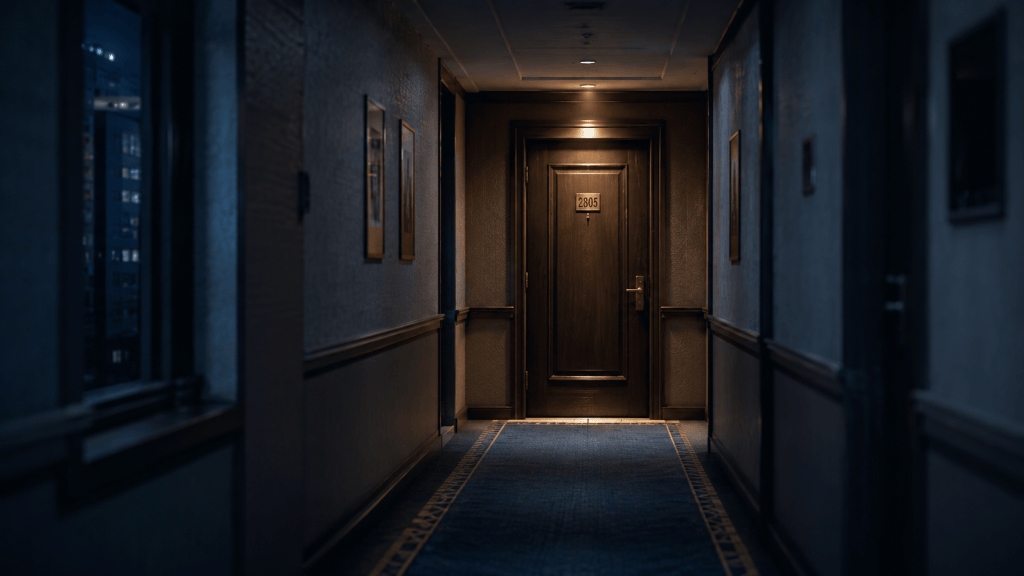
A false name. A locked hotel room. A gun with its serial number removed. Thirty-one years later, nobody can say who she really was.
Note: This article describes a real unresolved death. The established facts are separated from theories, and AI-generated illustrations—if used—should not be presented as authentic evidence.
On the evening of May 31, 1995, a young woman entered the Oslo Plaza, one of Norway’s tallest and most prestigious hotels.
She appeared calm and elegantly dressed. She spoke English and German and gave her name as Jennifer Fergate—although the surname was written as “Fairgate” in parts of the hotel’s records. She said she was from Verlaine, Belgium, and registered a second guest, Lois Fergate.
Almost everything she wrote down was false.
The address did not exist. The telephone details did not lead to her. Belgian police could find no Jennifer or Lois Fergate matching the information. Yet the woman was given room 2805 on the twenty-eighth floor without showing identification or providing a credit card.
Three days later, she was dead.
The Gunshot Behind the Door
The hotel had been unable to collect payment from the mysterious guest. On Saturday, June 3, a security guard went to room 2805 and knocked.
According to the investigation reconstructed by the Norwegian newspaper VG, the guard heard a gunshot from inside the room. Instead of entering immediately, he went to get the head of security. When staff returned roughly fifteen minutes later, the door was locked from within.
Inside, the woman lay on the bed with a fatal gunshot wound to her head. A Browning 9 mm pistol was in her hand. Its serial number had been partly removed. An attaché case contained ammunition.
Norwegian police concluded that she had taken her own life. But that conclusion did not answer the most basic question:
Who was she?
A Life Carefully Erased
There was no passport, wallet, purse, house key or ordinary collection of personal items that might identify her. Labels had been removed from much of her clothing. Her luggage contained several garments for the upper body, but investigators found no normal selection of trousers or skirts.
She had supplied a fictitious Belgian address and had apparently invented the person called Lois. Nobody came forward to report her missing. Her fingerprints did not reveal her identity.
Hotel key-card records also suggested that she had been away from the room for a substantial period during her stay. Where did she go? Whom did she meet? The answers disappeared with her.
One more detail deepened the unease: two shots had been fired in the room. One bullet had passed through bedding before the fatal shot. It may have been a test shot—but even that interpretation raises another question. Why would an apparently composed young traveller arrive at a luxury hotel with an untraceable pistol and a case of ammunition?
A Stranger from Germany?
The woman was buried in Oslo in 1996 without her real name.
Renewed reporting by VG eventually led to the exhumation of her remains in 2016. Later forensic work indicated that she was probably born around 1971 and may have grown up in Germany. A more complete DNA profile was obtained, but it did not restore the name she had lost—or deliberately abandoned.
Theories multiplied. Some believed she had been involved in intelligence work because of the false identity, removed clothing labels and altered weapon. Others suggested organized crime, murder staged as suicide, or a deeply troubled woman determined to die anonymously.
None of those theories has been proved.
The locked room supports the official suicide finding. The false identity and unusual belongings encourage darker interpretations. The honest answer is less dramatic and more disturbing: the available evidence does not tell us why she died or who she had been before entering the hotel.
The Shadow of the Isdal Woman
The case has an unsettling Norwegian predecessor.
In 1970, another unidentified woman was found dead in Isdalen near Bergen. She had travelled under false names, removed identifying labels from her belongings and left behind a trail that suggested careful concealment. Like Jennifer Fergate, she inspired theories involving espionage, yet her true identity remains uncertain.
The similarities are striking, but no reliable evidence connects the two women. A resemblance is not a solution. What the cases share is something more haunting: two human beings managed to move through modern Europe while leaving almost no usable identity behind.
Read: The Isdal Woman—The Stranger Who Died Without a Name
People Who Vanish—and Questions That Remain
Unsolved cases endure because they contain an empty space that facts cannot fill.
In London, the identity of Jack the Ripper vanished behind a name probably created by a letter writer. In Poland, investigative journalist Jarosław Ziętara left for work in 1992 and never arrived. In Oslo, the woman in room 2805 died beside a false name—and kept her real one.
Each story leaves a different question:
- Who was the killer?
- What happened to the missing man?
- Who was the dead woman?
Perhaps someone, somewhere, still recognizes her face. Perhaps an old photograph lies in a family album with a forgotten name written on the back. Until that connection is made, “Jennifer Fergate” remains only the final alias of the woman in room 2805.
Continue with More Unsolved True-Crime Stories
Jack the Ripper: The Killer Who Vanished into Whitechapel
The Journalist Who Left for Work—and Never Arrived
The Isdal Woman: The Stranger Who Died Without a Name
Sources
- VG: Mystery at the Oslo Plaza — investigative reconstruction, hotel records and evidence overview.
- The Doe Network: Case 1420UFNOR — identifying information and the continuing effort to give the unknown woman her real name.
This article concerns a real person whose identity and circumstances remain unresolved. Speculative explanations are presented only as theories.
 Dark Stories
Leave a comment