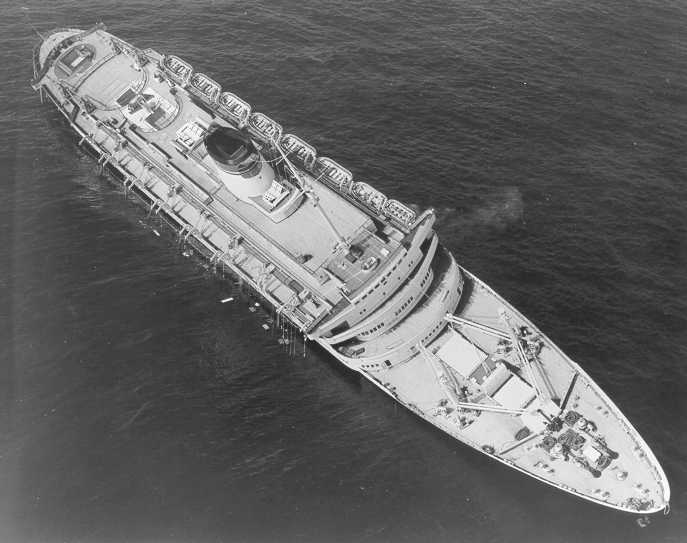
Two ocean liners approached each other in the darkness off Nantucket. Both had radar. Both believed they could pass safely. By morning, one would lie beneath the Atlantic—and fifty-one people would be dead.
Historical photograph: United States Coast Guard, 26 July 1956 / Wikimedia Commons. Public domain.
One Last Night at Sea
New York was only hours away.
On 25 July 1956, the Italian liner Andrea Doria was nearing the end of her Atlantic crossing. She carried 1,134 passengers and 572 crew members. Families were travelling towards new lives. Others were returning from holidays or business abroad.
The ship offered elegant lounges, works of art and three outdoor swimming pools. Beneath that beauty lay watertight compartments and modern navigation equipment. Her captain, Piero Calamai, had decades of experience at sea.
Some passengers had gone to bed. Others were enjoying their final evening aboard.
Outside, fog covered the water.
Two Screens, Two Different Seas
Coming the other way was the Swedish liner Stockholm, outbound from New York. On her bridge, third officer Johan-Ernst Carstens-Johannsen was keeping watch.
At about 10:45 p.m., an approaching vessel appeared on Andrea Doria‘s radar, around seventeen nautical miles away. The Swedish ship also detected the Italian liner.
They were no longer invisible to each other. Yet their bridge teams formed conflicting pictures of the encounter. The Italians expected a starboard-to-starboard passing. The Swedish officer expected a port-to-port passing.
Radar in the 1950s did not provide the automatic movement information familiar on modern displays. Bearings had to be interpreted and a target’s movement established through careful observations and plotting.
The ships continued closing. Andrea Doria was still travelling at more than twenty knots in fog. Course alterations that appeared sensible on one bridge were dangerous when combined with decisions on the other.
By the time the lights of the approaching ship became visible, there was almost no room left to correct the mistake.
The Bow Through the Cabins
At approximately 11:10 p.m., Stockholm‘s reinforced bow struck Andrea Doria‘s starboard side.
It tore into passenger accommodation. For a brief moment, the ships were locked together. When they separated, seawater poured into the Italian liner.
On the damaged side, cabins had become wreckage. Elsewhere aboard, people who had survived the impact faced a ship that was rapidly leaning beneath their feet.
One of the most extraordinary survivors was fourteen-year-old Linda Morgan. Asleep aboard Andrea Doria, she was somehow carried onto Stockholm‘s crushed bow during the collision. A crewman found her alive.
The press called her the “miracle girl.” But her survival belonged to a family tragedy: her stepfather and younger half-sister died, and her mother was badly injured.
Enough Boats—Until the Ship Tilted
Andrea Doria had lifeboat capacity for everyone aboard. Now, with the liner listing severely to starboard, the port-side boats could not be launched.
The remaining boats were difficult to use. Passengers had to negotiate sloping decks and reach boats waiting below. The emergency was no longer simply a damaged hull. It was a race to move hundreds of people off a ship whose ordinary escape arrangements had stopped working.
The distress calls asked nearby vessels for help—and for more lifeboats.
Stockholm, although badly damaged forward, remained afloat and joined the rescue. Other ships answered. The French liner Île de France, commanded by Raoul de Beaudéan, turned back towards the emergency.
A Ship of Lights in the Darkness
When Île de France arrived, her illuminated decks offered something the survivors desperately needed: a visible place of safety.
She launched thirteen lifeboats. Crews ferried people from the stricken liner, making repeated journeys through the night. The French ship ultimately took aboard 753 survivors. Stockholm, the freighter Cape Ann and other responding vessels also carried people away.
Every crossing mattered. Nobody could promise how long Andrea Doria would remain upright enough for the evacuation to continue.
Captain Calamai was reluctant to leave. His remaining officers refused to abandon him. Eventually, he entered a rescue boat.
At 10:09 a.m. on 26 July, the liner disappeared beneath the Atlantic, nearly eleven hours after the collision.
The Disaster Was Known. Responsibility Was Contested.
The commonly cited death toll is fifty-one: forty-six from Andrea Doria and five crew members from Stockholm. Many more lives had been saved through the combined rescue.
The shipowners blamed each other. Legal proceedings ended in an out-of-court settlement, without a final court determination of responsibility. Later analyses have examined radar interpretation, speed, course changes and navigation practices.
This was no unexplained disappearance. The collision and sinking were witnessed. The lasting argument concerns how two equipped, professionally operated ships reached the same patch of water with incompatible expectations.
That makes the story disturbing in a different way. Technology had shown each ship that another was approaching. It could not ensure that the people watching understood what would happen next.
In our account of Wilhelm Gustloff, evacuation unfolded amid war and bitter cold. Here, nearby ships and hours of remaining buoyancy gave rescuers a chance. And unlike Marine Sulphur Queen, which vanished without a distress signal, Andrea Doria could call for help.
The difference was measured in lives.
If this story moved you, please share it. Which maritime tragedy should we explore next?


Leave a Reply