They boarded to escape a war. Ahead lay the Baltic Sea, darkness and the promise of safety. On 30 January 1945, three torpedoes turned that promise into one of history’s deadliest disasters at sea.
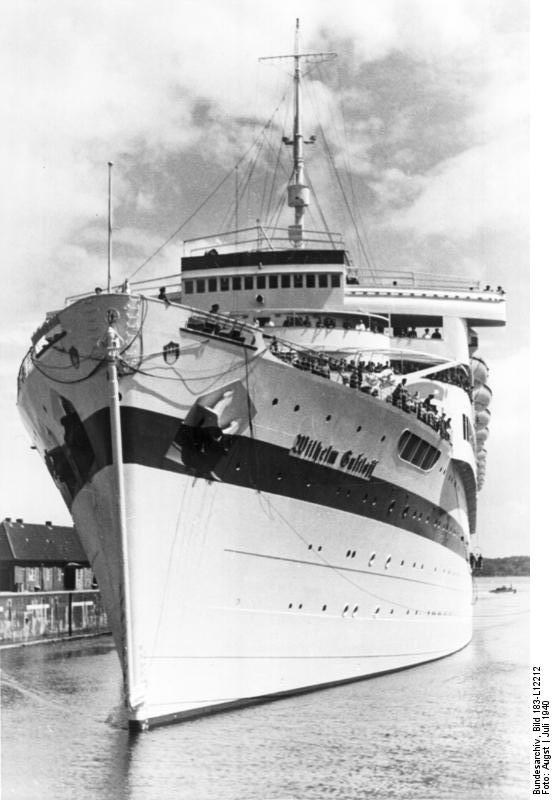
Wilhelm Gustloff as a hospital ship, July 1940 — not the 1945 sinking. Photo: Bundesarchiv, Bild 183-L12212 / Augst, CC BY-SA 3.0 DE, via Wikimedia Commons. Original photograph, unaltered.
A place on the ship
By January 1945, the Red Army was advancing and Germany’s defeat was approaching. Civilians fled towards the Baltic ports. In Gotenhafen, occupied Gdynia in present-day Poland, the Wilhelm Gustloff offered a way west.
The evacuation was part of Operation Hannibal. A former cruise liner was being asked to carry a desperate crowd: families, wounded soldiers and naval personnel. The distinction mattered to military planners. To those seeking passage, the immediate question was simpler: could they get aboard?
More than 10,000 people are believed to have crowded onto a vessel built for far fewer. In the confusion, the passenger records could not account for everyone. That missing count would haunt the story long after the ship disappeared.
The lights in the darkness
The Gustloff had begun life as a cruise ship for the Nazi regime’s Kraft durch Freude programme. During the war she served as a hospital ship, then as floating accommodation for naval trainees. By her final voyage she was carrying military personnel and had anti-aircraft weapons; her earlier hospital role no longer described her service.
Once at sea, the officers faced an ugly choice between shallower waters threatened by mines and deeper waters where submarines might be waiting. Captain Friedrich Petersen chose the deeper route. After receiving a report of an approaching minesweeper convoy, he ordered the navigation lights switched on to reduce the risk of collision.
In the darkness, visibility could protect a ship from one danger while exposing it to another.
The Soviet submarine S-13, commanded by Alexander Marinesko, found the Gustloff.
Three impacts
Shortly after nine that evening, three torpedoes struck. The blows hit forward, around the swimming-pool area used to accommodate female naval auxiliaries, and at the engine room.
The ship that had seemed an escape route became a trap. People tried to reach the decks and the lifeboats as the vessel listed. Cold and overcrowding made every movement harder. There were nowhere near enough places in the boats for everyone aboard.
For those who reached the water, survival still depended on rescue arriving before the freezing Baltic took their strength.
Other vessels came to help. Roughly 1,200 people survived, depending on how the totals are counted. Thousands did not. The liner sank in less than an hour.
The number that cannot be made exact
More than 9,000 deaths are commonly estimated. Some accounts give a figure close to 9,400. These are reconstructions, not a complete roll of names checked against a reliable passenger list.
The sinking is widely regarded as the deadliest loss of life from a single ship in modern history. Yet the figure itself cannot convey what was lost: entire families, children and people whose last hope had been a gangway leading away from the war.
The torpedoes are no mystery. The enduring darkness lies in how many lives vanished with them, and how easily a catastrophe of this scale can recede from public memory.
A ticket could get someone onto the Gustloff. It could not get them safely off.
For another disaster beneath cold northern waters, read Kursk: The Note from the Bottom of the Sea.
Sources
- Anne Frank House — The sinking of the Wilhelm Gustloff.
- Smithsonian Magazine — The Deadliest Disaster at Sea Killed Thousands, Yet Its Story Is Little-Known. Why? (29 January 2020).
- CTIF — Historical account of the Gustloff disaster (31 January 2025).
- MV Wilhelm Gustloff — historical overview and bibliography.
- Wikimedia Commons / Bundesarchiv — original photograph, date and licence.
If this story stayed with you, please share it. Help keep the memory of those lost aboard the Wilhelm Gustloff alive.


Leave a comment