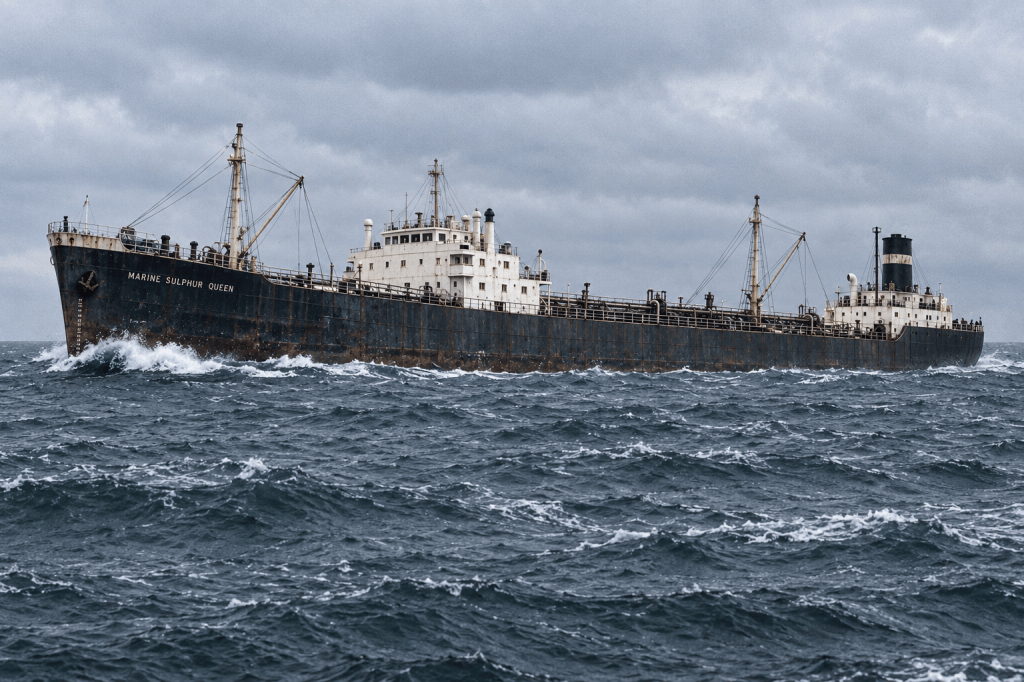
Cover: AI-generated historical illustration representing Marine Sulphur Queen. Not an archival photograph or a depiction of her unknown final moments.
At 1:25 in the morning, a message left a ship in the Gulf of Mexico. It was a personal radiogram from a crewman. No warning. No plea for help.
It was the last word anyone would hear from the Marine Sulphur Queen.
Thirty-nine men were aboard. Somewhere beyond the coast of Florida, all of them disappeared. The sea eventually returned a handful of objects. It kept the ship, and the moment that mattered most.
A Ship with Heat Inside Her
On 2 February 1963, Captain James V. Fanning took the Marine Sulphur Queen out of Beaumont, Texas, bound for Norfolk, Virginia. She was more than 500 feet long. To someone watching from shore, she must have seemed too substantial to simply vanish.
She had begun life in 1944 as the Esso New Haven, a T2 oil tanker. Nearly two decades later, she carried something very different: more than 15,000 tons of molten sulphur.
A huge heated tank ran through much of her cargo space, divided internally into four compartments. The conversion had changed the structure around it. Below the working decks was an immense weight of hot cargo, contained inside an ageing steel hull.
The voyage was supposed to end on 7 February. For the men aboard, it was a journey with an arrival date. For their families, it would become a journey without an ending.
The Radio Falls Silent
The final message was received at 1:25 a.m. Eastern time on 4 February. The ship’s position at that moment was later estimated from her route and speed; it was not a confirmed final position sent with a distress call.
Later that morning, RCA Radio tried to contact her. There was no reply.
Silence at sea can mean many things. A faulty radio. A missed call. A ship moving beyond easy contact. But the expected arrival notices never came either, and Norfolk waited for a vessel that did not appear.
No distress signal was received. Whatever happened left the shore without a final explanation.
We do not know what the men saw, heard or understood. No account of their last minutes survived. Any scene of a captain shouting orders or a crew racing for boats would be an invention. The frightening part is that the record stops while ordinary life is still going on.
Searching an Empty Horizon
After the ship was reported overdue on 7 February, aircraft and vessels searched her expected route. The search widened across the Gulf and the approaches to Florida. Other ships were asked whether they had seen her.
There was no answer that brought her home.
Then, on 20 February, a Navy vessel southwest of Key West recovered a foghorn and a life jacket bearing the ship’s name. More objects followed.
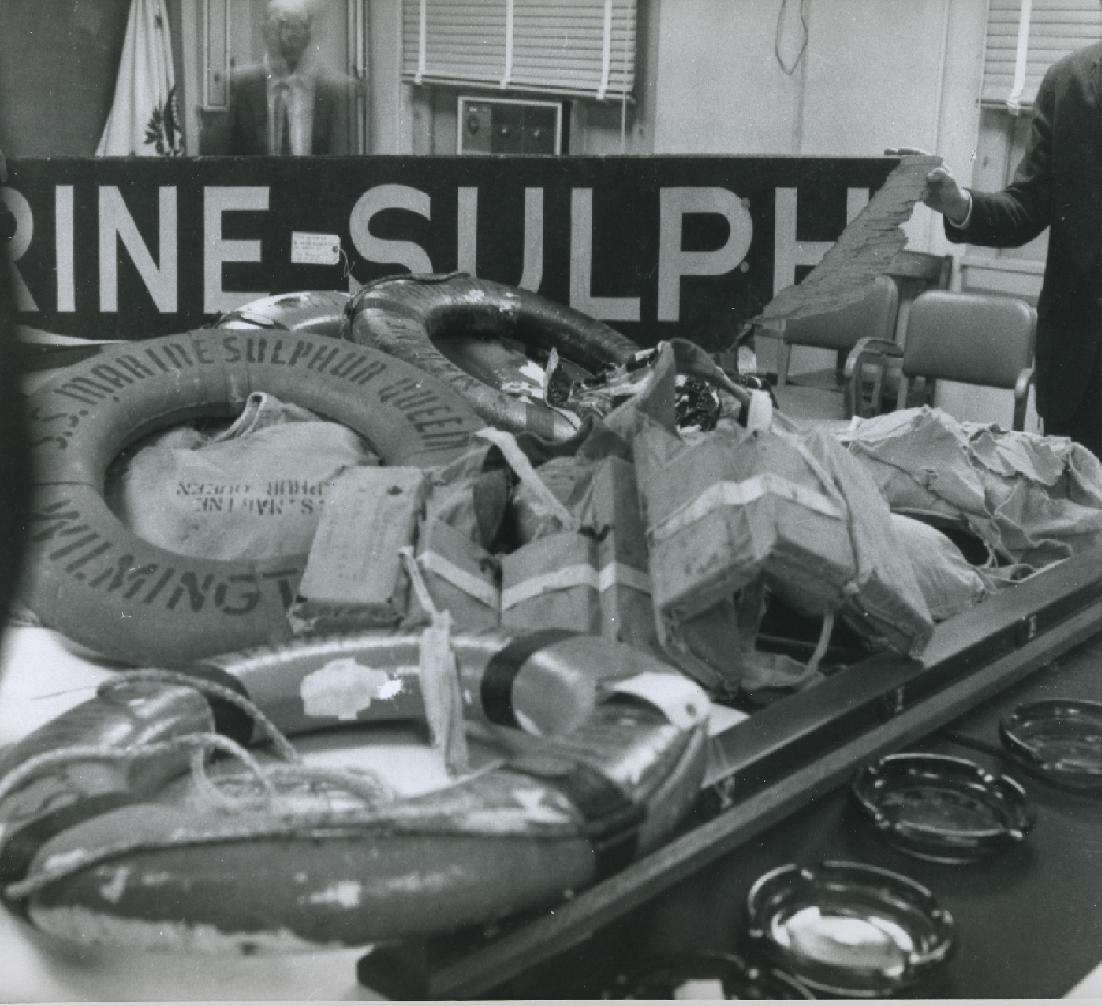
The investigators eventually had eight life jackets, five life rings, two name boards, a shirt, part of an oar and several other small items. The name that had belonged to a ship now belonged to things laid out for examination.
These were real traces of a loss. They were also terribly incomplete. They could establish where the objects came from, but they could not explain how the vessel had gone down. A Navy underwater search failed to locate her hull.
The Danger Already Aboard
As investigators looked backward through the ship’s short career as a sulphur carrier, a disturbing history emerged.
There had been repeated fires around the cargo tank and its insulation. Molten sulphur had leaked into the ship’s bilge. The conversion had removed and altered important internal structures, and experts argued over what that had done to the hull’s strength.
There were concerns about potentially dangerous gases and how effectively they could be vented. This was no spotless vessel struck by an inexplicable force. There were physical hazards to investigate.
The weather mattered too. Reconstructed conditions along her probable track included rough seas and strong northerly winds. But the courts did not regard this as weather beyond what a seaworthy ship should have been able to survive.
That makes the mystery more unsettling. The danger may have travelled with the men from the moment they left the pier.
Four Ways to Lose a Ship
The Coast Guard considered several possibilities: an explosion in the cargo tanks; a failure of the hull that broke the vessel in two; capsizing as the ship’s rolling matched the waves; or a steam explosion after water entered the space around the heated tank.
The Board did not rank these possibilities. Without survivors or the ship’s physical remains, it could not determine the exact cause.
The recovered objects showed no clear evidence of fire or explosion. That limited what could be proved; it did not reveal everything that might have happened deep inside a sinking ship.
In 1972, the appeals court upheld liability against the owner and operating charterer over the vessel’s unseaworthiness. Yet legal responsibility did not produce a reconstruction of her final moments. The men’s families could win a case while still being left with the same unanswered question.
What the Sea Returned
The Marine Sulphur Queen became part of Bermuda Triangle folklore. But her disappearance was investigated as a maritime disaster, with evidence of ordinary, dangerous failures. No supernatural explanation is needed.
The exact sequence remains unresolved. That is different from having no clues. We have the voyage, the last radio message, the ship’s troubled history and the objects recovered from the water.
We do not have the voices that could connect them.
Look at the archive photograph of the recovered equipment. A life ring still carries the ship’s name. It was made to keep someone alive. Now it is evidence.
Thirty-nine men sailed from Texas. One of them sent a message in the small hours of the morning. After that, the sea did all the talking.
Sources and Image Notes
Based on the U.S. Coast Guard inquiry, reproduced in the 1970 district court opinion, and the 1972 appeals court decision. The four possibilities are recorded in the Coast Guard report. This narrative does not invent dialogue or eyewitness accounts.


Leave a comment