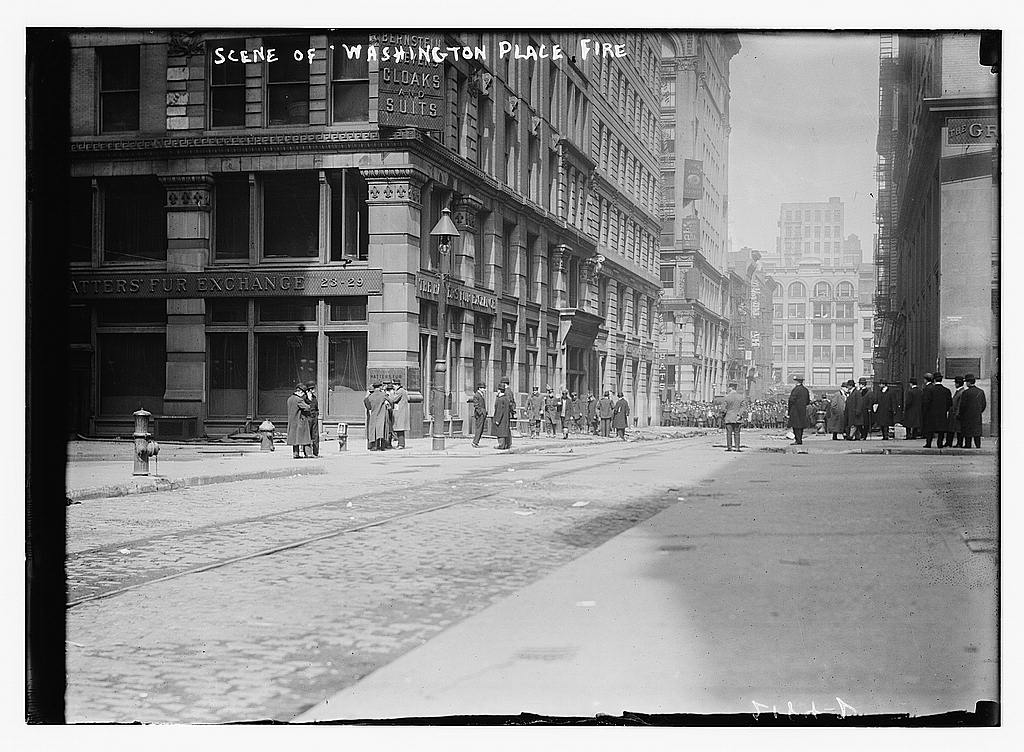
Rosaria was fourteen. Lucia was twenty. Their mother, Catherine, worked in the same New York garment factory. On 25 March 1911, all three died there. One family lost a mother and two daughters in a single afternoon.
They had arrived from Italy four years earlier. Catherine’s husband, Serafino, had gone ahead in 1905; she followed with the children in 1907. By 1911, mother and daughters were among the immigrant workers making blouses at the Triangle Waist Company.
Their ages and their shared address survive in records. So do their death certificates. Those documents establish who they were. They do not tell us their last words, or whether they found one another when the fire began.
The end of the working day
It was Saturday, close to finishing time. The factory occupied the eighth, ninth and tenth floors of the Asch Building, near Washington Square. Then fire broke out.
Cloth scraps, lightweight cotton and dust helped the flames spread. The Smithsonian’s account identifies a scrap bin as the reported starting point and a discarded cigarette or cigar as the probable ignition source. That is a historical assessment, not proof of who started it.
There were no sprinklers. Buckets of water could not stop what followed. The building itself could withstand fire far better than the people working inside it.
A way out that would not open
Survivors described trying to open the ninth-floor door to the Washington Place stairs and finding it locked. The other stairway was engulfed by fire. Workers crowded towards alternatives that were disappearing.
The outside fire escape collapsed. On the street, firefighters arrived with ladders that could not reach the trapped workers. People at the windows could see rescuers below, but there was no safe connection between them.
Some jumped. Others died inside. The toll reached 146.
The records do not justify placing Catherine, Lucia or Rosaria in a particular final scene. Their deaths are certain; the exact sequence of their last moments is not. Serafino survived to face the loss of his wife and both daughters.
What the court could prove
The factory owners faced manslaughter charges. In December 1911, a jury acquitted them. A central issue was whether the prosecution had proved that they knew the door was locked at the time of the fire.
That verdict did not erase the survivors’ testimony about the door. It was a criminal verdict under the standard of proof required for that charge. For the families, an acquittal and an explanation were very different things.
The fire helped drive factory investigations and stronger fire-prevention laws. The lessons concerned ordinary physical things: an exit, a stairway, a route that remained usable when everything else failed.
For Catherine’s household, those protections arrived too late. Rosaria had been fourteen, Lucia twenty, Catherine thirty-nine. Remembering those ages restores something that the number 146 cannot convey: three lives within one family, each with years that never happened.
For other families changed by preventable catastrophe, read Aberfan: The Last Day Before the Holidays and Valencia: The Family the Lifeboat Could Not Save.
Photograph and sources
Cover: the Asch Building, scene of the fire, 1911. Bain News Service / Library of Congress, George Grantham Bain Collection, ggbain.09113. Authentic archival photograph; public domain, with no known restrictions on publication. Archive record · Image and rights record.
Family records: Cornell University, Catherine Maltese, Lucia Maltese and Rosaria Maltese; U.S. Census Bureau, March 2016: The Triangle Shirtwaist Fire.
Events and findings: Cornell University’s Kheel Center, Fire! and Investigation & Trial; Smithsonian National Museum of American History, What you may not know about the Triangle shirtwaist factory fire; OSHA’s historical account.


Leave a Reply