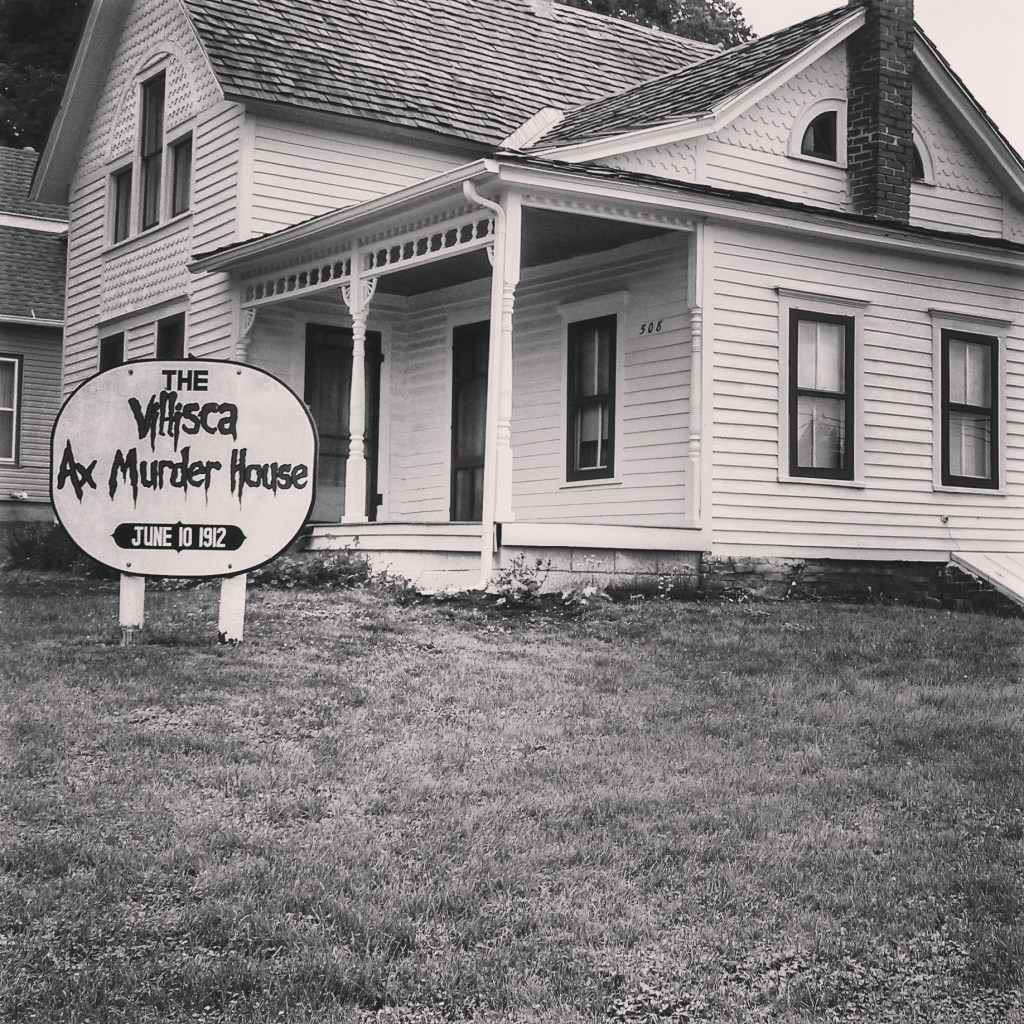
Eight-year-old Ina was staying with friends for the night. Her sister Lena was there too. By morning, the house was locked, nobody answered, and the two girls’ family would never see them come home.
Villisca, Iowa. Sunday, 9 June 1912. Sarah had helped organise a Children’s Day programme at the Presbyterian church. Afterwards, she and Josiah walked home with their four children and the two visiting sisters. They reached the house at around ten.
Herman was eleven; Katherine, ten; Arthur, seven; Paul, only five. The sisters slept downstairs. The other children went upstairs, near their parents’ room. For the girls’ family, the overnight visit would become the detail that separated them from the children they lost.
The neighbour who knocked
Next morning, a neighbour, Mary, noticed that the family had not appeared for their usual chores. She knocked. No answer. The door was locked.
Josiah’s brother, Ross, arrived with a key. Inside the downstairs bedroom, he found Ina and Lena dead. The search through the house revealed six more victims. An axe belonging to Josiah had been left behind.
Investigators believed most of the victims had been asleep. They thought Lena might have woken and tried to defend herself, based on her position and an injury to her arm. That remains an interpretation of the scene. Nobody survived to describe what she saw or how long she understood the danger.
The discovery drew crowds. The historical review in The Annals of Iowa describes spectators entering the house and even handling the axe. Before investigators could properly preserve the scene, strangers had walked through it. We cannot know which useful traces were lost.
A confession that did not solve it
Years of suspicion produced one defendant: a visiting minister, George, who had been in Villisca that weekend. In 1917, after prolonged questioning, he signed a confession. He later withdrew it.
His first trial ended with a jury unable to agree. At the second, he was acquitted. No one has been convicted of the murders. A signed statement had seemed to promise an ending; the trials left the central question open.
Someone local—or someone passing through?
One theory grew from local business rivalries: perhaps Josiah had been deliberately targeted. It offered a motive, but the accusations did not establish who entered the house. One alleged hired killer was released after employment records supplied an alibi. Rumour damaged lives without resolving the crime.
Another theory places Villisca within a series of similar killings across the Midwest. Researchers have considered whether a travelling murderer used the railway network to move between towns. The comparison is disturbing: sleeping households, an axe, and an attacker gone before morning.
But resemblance alone cannot prove that the same person committed different crimes. Nor does a railway connection identify a passenger as a murderer. Both the local-revenge theory and the travelling-killer theory remain unproved.
The questions are still brutally simple. Why this house? Were all eight people intended victims? Did the visitor know the family, or merely find a sleeping household? The surviving record gives us no dependable account of the killer’s thoughts.
On 12 June, the town gathered for the funeral. Eight coffins were taken to the cemetery. For the sisters’ parents, two children had gone to a church programme and a sleepover. For Josiah and Sarah’s relatives, an entire household was gone.
More than a century later, the house still stands. It has an address, a history and visitors. What it does not have is a proven name for the person who killed eight people inside.
Another household, another unresolved crime: read The Shadow of Setagaya and Hinterkaifeck: The Farm That Fell Silent.
If this story stayed with you, share it—and keep the people behind the mystery in view.
Photograph and sources
Cover: the restored Moore family house, photographed on 8 April 2014 by Ryan Moomey, via Wikimedia Commons. CC BY 2.0. This is a real photograph, not an AI image or a photograph from 1912. Display crops may apply.
Sources: Iowa State Capitol Tour Guides, Pieces of Iowa’s Past (13 May 2015); Lawrence H. Larsen and David N. Atkinson, The Villisca Axe Murders: A Review Essay, The Annals of Iowa (2003); Iowa Cold Cases; Villisca Axe Murder House, historical suspects and theories; Villisca Historical Society. Historical accounts differ on some details; theories and interpretations are identified as such.


Leave a Reply