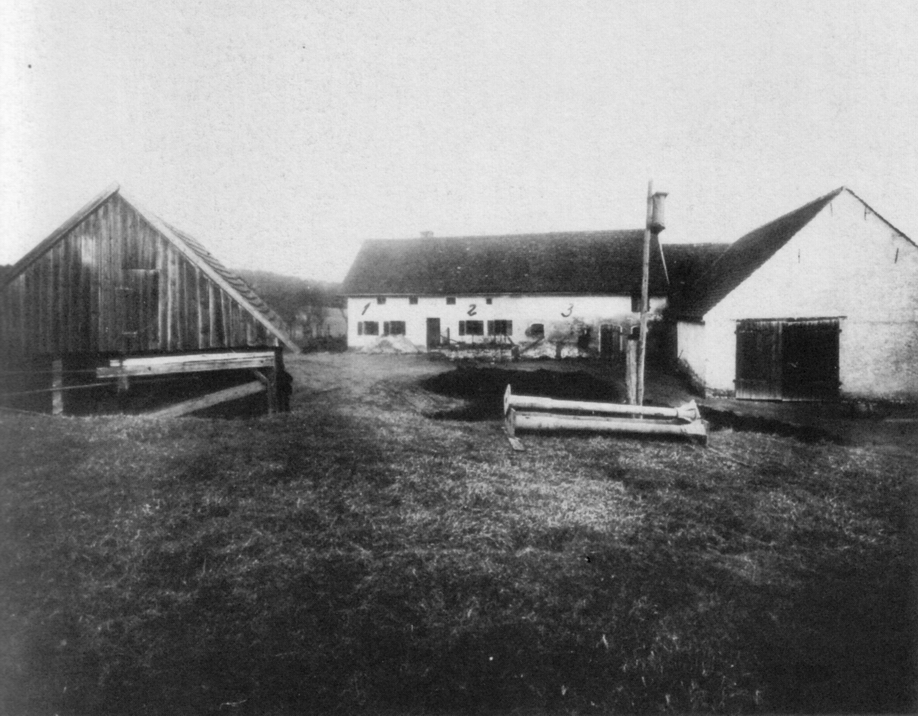
Historical photograph: Andreas Biegleder, 1922 or earlier / Wikimedia Commons. Public domain.
Six people were killed on a Bavarian farm in 1922. Four days passed before anyone found them. More than a century later, the silence still has no explanation.
Reading time: approximately 6 minutes.
At first, the absence could be mistaken for ordinary life. A family busy elsewhere. A child kept home from school. A door that remained closed when somebody called.
Then the absences began to gather.
On 4 April 1922, neighbours entered Hinterkaifeck, a farm outside Gröbern in Bavaria. Inside, they found six people dead. What had happened there was terrible enough. What might have happened in the days before the discovery would give the case its enduring, unsettling power.
Someone might have remained on the property after the murders.
The farm had become a crime scene. To people passing nearby, it had not immediately looked like one.
Six lives beneath one roof
Hinterkaifeck was a single farm, rather than a village. Its buildings joined living quarters to the places where animals were kept and work was done. The nearest neighbours were only about half a kilometre away. The family was apart from the settlement, but it had not vanished beyond the reach of other people.
Andreas Gruber lived there with his wife, Cäzilia. Their widowed daughter, Viktoria Gabriel, was 35. Her children were seven-year-old Cäzilia, often called Cilli, and two-year-old Josef.
The sixth victim was Maria Baumgartner, a new maid. She had arrived on 31 March, accompanied by her sister. Her sister left that afternoon. Maria stayed.
It is a detail that needs no embellishment. A woman reached a new place of employment. Within hours, her life was over.
All six victims are generally believed to have been killed that evening. Nobody survived to give an account of the attack.
The warnings in the story
The most famous detail concerns footprints. According to witness accounts, Andreas had spoken of tracks in the snow leading towards the farm, without corresponding tracks leading away. There were also reports of attempted entry.
Other retellings describe unexplained noises above the family’s rooms. These claims require care: some were recorded years afterwards or came through hearsay. They do not establish that a murderer was secretly living in the attic.
That distinction matters. A footprint is a clue only if we know when it was made, who saw it and what the conditions were. A remembered sound cannot tell us who caused it.
Still, the possibility is difficult to dismiss from the imagination. Had an intruder approached the farm before the attack? Had somebody watched the family? Had the warning already been there, waiting to be understood?
The surviving accounts cannot answer those questions with certainty.
Four days without an answer
Over the following days, the family failed to appear in familiar places. Cilli was absent from school. The household was missed at church. Visitors found nobody to speak to.
On 4 April, mechanic Albert Hofner came to repair an engine. He reported hearing the animals, but saw no member of the household. He waited, then carried out the repair. For hours, an ordinary job continued beside a catastrophe that had not yet been discovered.
Later that day, the neighbours went to investigate.
Four victims lay in the barn: Andreas, his wife, Viktoria and Cilli. Maria and Josef were found in separate rooms in the living quarters. Bodies had been covered.
Investigators would attempt to reconstruct the sequence. A common theory was that the four victims in the barn had been drawn there separately. But a reconstruction is not an eyewitness account. The precise order, the reason each person entered the barn and the words spoken that night remain unknown.
We cannot put dialogue into their mouths. We cannot tell ourselves that we know what a child heard, or what a mother understood, in the final moments.
There is enough horror in what is known.
Did the killer stay?
Reports of activity at the farm, including a fire and signs interpreted as care of the livestock, helped create the theory that the killer remained after the murders. Whether the animals were fed or milked, and for how long, is less secure than many popular versions suggest.
It is a possibility, not a proven three-day timetable.
Yet it changes the shape of the mystery. A person who flees immediately leaves one kind of question behind. A person who stays leaves another. What could make somebody feel safe inside a house where six people had just been killed?
Knowledge of the place? Confidence that nobody would come? A wish to hide? Those are questions, not findings.
Over time, Hinterkaifeck attracted many suspects and explanations. None produced a conviction. Suspicion attached to a name is not proof, and repeating an accusation a hundred years later does not make it stronger.
The weapon beneath the floor
By the time the police examined the farm, the scene had already been disturbed. Some bodies had been moved during the search for victims. Investigators had to work backwards from a place that no longer preserved every original detail.
In 1923, the farm buildings were demolished. During that work, a mattock—a heavy agricultural tool used to remove roots—was discovered concealed in the structure. It was identified as the murder weapon.
The object survived long enough to reveal something about the attack. It did not reveal the person who had wielded it.
The walls came down. The family did not return. A place that had once contained work, meals, childhood and ordinary days became a location people discussed because of its ending.
What the silence leaves behind
Hinterkaifeck remains unsolved. The passage of time has added distance, competing theories and dramatic retellings. It has not supplied a verified answer.
The questions endure because the intervals are so disturbing: between a possible warning and the attack; between the murders and their discovery; between a physical clue and an identifiable killer.
But behind those questions were six people. Andreas. Cäzilia. Viktoria. Cilli. Josef. Maria.
They were more than the inhabitants of a frightening story. Their deaths created the mystery, and the absence of justice keeps it open.
More than a century later, nobody has been convicted of killing them.
The farm is gone. The question remains.
Get the next Dark Story
Subscribe for free to receive new stories by email. You can unsubscribe at any time.
If this story stayed with you, share it with someone who follows unsolved mysteries.
More unsolved mysteries
Two Shots in Stockholm · The Dyatlov Pass Mystery
Sources and editorial note
This narrative uses documented events without invented dialogue. Uncertain witness recollections and investigative theories are identified as such. Sources: Hinterkaifeck research archive, chronology, victims and crime scene; historical overview and references.


Leave a comment