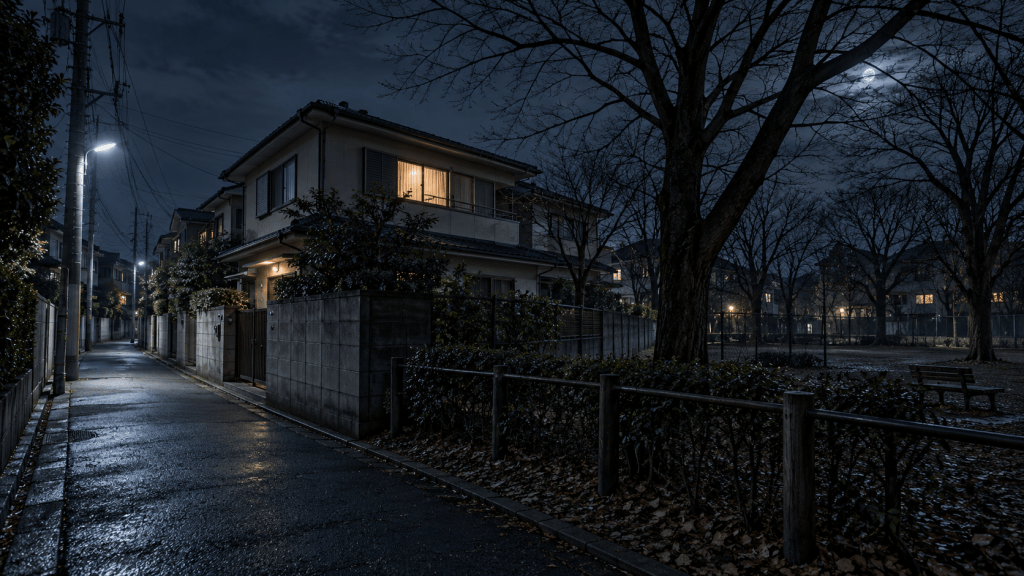
Tokyo, December 2000. A villa in Setagaya, right next to Soshigaya Park, became the scene of a crime that defies all logic. It is a case where the killer didn’t just leave clues behind—he left himself behind.
Despite DNA, fingerprints, and items of clothing, the case has remained an open wound for more than twenty-five years. The Miyazawa family never received justice, and the answers they deserve remain elusive.
Title image: AI-generated editorial illustration. An imagined setting, not a photograph or a reconstruction of the crime scene.
The Last Ordinary Evening
December 30, 2000, was a day like any other. The Miyazawa family—Mikio (44), Yasuko (41), their daughter Niina (8), and son Rei (6)—spent the day shopping and dining. It is a painfully mundane description, drawn from the police’s own archives. A father who loved animation, a mother who taught, children who took piano lessons. Nothing in their lives pointed toward the abyss that awaited them.
They lived on the edge of an area that was being cleared of residents due to a planned park expansion. They were almost entirely alone. That is where the killer went during the night.
The Discovery
When Yasuko did not answer the phone the next morning, her mother, who lived next door, became worried. When she went over to check, she was met with a sight that no human should ever have to experience. The family was dead. Rei had been strangled; Mikio, Yasuko, and Niina had been stabbed.
This marked the start of a criminal investigation that, as time went on, became increasingly frustrating. For the killer had not been careful. He had been everywhere.
A Home, a Crime Scene, a Mystery
This was not a crime committed by a ghost. The killer left behind an almost absurd amount of evidence. Fingerprints. Blood. DNA. He abandoned his personal belongings: a sweatshirt, a hat, a scarf, a hip bag.
It wasn’t just evidence that could be secured; it was evidence that could be traced. Yet, the killer seemed to have made himself at home. According to reports, he stayed in the house for hours after the murders, eating the family’s ice cream and using their computer. It is a detail that is hard to process: the everyday movements in a home where those who should have performed them would never breathe again.
Hunting a Shadow
The police worked methodically. They traced the origin of the sweatshirt—a model that had only 130 units sold in all of Japan, and only ten in Tokyo. That should have been enough to narrow down the killer. But a production total is not a list of names. A garment can change owners, be sold for cash, or be thrown away. The distance between tracking an object and convicting a person proved to be a chasm.
Criticism of the investigation has been harsh over the years. Some argue that an excessive focus on fingerprints led to other, more promising leads being ignored. The DNA profile was a powerful key, but without a match in the system, it remained a door without a lock. Theories of robbery or personal vendettas have been aired, but none have led to a breakthrough. The portrait of the killer still lacks a face.
The Legacy of the Case
For the relatives, time has stood still. In a 2019 interview, Mikio’s mother, Setsuko, spoke of the grandchildren she never got to see grow up. She preserves their toys, a memorial altar in the home for a future that never had a chance.
While investigators count leads, the grandmother counts years of silence.
The Tokyo police updated their official wanted poster as recently as January 2026. The case is not forgotten, but it remains unsolved. The killer left behind evidence of his body, his clothes, and his actions. The only thing he did not leave behind was the reason, the motive, or the name that could give the Miyazawa family final closure.
Sources and factual note
This account uses documented events and attributed reporting. Interpretations and possible explanations are identified as such. No dialogue, private thoughts or unrecorded final moments have been invented.
- Tokyo Metropolitan Police: English case leaflet — family details, last day and evidence.
- Tokyo Metropolitan Police: official English appeal — updated January 30, 2026; location and sweatshirt distribution.
- ABC News: The killer without a face — December 29, 2019; discovery, reported activity in the home and family interviews.
- Jiji Press: Setagaya Family Killer on Run after 20 Years despite Many Clues — December 30, 2020; fingerprints, DNA and investigative criticism.


Leave a Reply