The ferry leaned, and did not come back. A passageway became a steep slope. People who had been walking towards the stairs now had to pull themselves upwards. Below them, others were losing their grip.
Estonia had left Tallinn for Stockholm on the evening of 27 September 1994 with 989 people aboard. There were cabins, restaurants and bars, shops and entertainment. Passengers were returning from holidays, travelling for work or making an ordinary overnight crossing.
Outside, the wind strengthened. By the early hours, waves were around four metres high. They struck the ferry’s bow as she pushed across the northern Baltic.
Inside, some passengers were asleep. Some entertainment areas were still open. Within an hour, the ferry would be gone.
The sea came through the bow
At the front of the ship was the bow visor: a huge steel cover that could be raised in port. Behind it stood the loading ramp through which vehicles entered.
In the heavy seas, the visor’s attachments failed. As it broke away, it pulled the ramp open. Waves could now drive directly onto the vehicle deck.
This was a broad space inside the hull. Water spreading across it took away the stability the ferry needed to remain upright. Estonia began to heel sharply to starboard.
A ship can look enormous from the quayside. Inside that ship, a passenger’s chances could now depend on crossing a few metres of floor before the angle became too steep.
The stairs were becoming a wall
Survivors described furniture and loose objects sliding across rooms. The way to an exit might lead uphill across an open space with nothing secure to hold. A fall could carry someone away from the door they were trying to reach.
Sara had been sleeping on a sofa. As the list increased, she moved towards an outside deck, gripping whatever she could. The ship kept changing position beneath her. Reaching the next level meant more than finding the correct staircase; she had to remain on her feet long enough to climb it.
Elsewhere, Magnus woke Katarina and knocked on his parents’ cabin door. He started upstairs, believing they were following. Then he realised they were not behind him.
He went back.
Across the entrance hall, his parents and Katarina were holding a railing. He called to them to come to the stairs. His mother answered, in English translation: “We can’t. Run. Save yourself!”
Magnus turned towards the way out again.
The original investigation estimated that escape to the open decks became practically impossible around a list of forty-five to fifty degrees. For many passengers, the useful escape window after the first severe heel was only about ten minutes.
1:22 a.m. — Mayday
Times follow the original investigation’s chronology, UTC+2.
The first known distress call went out at 1:22 a.m. Nearby ferries heard Estonia asking for help.
Her crew could not immediately give a position. The list and loss of electrical power made that difficult. About seven minutes passed before the position was transmitted. After that, no further distress traffic was received from Estonia.
The rescuers now knew where to go. The people inside the ferry still had to get out.
As water entered and the ship rolled further, places designed for ordinary movement became obstacles. People who had reached an outside doorway could help someone climbing towards it. Those still deeper inside had ever fewer routes left.
The hull became the last deck
None of Estonia’s ten lifeboats was successfully launched before the sinking. The severe angle and the conditions defeated an orderly evacuation.
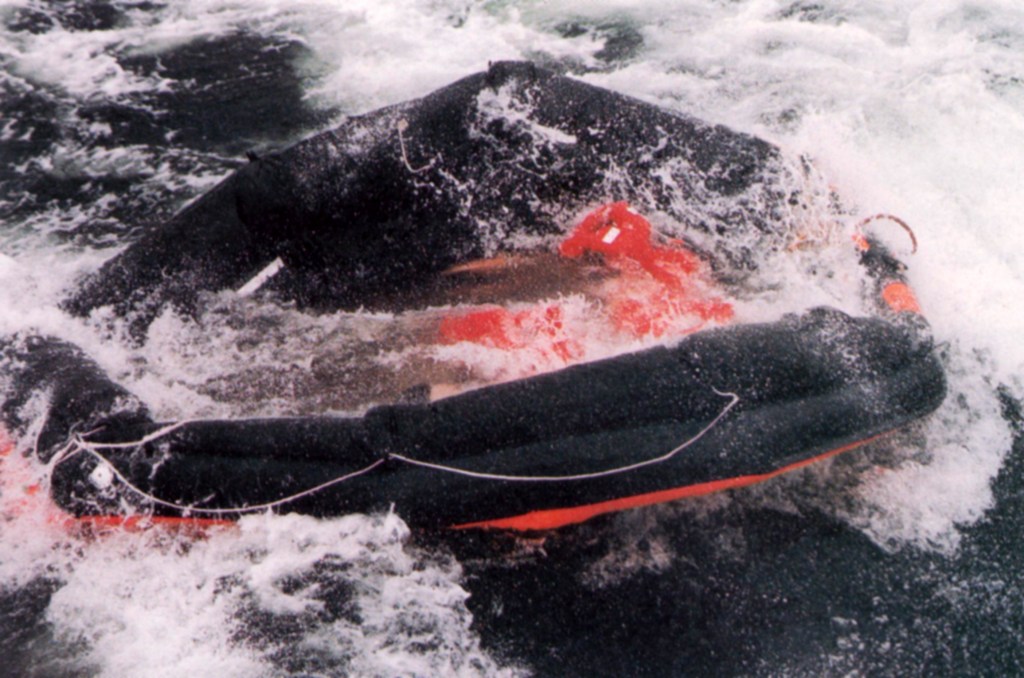
Passengers and crew released inflatable rafts. Some inflated the wrong way up. Lifejackets could be difficult to put on, and some were torn away when their wearers hit the water.
Magnus reached the outside of the ship. He later described standing on her side as she lay at almost ninety degrees. A wave swept him into the sea.
Sara had met Kent. They agreed to help each other and held hands before entering the water. Both eventually reached a raft.
Around 1:50 a.m., Estonia disappeared beneath the surface. Less than half an hour had passed since her first Mayday.
For the people still inside, there was no further escape. For those floating outside, the night continued.
Rescue ships were close. Safety was not.
Mariella reached the scene around 2:12 a.m. Other ferries followed. Their size and lights promised help, but the same heavy seas made launching small rescue boats dangerous.
People could be near a large ship and remain desperately difficult to recover. Rafts rose and dropped in the waves. Survivors were wet, injured or exhausted. Cold reduced the strength needed to climb and hold on.
The first rescue helicopter arrived shortly after three. Crews searched the darkness, locating rafts and lowering rescuers to lift people out. The operation continued through the morning.
Ships recovered 34 people alive; helicopters recovered 104. One of those rescued later died in hospital. The final number of survivors was 137.
There had been 989 people aboard. The disaster took 852 lives.
Magnus survived, but his parents and Katarina did not. Sara and Kent survived hours in a raft. Reaching open air, finding flotation and finally being lifted to safety were separate struggles. Many people escaped one danger only to meet the next.
What failed before that night
The joint reassessment published in December 2025 supported the bow-visor failure and rapid flooding sequence. Investigators attributed the later-examined starboard damage to contact with the seabed and found no evidence of an explosion or collision during the final voyage.
The Estonian and Swedish authorities also assessed the ferry as unseaworthy because of structural and certification deficiencies. The wider findings described failures involving design, regulation, inspections and the sharing of safety knowledge.
These were protections that passengers could not check for themselves when they boarded.
Related stories: Herald of Free Enterprise: The People Who Reached Back and Scandinavian Star: The Mother Who Woke Them.
What remained for Magnus was a life without the three people who had travelled with him, and his mother’s words across that tilted entrance hall. She had told him to save himself. He carried those words home.
Archive photograph: a liferaft from Estonia. Accident Investigation Board Finland, via Wikimedia Commons. Public domain.
Sources
- Joint Accident Investigation Commission, 1997: escape, distress traffic and rescue.
- Vrak Museum: the crossing, sinking chronology and rescue; official accident overview.
- Magnus’s accounts: Aftonbladet, 2004 and Sveriges Radio, 2014. Sara’s account, 2024.
- SHK: joint reassessment conclusions, December 2025.


Leave a Reply