Christine woke her husband. He carried their little boy out. She never came back.
Before Scandinavian Star became a case file, it was the beginning of an Easter holiday. Jan Harsem and his pregnant wife, Christine, had rented a house on Denmark’s west coast. Their son Halvor was eighteen months old. There would soon be another child.
On the night of 6–7 April 1990, their ferry was travelling from Oslo to Frederikshavn. A cabin was somewhere to sleep until morning. Then Christine shook Jan awake.
In his later account, he recalled struggling at first to understand what was happening. Christine left the cabin, heading towards the deck for fresh air. Jan picked up Halvor and followed.
He reached the aft deck with his son. He would never see Christine alive again.
The way out was disappearing
The chronology makes terrible reading. Between about 1:45 and 2:00 a.m., bedding burned outside a cabin on deck four. That fire was extinguished. Shortly after 2:00, another fire was discovered in a corridor on deck three.
This time, fire and poisonous smoke spread rapidly into cabin sections on decks four and five and upwards through the vessel. The Mayday went out at 2:24.
Those times are precise. The experience they describe was chaos: sleeping passengers, unfamiliar passageways and escape routes becoming dangerous before people could use them. Reaching an open deck meant surviving one part of the disaster. It did not mean knowing where the rest of your family had gone.
Years later, in a memorial speech, Jan described calling out on the aft deck and receiving no answer.
His son was with him. His wife was missing. The child she was carrying was missing with her.
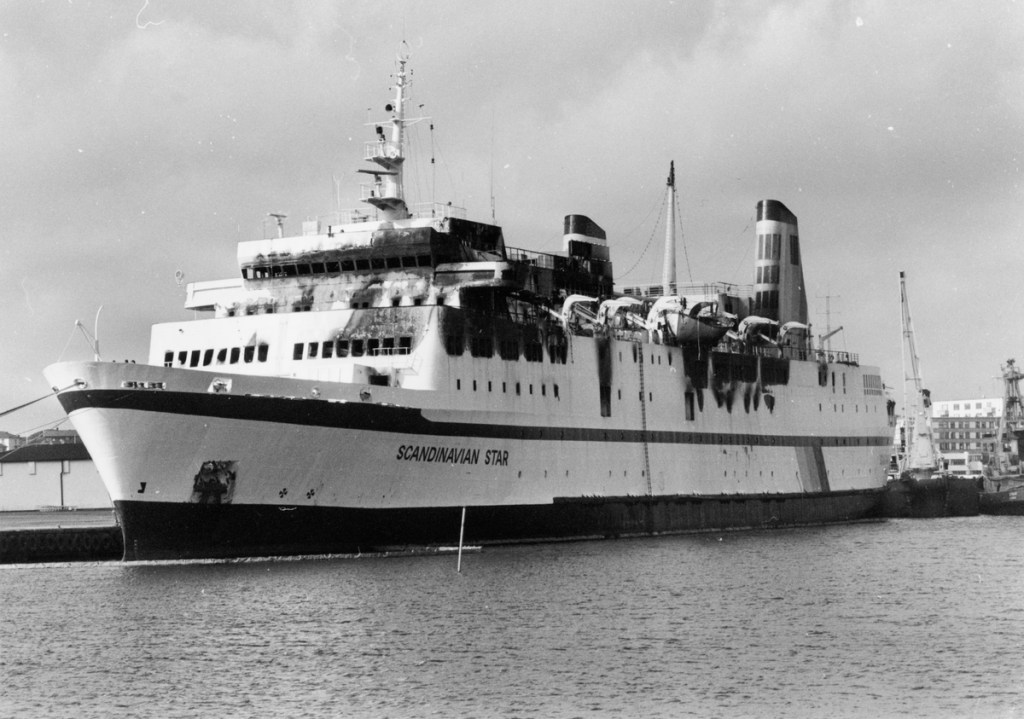
Scandinavian Star did not sink. The damaged ferry was eventually towed to Lysekil, Sweden, where the fire was finally extinguished on 8 April. A total of 159 people died as a result of the disaster.
A crime inside a safety disaster
The fire was deliberately started. But identifying arson does not answer the question that has haunted the case: who did it, and why?
Alongside that mystery were failures in the ship’s safety arrangements and the crew’s preparation. The Danish taskforce’s 2024 investigation concluded that a proper inspection would have exposed the need for drills. Better preparation could have improved passengers’ chances of survival.
That distinction matters. An inspection could not prevent someone striking a flame. It could help determine what happened to the people sleeping beyond it.
Readers of Herald of Free Enterprise: The People Who Reached Back will recognise the awful distance between a routine crossing and a disaster passengers had no reason to expect. On Scandinavian Star, that distance was measured in smoke.
Was it insurance fraud?
One persistent theory asks whether the ferry was burned for an insurance payout. A recent sale, complicated ownership arrangements and unfinished registration paperwork helped keep suspicion alive.
The theory is disturbing: a ship worth more as an insurance claim than as a working ferry, with passengers caught in somebody else’s calculation. That is a hypothesis, not an established account of what happened.
The Danish taskforce examined the ownership, sale and insurance arrangements. Its 2024 report found that the purchase price of US$21.7 million reflected the market. It also found that the vessel’s insured value had risen gradually, rather than being suddenly inflated for the transfer.
The taskforce judged an insurance-payout motive improbable, citing the contracts, settlement and interests in continued operation. It found no basis for further police investigation within its ownership-and-insurance remit.
Those findings deserve space beside the suspicions. They do not identify the arsonist. They do mean that insurance fraud cannot responsibly be presented as the solution to the case.
The birthday at the grave
Halvor was too young to retain a memory of the fire. He grew up with its consequences.
In his own account, written as a young adult, he described visiting the grave of his mother and unborn little brother. There were flowers, candles and flags. There could also be birthday cake and cocoa.
It is an image quieter than a burning ferry: a child’s birthday celebration beside a grave. Yet it tells us something the casualty figure cannot. The catastrophe continued to appear in ordinary family rituals, long after the television cameras had gone.
Halvor also wrote about the closeness between him and his father. Their lives contained more than the disaster. Jan later remarried, and the family grew. Rebuilding a life did not erase the people missing from it.
Another father and child appear in SS Arctic: The Boy in His Father’s Arms. The outcomes were different. Both stories leave us facing a human bond that the language of maritime statistics cannot contain.
A mother tracing a name
Jan’s memorial speech also remembered Winifred Rome, who travelled from Michigan after losing her only daughter, Ruth, a singer. At the Oslo memorial, the elderly mother passed her hands over her daughter’s engraved name.
There is no mystery about that gesture. A name in stone was what she could touch.
Research conducted twenty-six years after the disaster found lasting psychological burdens among survivors and bereaved relatives, alongside many accounts of good health and lives rebuilt. Both belong to the story. People can go on living while carrying something that never becomes ordinary.
The unanswered questions about Scandinavian Star remain compelling. Ownership documents, fire investigations and competing explanations all deserve scrutiny.
But before any of those came Christine’s hand waking her husband. After it came a father on an open deck, a little boy alive in his care, and a family waiting for someone who would never return.
Historical photograph: Scandinavian Star at Lysekil after the fire, April 1990. Photo: Terje Fredh / Sjöhistoriska museet, via Wikimedia Commons, CC BY-SA 4.0.


Leave a Reply