The boats were disappearing into the fog. On the dying liner, Captain James Luce still had his young son beside him. He could command a ship. He could no longer find a way to get his child off it.
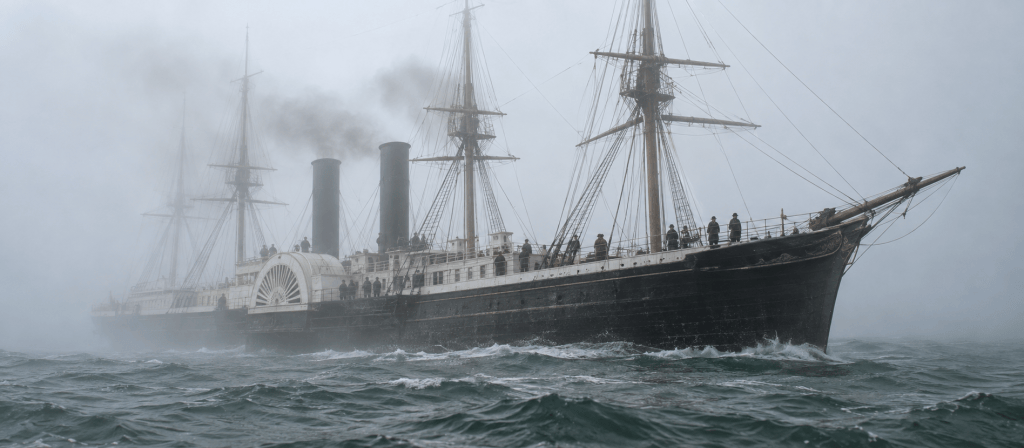
Cover image: AI-generated historical reconstruction of SS Arctic in fog. An illustration, not an archival photograph or a record of the collision.
A child on his father’s ship
William Robert Luce was eleven. His father, James, commanded one of the most admired liners on the Atlantic.
For the captain, taking his son to sea had offered the possibility of doing him good. The boy had health difficulties; Luce hoped the voyage would help. Instead of leaving William ashore, he had brought him into the world he knew best.
There must have been reassurance in that arrangement: a child travelling under his father’s care, aboard his father’s ship. What they said to each other is not preserved in the captain’s account. What happened when the ship sank is.
Arctic left Liverpool for New York on 20 September 1854. Among those aboard were families travelling together, including the wife, daughter and son of Edward Collins, the man whose shipping line owned her.
A week later, they were approaching Newfoundland. Home lay across the remaining miles.
The wrong ship seemed to be sinking
On 27 September, fog moved across the Grand Banks. Sometimes Luce could see a reasonable distance. Then another dense patch would close around the ship.
Shortly after noon, he went below to work out their position.
A shouted helm order brought him running back.
The French steamer Vesta struck Arctic on her starboard side. Looking at the smaller vessel’s crushed bow, Luce believed she might sink within minutes. His own liner appeared comparatively unharmed.
He sent a boat to help.
Then the damage aboard Arctic began to reveal itself. Water was entering through the hull. The pumps could not keep pace.
The vessel that seemed capable of rescuing the other was now fighting for her own life.
Fifty miles
Luce turned towards land, which he judged to be about fifty miles away.
Passengers and crew worked the pumps. Attempts were made to draw canvas over the damage. They needed to slow the flooding long enough for the engines to carry them in.
Below them, the sea kept rising.
For anyone waiting on deck, there was still the movement of the ship to hold on to. While she moved, land remained something they might reach.
But water reached the boiler fires. The engines lost their power. The distance to safety could no longer be crossed.
The boats became the only way out.
The ropes were cut
There were too few places for everyone.
In his later statement, Luce described trying to get women and children into the boats. Men rushed them. A boat was damaged in the struggle; people fell into the sea. Others cut themselves loose and vanished astern into the fog.
The captain’s orders could still be heard. They could no longer make everyone obey.
Aboard the liner, families watched the boats leave. Each one carried away seats that would never return for them. A parent could keep a child close, lift them, shelter them from the crowd. None of that could create another boat.
Luce and those still helping tried to build a raft from spars and other timber. The last remaining boat was lowered to assist.
Then came the warning that the ship was going down. That boat, too, got clear.
William was still aboard.
His arms were not enough
Late that afternoon, Arctic sank.
Luce went under with her. When he struggled back to the surface, his child was in his arms.
Then he was dragged down again.
In the account he wrote afterwards, he described nearly dying before he reached the surface a second time. In that struggle, he lost his hold on William.
Around him were people calling for help among the wreckage. Luce was trying to save his boy when part of a paddle-wheel housing surged up through the water.
It grazed the captain’s head.
It struck William.
Luce saw his son lifeless in the sea.
The piece of wreckage that had killed the child became the father’s refuge. He climbed onto it with other survivors.
There was no rescue boat beside them. There was no shore to swim to. The father who had brought his son aboard for his health was left standing in cold water on the remains of his ship.
A light that kept going
The first night passed. Men on the wreckage died one by one.
Morning brought fog. Their makeshift refuge absorbed water and settled lower. Another day went by without rescue.
By the second night, Luce’s account records only three men left in his group.
Before dawn on 29 September, they saw a vessel’s light.
They shouted until they were exhausted.
The light passed away to the east.
After daylight, another vessel appeared. For a time it seemed to be coming towards them. Then it, too, disappointed them.
Finally, the sailing ship Cambria arrived in the area. A man rescued from nearby wreckage told her captain that others were still out there.
A search from aloft found them.
This time, a boat came.
The passenger who could not come home
Luce survived. William did not. No woman or child aboard Arctic survived the disaster. The precise death toll remains uncertain; hundreds were lost.
The captain’s statement was addressed to Edward Collins. Near its beginning, Luce told him that his wife, daughter and son were feared dead. He had taken leave of them as the liner went down.
One bereaved father was writing to another.
Near the end, Luce described his own return to New York in four words: a home of sorrow
.
At sea he had faced a leaking hull, departing boats, cold, darkness and ships that failed to see him. Ashore, the work of surviving would continue in a home to which William would never return.
The boy had been eleven. There should have been years left for his father to watch him grow.
Instead, Luce had to bring home the story of the moment he could no longer hold him.
For another collision in fog, and a very different rescue, read Andrea Doria: Eleven Hours Before the Sea Took Her. The choices people make when others need help also run through Herald of Free Enterprise: The People Who Reached Back.
Subscribe to Dark Stories for more true accounts of the people behind history’s disasters. Explore the maritime collection at Lost at Sea.
Sources and historical note
The sinking and rescue sequence follows Captain James C. Luce’s contemporary statement, reproduced by the Maritime Heritage Project from the Mountain Democrat, 18 November 1854. It is a survivor’s account, not an independent inquiry. William’s age and the voyage’s background are cross-checked against the referenced historical overview, Sinking of the SS Arctic. Published passenger, casualty and survivor totals differ; this story avoids presenting a disputed exact total as settled fact. No dialogue or private thoughts have been invented.


Leave a Reply