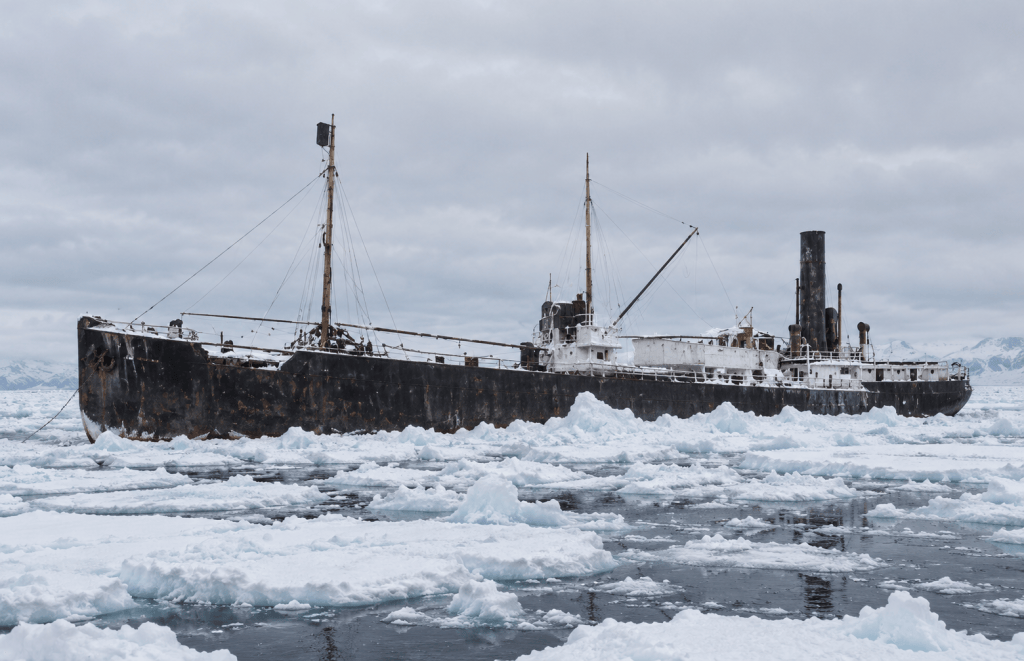
In 1931, the crew of a trading steamer escaped the Arctic ice and left their ship behind. They thought she was finished. Yet for decades, people kept reporting the same dark hull along the coast of Alaska. The last sighting recorded in the company archives dates to 1969. What happened after that remains unknown.
Reading time: about 5–6 minutes. Featured image: AI-generated historical reconstruction, not an archive photograph.
The Ship Had Gone
After the November storm, there should have been a ship beside the camp. Instead, there was ice.
Captain Sidney Cornwell and the men who had stayed behind were watching over Baychimo, a cargo steamer imprisoned off northern Alaska. They had built shelter away from her and hoped to survive the winter. When the weather cleared, the vessel was no longer where they had left her.
It seemed a grim but understandable ending. The ice had won. A ship caught in that country could be crushed, torn open, and swallowed without anyone seeing the moment it went down.
Then word arrived from an Indigenous hunter. A vessel had been seen farther along the coast. It was Baychimo.
The men had not been watching a ship die. They had been watching the beginning of a disappearance that would take decades.
A Swedish Hull in a Different World
Baychimo had been built at Lindholmens in Gothenburg in 1914. Originally named Ångermanelfven, she began working for German owners before passing to Britain after the First World War. The Hudson’s Bay Company bought her in 1921.
She was about seventy metres long: a working steel steamer with cargo spaces, masts and a coal-fired engine. Her company sent her into the Arctic trading world, carrying supplies and collecting furs. Her career connected Sweden, Scotland and distant northern communities.
There was nothing supernatural about her. She had a builder, an owner, a master and paperwork. Every voyage was supposed to end with people unloading a hold and preparing for the next journey.
In 1931, that ordinary pattern broke.
The Winter Closing Around Them
During the autumn return journey, bad weather and growing ice stopped the ship near Alaska’s northern coast. The crew could no longer treat the ice as an obstacle they would simply steam through. They had to prepare to remain.
Some people were evacuated by aircraft. Cornwell and fourteen men stayed behind. The shelter they built offered an alternative to spending the winter inside a large vessel that would be difficult to heat.
There is a particular helplessness in having a ship but no freedom to sail her. The engine, the wheel and the strength of the hull mean little when the water itself has become a moving wall.
In late November, a severe storm swept through. The Hudson’s Bay Company Archives records the ship’s disappearance on 26 November. Other accounts describe the surrounding events with slightly different dates. What matters is the sequence: the men sheltered, the storm passed, and the ship was gone.
After the hunter’s report, the remaining crew reached her again and removed valuable furs. They judged that leaving her was safer than trusting her through the winter. By March 1932, the men who had remained were back in Vancouver.
The people’s story had an ending. The ship’s did not.
Visitors to an Empty Ship
Baychimo was seen again. Then again. A vessel that had been written off began returning to the record in scattered encounters.
In 1933, people aboard the small trading vessel Trader reached her. They attempted to free her from the ice, but she remained caught. They recovered objects instead.
This encounter left more than a dramatic anecdote. Some objects removed from Baychimo eventually entered the University of Alaska Museum of the North. Researchers later traced their route from the abandoned steamer, through Trader, into the museum collections.
These things mattered because they could be handled, catalogued and studied. They were physical connections to a ship that otherwise kept slipping back into distance.
Imagine approaching a familiar merchant vessel and finding no one ready to take your line. No engineer maintaining her. No captain deciding where she would go next. This is an imagined impression, not a recovered eyewitness scene. Her movements now depended on wind, water and ice.
In Joyita, the ship was found but the people were lost. With Baychimo, the crew returned and the vessel became the missing subject.
Thirty-Eight Years
The reports did not stop with the first people who boarded her. The years became decades. The vessel’s history sheet in the Hudson’s Bay Company Archives gives 1969 as the most recent sighting in its records. That was thirty-eight years after the abandonment.
Think of the span between those dates. A person born when the ship was abandoned could have grown up, married and raised children before that final recorded report. The original voyage belonged to another age. Yet somewhere along the Alaskan coast, people were still reporting its ship.
That does not mean anyone watched her continuously for thirty-eight years. Sightings are separated by gaps. The record cannot tell us every place she travelled, every season she endured, or how her condition changed between encounters.
The gaps are part of the mystery. They should not be filled with invented voyages.
The Last Unanswered Question
Today, the Scottish Maritime Museum describes her whereabouts as unknown and considers it likely that she sank after the last recorded sighting. That is a reasonable explanation. It is not a located wreck or a witnessed sinking.
At some point, perhaps corrosion, ice damage or a storm finally overcame her. We do not know which. We do not know where. The absence of later reports does not prove that she is still afloat, and it does not provide a date for her loss.
Unlike the mystery of Mary Celeste, there is no need to explain why Baychimo had no crew. That decision is documented. The unanswered question is what happened to the vessel afterward.
A ghost ship does not require a ghost. Sometimes it is simply a ship for which the final page was never written.
Baychimo left Sweden with a name and a purpose. She outlived the voyage that should have ended her career. Then, after decades of returning, she stopped returning.
Somewhere beyond the last recorded sighting, the sea kept the rest of the story.
Sources and Image Note
Based on the Hudson’s Bay Company Archives vessel history; Manitoba Museum’s historical account; the University of Alaska Fairbanks account of recovered objects; and the Scottish Maritime Museum’s collection research.
The cover is an original AI historical reconstruction informed by photographs of the vessel. It does not depict a confirmed sighting or her unknown final moments. No dialogue has been invented; imaginative passages are identified.
What do you think finally happened to Baychimo? Leave a comment, share this story with someone who loves maritime mysteries, and subscribe to Dark Stories for the next voyage into the unknown.


Leave a Reply