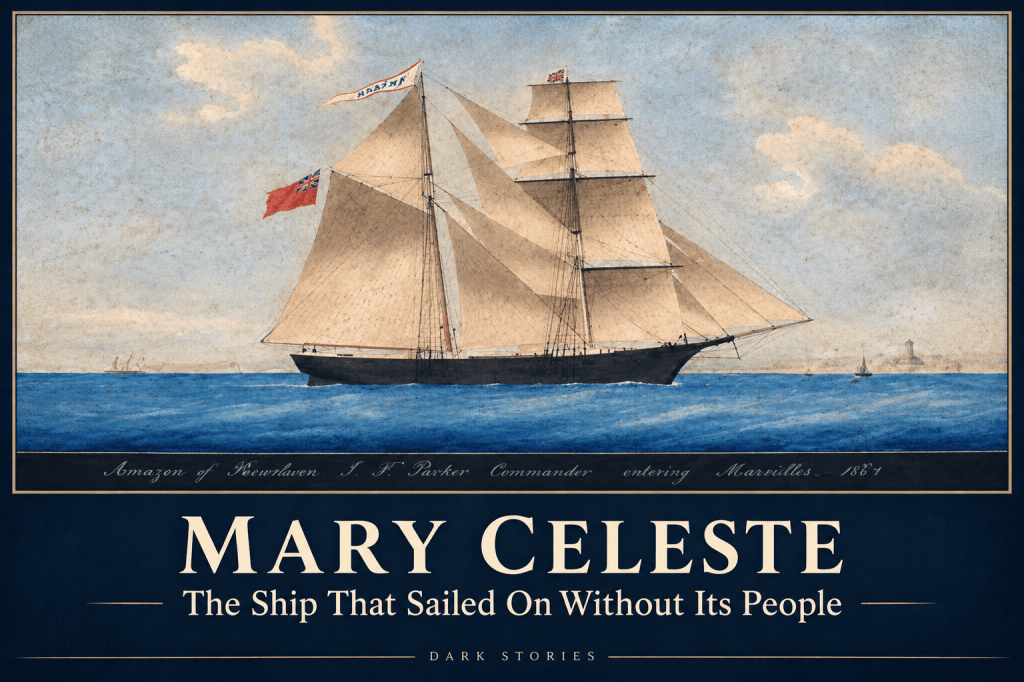
The Ship That Should Not Have Been Empty
In November 1872, the brigantine Mary Celeste left New York. She was heading for Genoa, Italy. Her hold was full of barrels of industrial alcohol.
Her captain was Benjamin Briggs, a careful and respected sailor. His wife Sarah was on board, and so was their two-year-old daughter, Sophia. Seven crewmen completed the group. That made ten people in all, on a strong ship with a long road of water ahead of them.
Nobody on that pier could have known what would happen next. Within weeks, every one of those people would be gone.
December 5, 1872
The Atlantic was gray and restless. Not far from the Azores, the crew of a British ship, the Dei Gratia, saw another ship in the distance.
Something about it looked wrong.
The ship moved in a strange, lazy zigzag. Her sails were only partly set, and some were torn or missing. Nobody seemed to be steering her. The men on the Dei Gratia signaled to her, and no answer came. They tried again. Still nothing.
A ship at sea is never truly quiet. There are always voices, footsteps and orders. This ship had none of that. She drifted like something that had forgotten where it was going.
The captain of the Dei Gratia sent men across in a small boat. They climbed up the side of the Mary Celeste and stood on her deck. No one came to meet them.
Walking Through a Ghost Ship
The men called out, and only the wind and the creak of the wood answered them.
They searched the ship. What they found did not look like a disaster. It looked like a place where people had been living just a moment before.
- There was plenty of food on board, and enough fresh water to last for months.
- The cargo was almost all still in place.
- The crew’s belongings were still in their cabins, including personal items like pipes and money.
- There were no signs of a fight. There was no blood, no broken doors and no sign of violence.
If pirates had come, they had taken nothing. If there had been a mutiny, no one had left a mark of it.
Yet some things were wrong. Water had got into the ship, though not enough to sink her. The main compass was damaged. The ship’s lifeboat was gone. The logbook was still there, but its story simply stopped, with no final entries to explain what came next. The last notes had been written days earlier, and after them there was only silence.
The ship had not sunk, and she was still seaworthy. But the people who had sailed her were nowhere to be found.
The Empty Place Where a Boat Should Be
Think about what the missing lifeboat means.
Someone made a choice. Someone looked at a healthy ship and decided that the sea in a small boat was safer than the deck under their feet. That is a terrible decision to make. A captain does not give such an order lightly. Captain Briggs had his wife and his little daughter with him. He would not have put them into an open boat on the Atlantic unless he believed he had no other choice.
So what did he see, or fear, that made him do it?
The people on the Dei Gratia could only wonder. They searched the waves for a boat, a body or any sign at all, and found nothing. Captain Briggs, Sarah, little Sophia and the seven men had vanished. They were never seen or heard from again.
A Prize and a Suspicion
The crew of the Dei Gratia took the Mary Celeste in and brought her to port. Because they had saved an abandoned ship, they were entitled to a reward, called salvage.
But a reward can look like a motive. Officials asked hard questions. Had the men of the Dei Gratia done something to the ship’s crew? Had they lied about what they found?
Investigators studied the ship closely and found no proof of any crime. The salvage men were not punished. Even so, a shadow of suspicion followed the story for years. When no answer can be found, people start to look for someone to blame.
The Theories
For more than 150 years, people have tried to explain what happened. Some of the ideas are reasonable. Others are wild.
Mutiny. One early idea was that the crew got drunk on the alcohol cargo, turned on the captain and killed him. But the crew’s belongings were untouched, and there was no evidence of a fight. Even descendants of the crew have argued against this story.
Pirates. Some suggested pirates attacked the ship. But pirates would have taken the valuable cargo and the money. They took nothing.
A sea monster. Sea monsters were a popular explanation in the 1800s, and the idea has never completely gone away. It makes a good campfire story, but there is no evidence for it.
Fear of an explosion. This is the explanation many experts find most convincing. The ship carried a huge amount of alcohol. If fumes leaked from the barrels, Captain Briggs may have feared the whole ship was about to blow up. He may have ordered everyone into the lifeboat to wait at a safe distance, planning to return once the danger passed.
Imagine that moment. The crew stand in the small boat, tied to the ship by a rope and watching her. Then a sudden storm or a strong wind comes. The rope snaps, or it is cut. The ship drifts away with her sails up. The people in the little boat can only watch her go, with no food, no shelter and nothing but open water around them.
This theory fits many of the facts, but it is still only a theory. No one has proved it.
How a Mystery Becomes a Legend
The real story was strange enough. But the legend grew even stranger.
In 1884, the writer Arthur Conan Doyle, who later created Sherlock Holmes, wrote a fictional story about a ship called the Marie Celeste. He changed many facts and invented a spooky tale of horror. Many readers believed his version was true. Over time, fiction and fact mixed together, and myths grew around the ship, such as tables set for dinner and warm food still on the plates. These details are false. They are not part of the real record.
That is why it matters to separate what we know from what people invented. The true story needs no decoration. It is already frightening.
What We Know and What We Don’t
We know that a healthy ship left New York with ten people on board. We know that it was found drifting weeks later, half-sailing on her own, with no one aboard. We know her cargo, food and water were mostly untouched, and that the lifeboat was gone. We know the crew were never found.
We do not know what made them leave, and we probably never will. The sea kept its secret.
What remains is a quiet picture: a ship moving through gray water with her sails set, and a captain, a mother, a little girl and seven sailors who left her and never came back.
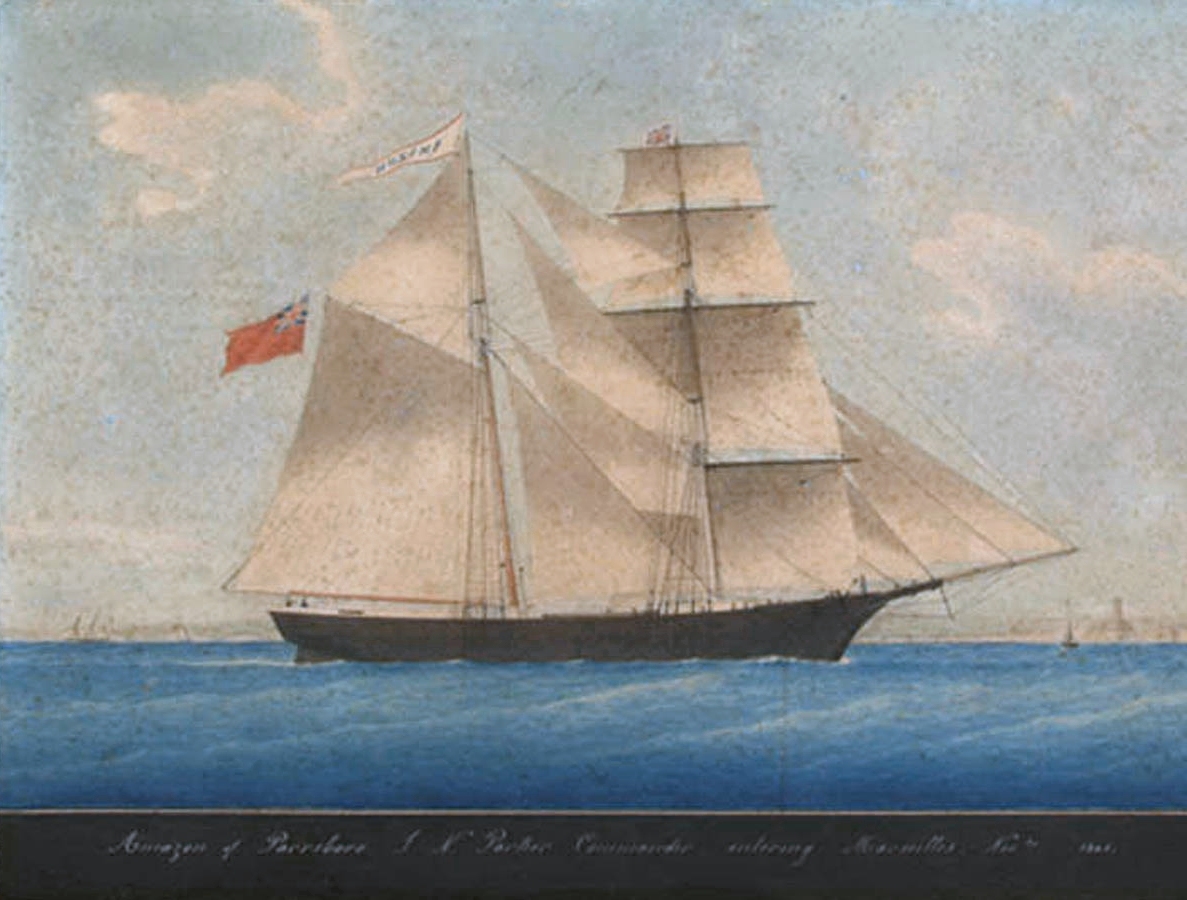
Image note: The title card is an AI-assisted adaptation of this public-domain painting. The image above is the unaltered historical reproduction.
Sources and historical note
This narrative uses documented facts and clearly identified hypotheses; it contains no invented dialogue. Sources: Royal Museums Greenwich; Smithsonian, 2007 investigation; Smithsonian, 2024 historical account; Mary Celeste historical overview and references. Discovery dates are given as 4 or 5 December in different accounts; this story uses the 5 December date given in Smithsonian’s 2007 account. The cause of abandonment and the fate of those aboard remain unconfirmed.
For more true mysteries and dark history, subscribe to Dark Stories using the Subscribe button on this page.


Leave a comment