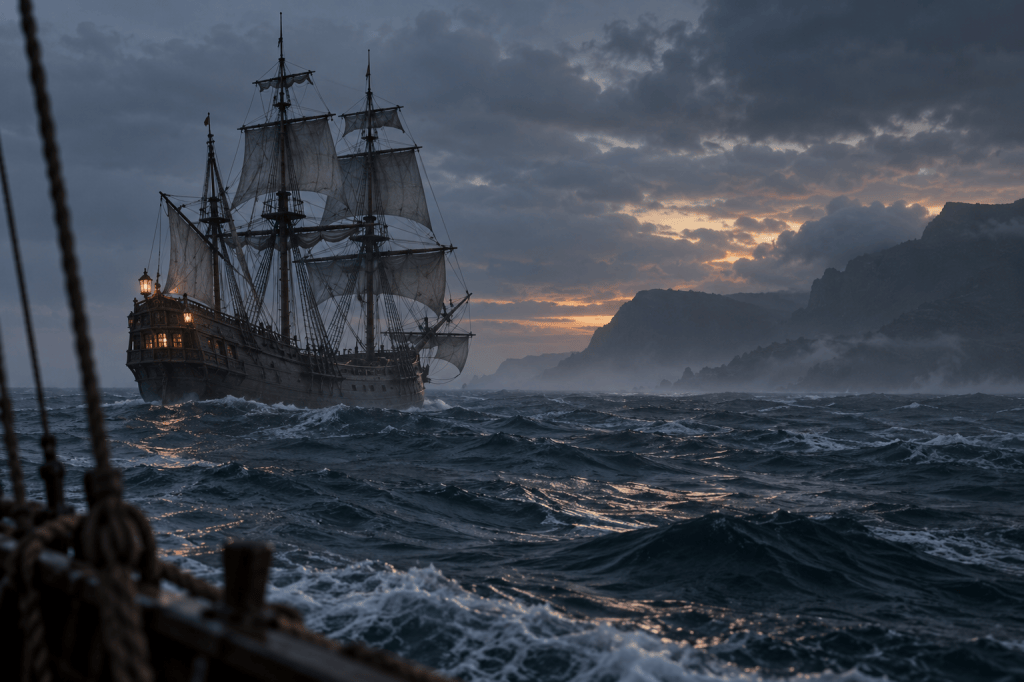
Before dawn on 11 July 1881, a red light appeared ahead of a British naval vessel. Within it, witnesses reported the outline of a sailing ship. Moments later, there was nothing to find. The published account gave the apparition a name sailors already feared: the Flying Dutchman.
This story explores a maritime legend and historical reports, not a verified supernatural event. Cover: an AI-generated imagined scene, not a historical photograph.
A Light Before Morning
The account appears in the 1886 book The Cruise of Her Majesty’s Ship “Bacchante,” compiled from the two British princes’ journals and correspondence with additions by their tutor, John Neill Dalton. Prince George would later become King George V.
The entry describes an encounter during the voyage off Australia. It begins at four in the morning. A red light surrounded what looked like the masts and sails of a brig, close to the port bow.
A lookout reported it. An officer saw it. A midshipman was sent forward to investigate. By the time he reached the forecastle, no vessel could be found. According to the account, the night was clear and the sea calm. Thirteen people had seen the appearance.
Then the entry records something worse. Later that morning, the seaman who had first reported the apparition fell from the rigging and died. He was buried at sea that afternoon.
It is an unsettling sequence. It is also important to understand what it establishes. A published narrative records an extraordinary observation and a fatal accident. It does not establish that a ghost ship appeared, or that the observation caused the death.
The tragedy gave the older legend precisely the kind of ending that keeps a story alive.
The Captain Who Could Never Come Home
In familiar versions of the tale, a Dutch captain tries to round the Cape of Good Hope in terrible weather. He refuses to turn back. His defiance becomes a curse: he and his vessel must continue sailing, unable to reach the safety of a harbour.
The punishment is simple enough to frighten anyone who has waited for a voyage to end. The work never stops. The weather never releases its hold. Home remains a destination that can be imagined but never reached.
Yet the legend has no single, stable history. Its captain changes between versions. So does the reason for his punishment. A ship lost in a storm becomes a ship carrying the consequences of a terrible crime. A frightening sight becomes a warning that someone else will die.
Those changes matter. They show us a story being retold, rather than the consistent record of one identifiable wreck.
Before the Curse
One of the earliest printed references appeared in John MacDonald’s travel book in 1790. He reported sailors speaking of a Dutch ship that had failed to enter a harbour near the Cape during bad weather and had been lost. They believed its apparition returned in storms.
This is evidence that the belief existed. It is not independent confirmation that the ship described by the sailors existed as they imagined it.
An account published in 1795, attributed to George Barrington, already offered a less supernatural reading. Sailors mistook an ominous shape for a lost vessel; when conditions changed, the supposed ship disappeared. The narrator identified the object as a dark cloud.
Fear and doubt were travelling together almost from the beginning.
In 1821, Blackwood’s Edinburgh Magazine published “Vanderdecken’s Message Home.” Its doomed captain wanted letters delivered to people on land. The recipients belonged to a past that had long since disappeared.
That is the legend’s most sorrowful idea. The sea has kept someone so long that the world waiting for him is gone. His voyage continues, but the people who could welcome him home are dead.
What the Air Can Do
There is a real phenomenon capable of making ships look extraordinary: atmospheric refraction. Light bends as it passes through air with changing density. Over the sea, layers of air at different temperatures can distort the distant horizon.
A superior mirage can shift an image upward. More complicated effects, including Fata Morgana, can stretch, multiply or invert distant objects. A real vessel can acquire an appearance that seems impossible.
The illusion is not necessarily something imagined by a frightened observer. Light really reaches the eye in an unusual pattern. Several people looking from similar positions may see the same distorted image.
That gives some “phantom ship” reports a plausible natural explanation. It does not prove what caused the red light in the 1881 account. We do not have enough observational detail to diagnose that encounter with certainty.
When Ghost Ships Are Real
Some ships called “ghost ships” have a much firmer place in history. Baychimo: The Ship That Would Not Disappear concerns a real steamer abandoned in Arctic waters and reported again over subsequent decades. Her builder, owners and abandonment are documented.
In The Ship That Sailed On Alone, Mary Celeste was a real vessel found without her people. The mystery concerns what happened to them.
The Flying Dutchman belongs to a different kind of story. No verified historical ship has been identified whose fate establishes the legendary curse. The evidence concerns what people reported seeing, what they believed, and how writers developed those beliefs.
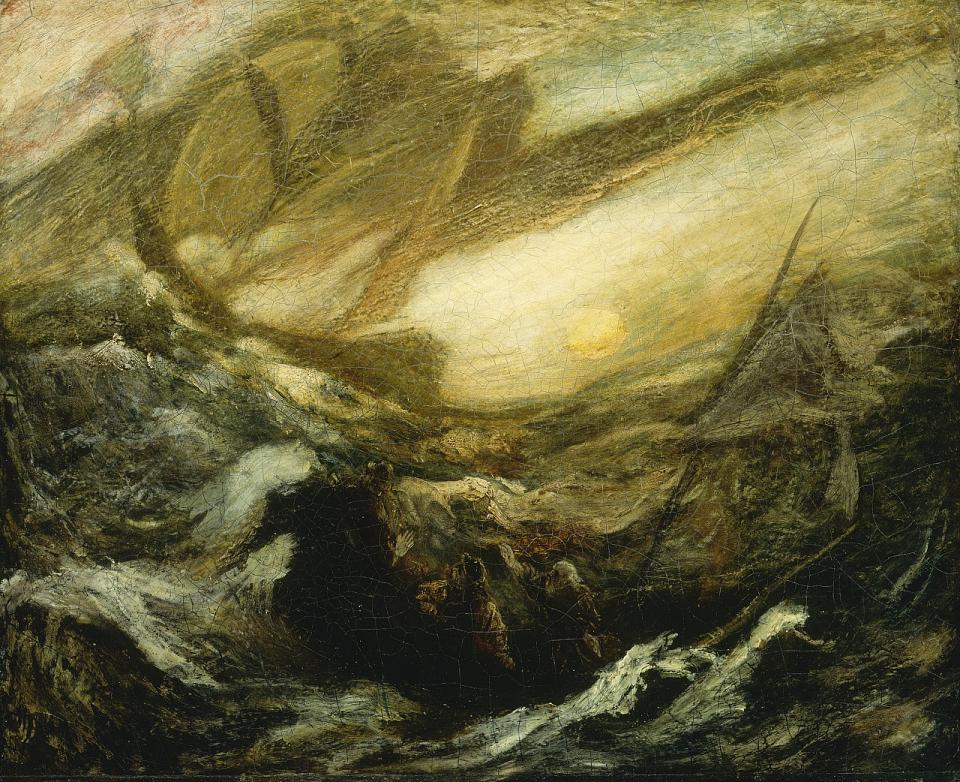
Paintings and books show how powerful the image became. They cannot establish the captain’s existence.
The Ship Beyond the Horizon
The Flying Dutchman has real roots in sailors’ reports, dangerous voyages, optical phenomena and storytelling. A vessel condemned to sail forever remains a legend.
That leaves a quieter kind of unease.
Consider the moment before a strange light becomes a familiar ship. A lookout has seen something. Other people turn to look. For a few seconds, they agree that there is a vessel ahead. Then the appearance changes, and the water is empty.
This is an imagined general impression, not an additional eyewitness account.
A sailor can explain a storm, mend a sail and take a bearing. An appearance that leaves nothing to inspect offers him no such task. It gives him only a memory.
The Flying Dutchman survives in that gap: between what was seen and what could be proved.
If this story stayed with you, share it with someone who loves maritime history and legends. Subscribe to Dark Stories for more voyages into the unknown.
Sources and image credit
Historical texts: John MacDonald (1790), the account attributed to George Barrington (1795), “Vanderdecken’s Message Home” (1821), and The Cruise of Her Majesty’s Ship “Bacchante,” volume 1, page 551 (1886), reproduced with source references in D. L. Ashliman’s University of Pittsburgh collection. Optical explanation: American Meteorological Society: superior mirage and Andrew T. Young, San Diego State University: superior-mirage simulations. The 1881 source is a compiled narrative. No dialogue has been invented.


Leave a Reply