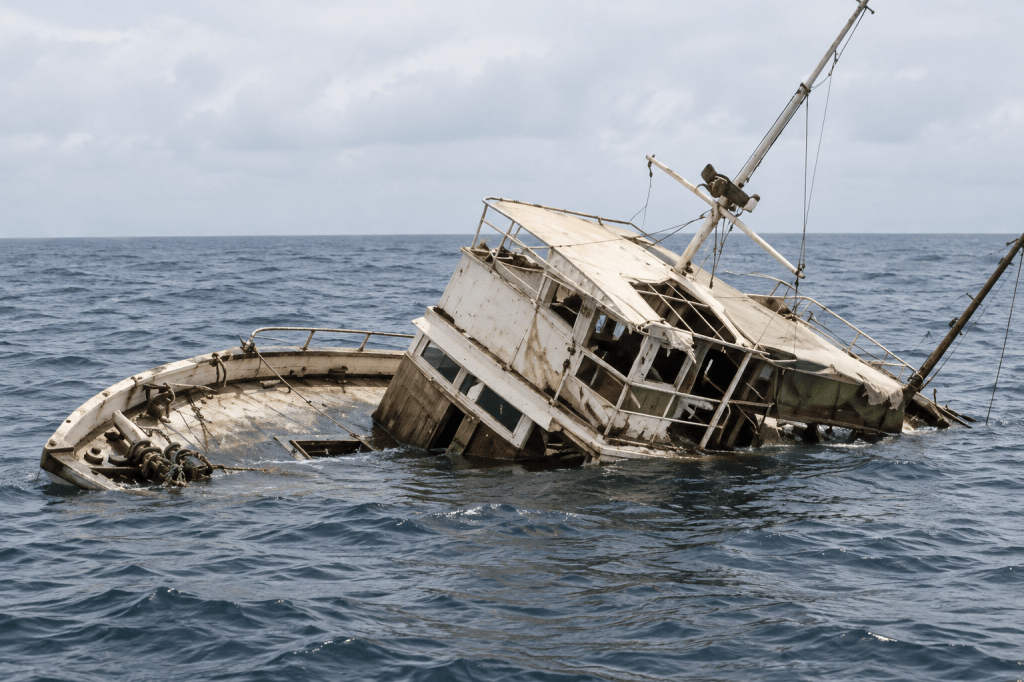
In October 1955, a small trading vessel left Samoa with twenty-five people aboard. Five weeks later, the ship was found hundreds of miles away, flooded and leaning into the sea. She was still afloat. Every passenger and crew member was gone.
Reading time: about 6 minutes. Cover image: AI-generated historical reconstruction.
A Ship Without Voices
On 10 November 1955, the merchant ship Tuvalu encountered an abandoned vessel north of Fiji. Her name was Joyita. She lay low in the water, listing heavily to port, a damaged little ship surrounded by an enormous ocean.
Finding her should have ended a desperate search. Instead, it changed the question. The missing vessel had been located. The people aboard had not.
There were no survivors waiting on deck. Nobody could explain where she had been, how long she had drifted, or what had happened inside her flooded hull. The ship had come back into the human world carrying no human voice.
The Journey That Began Normally
Joyita had left Apia, in what was then Western Samoa, on 3 October. Her destination was the Tokelau Islands. It was a voyage normally measured in days, not weeks.
Captain Thomas Henry “Dusty” Miller commanded a vessel with a long history. Built in California in 1931 as a private yacht, she had served in the United States Navy during the Second World War. Later, she became a working boat in the Pacific. At about sixty-nine feet long, she was small enough for the sea around her to feel very large.
This time, she carried sixteen crew members and nine passengers. Among them were Tokelauans travelling between the islands and Samoa, and a doctor making the journey for a medical emergency. Supplies were aboard for the island communities. These were people with destinations, responsibilities and families expecting them.
The voyage also began with defects. Contemporary inquiry reporting described a faulty engine and an unreliable radio. According to evidence presented to the commission, Miller intended to repair the engine at sea.
That detail matters. It suggests that the danger may not have arrived suddenly from outside. Something capable of beginning a disaster was already aboard when Joyita left the harbour.
The Waiting
By 6 October, Joyita was reported overdue. A sea and air search followed.
But the days continued. The search produced no confirmed account of the people aboard. Then, more than five weeks after departure, Joyita appeared near Fiji, far from her intended route.
She had survived long enough to be found. Twenty-five people had not been found with her.
A Radio Set for Help
The abandoned vessel contained signs of an emergency. Water had entered her. Her radio transmitter was set to the distress frequency, but the equipment was defective. No confirmed message explained her predicament.
The distinction is chilling. A radio can be set correctly and still fail to deliver the words that matter. On an isolated vessel, the difference between attempting a call and being heard can be the difference between rescue and silence.
Contemporary testimony also recorded missing lifejackets and two missing rafts. Supplies were missing from the cargo. Investigators considered whether they had been thrown overboard to lighten the vessel as water rose.
Those clues permit a possible sequence: a damaged ship, efforts to keep her afloat, an attempt to call for help, and people leaving aboard rafts. They do not establish that sequence. Nobody survived to confirm it.
Compare the unanswered radio silence in Marine Sulphur Queen: The Last Message, where no distress signal was received.
The Broken Pipe
An official commission sat at Apia in February 1956. Its investigation identified a broken pipe in the cooling system as the cause of the flooding. It also found inadequate lifesaving equipment and a failed radio transmitter.
Here, at least, was something solid. A damaged pipe could explain how the engine room filled with water. Equipment failures could explain why help did not arrive. The mystery did not require a sea monster or a secret force to begin. An ordinary mechanical failure could have been enough.
Yet identifying the failure was not the same as accounting for the disappearance. Contemporary reporting of the commission’s findings stated that it could not determine why the vessel had been abandoned. Joyita had remained afloat and still offered some protection.
That is the question which has outlived the investigation: what persuaded everyone to leave?
The same question haunts Mary Celeste: why leave a ship that could still float?
The Decision Nobody Can Describe
Imagine a small vessel taking water, the deck tilting beneath your feet, and a radio that brings no reassuring reply. This is a possible reconstruction, not a recorded scene. We do not know what anyone aboard Joyita said or saw.
Perhaps the people believed the hull would soon disappear beneath them. Perhaps a raft seemed to offer a chance the ship no longer could. Perhaps circumstances we can no longer recover made staying aboard appear impossible.
But hindsight is merciless. We know the damaged vessel continued to float. The people making their decision would not have known that future. They had to judge the danger from inside it.
Nor does a missing raft tell us what happened after departure. It cannot establish how many people reached it, how long they survived, or whether abandonment occurred in the way investigators suspected. The evidence takes us to the edge of a decision and stops there.
Twenty-Five Empty Places
Later writers offered explanations. David G. Wright devoted a book to investigating the case. But a plausible explanation is not an eyewitness account, and the discovery of the ship never produced a confirmed account of the twenty-five people’s fate.
For their families, this was not merely a ghost-ship story. It was an absence carried through the years: someone who never reached the next island, never stepped ashore, never returned to explain the delay.
Joyita is remembered because the ship remained. Had she sunk completely, her disappearance might have looked like another tragedy at sea. Instead, she left behind a terrible contradiction.
There was enough of a ship to find. There was nobody left to ask.
Read Another Maritime Mystery
Another vessel returned without her crew: Carroll A. Deering: The Ship That Came Back Empty.
What do you think made the people aboard Joyita abandon her? Leave a comment, share this story with someone interested in maritime history, and use the Subscribe button to follow Dark Stories.
Sources and Image Credit
This is a factual narrative with clearly marked hypothetical reconstruction. No dialogue or final moments are presented as established fact.
Sources: Pacific Islands Monthly, February 1956, inquiry coverage; The Navy, May 1956, commission findings; NavSource, YP-108 / Joyita; Te Vakai, Tokelau community account; Auckland University Press, David G. Wright’s Joyita: Solving the Mystery.
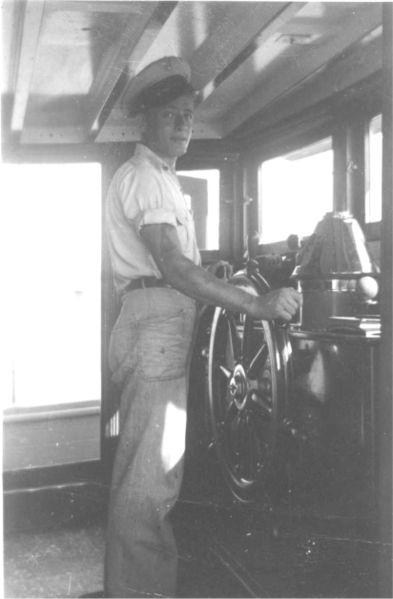
Archive photograph: Chief Body at Joyita’s wheel, circa 1942, during her US Navy service as YP-108. Unknown photographer; Wikimedia Commons, public domain (US government work). The sailor shown is not identified as one of the people who disappeared in 1955.


Leave a Reply