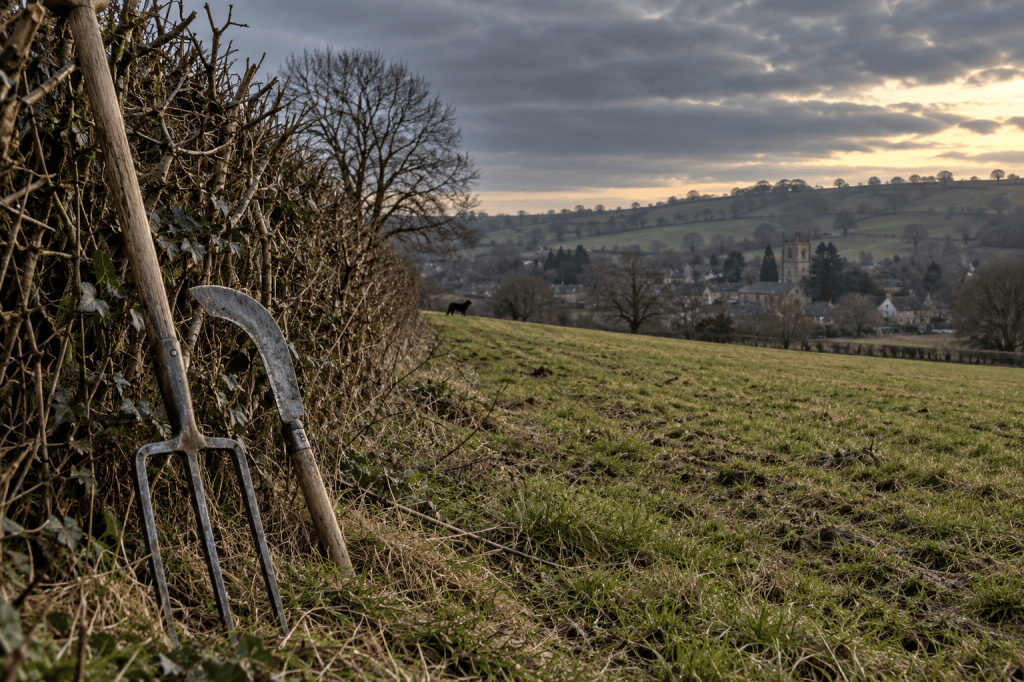
He left home to cut a hedge. By nightfall, he lay dead beneath it, pinned to the earth with a pitchfork. Scotland Yard searched for a murderer. The stories that followed searched for something older: witchcraft, blood sacrifice, and a black dog said to appear before death.
The man who did not come home
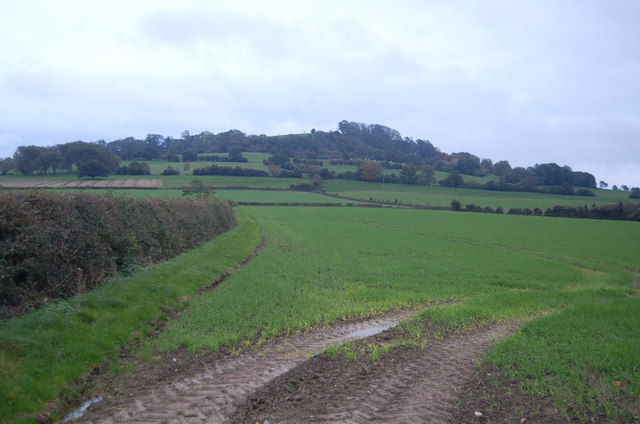
On 14 February 1945, Charles Walton went to work on the slopes of Meon Hill, near Lower Quinton in Warwickshire. He was seventy-four, a widower who still took agricultural jobs despite painful joints. His tools were ordinary things: a pitchfork and a cutting hook for the hedge.
Walton lived with his niece Edith, whom he had helped raise. She knew his habits. He was expected home by late afternoon. When she returned around six and found him absent, there was no comfortable explanation waiting in the cottage.
She asked a neighbour, Harry Beasley, to help. They went to the farm where Walton had been working and joined Alfred Potter, his employer. Together, they headed towards the hedge.
The search ended where the working day had ended. Charles Walton was still there. But somebody had turned his tools against him.
Beneath the hedge
The injuries were brutal. Walton had been struck and his neck cut; a pitchfork pinned him to the ground. The cutting hook remained at his neck. The scene left investigators facing a question that would survive them all: why attack an elderly labourer with such violence?
The same unease runs through Hinterkaifeck: The Farm That Fell Silent, another unsolved rural murder case in which an agricultural tool became a weapon and suspicion never became a conviction.
A sudden quarrel could become murder. An attack could continue in panic. But to later readers, the way the body had been left suggested something deliberate, almost ceremonial. That impression would become the doorway through which the supernatural entered the case.
It was an impression, not proof. Yet once a crime acquires a ritual explanation, even ordinary objects begin to look like symbols. A farm tool becomes an instrument of sacrifice. A quiet man becomes a suspected sorcerer. A hill becomes a place to avoid after dark.
Scotland Yard arrives
Robert Fabian of Scotland Yard joined the investigation. Hundreds of statements were taken. The surrounding ground was searched, with Royal Engineers using mine detectors in the hunt for a missing pocket watch or another overlooked clue.
There were people to question, movements to reconstruct, accounts to compare. Walton had not vanished in a distant wilderness. He had been killed close to a village where he had spent his life.
That made the absence of an answer more troubling. Had someone passed the field? Heard an argument? Seen a person leaving? Did a neighbour possess a small, apparently harmless detail that would make the whole sequence clear?
Suspicion fell on his employer, Alfred Potter. But suspicion never became a proven case. No one was convicted, and there is no basis for presenting Potter as the established killer. The investigation produced possibilities. It did not produce justice.
Then came the black dog
Later accounts wrapped Walton in the folklore of the countryside. He was said to have an unusual way with animals. Stories about birds and toads were retold as though a familiarity with nature might reveal a familiarity with forbidden powers.
One especially unsettling tale concerned a young man named Charles Walton who supposedly encountered a phantom black dog in the nineteenth century. In the telling, the animal foretold a death in his family. The shared name helped attach the story to the murdered labourer.
But that identification is disputed. The old tale cannot safely be treated as an episode from the victim’s childhood. A name repeated across generations is not evidence of a haunting.
Another story places Fabian himself on the hill when a large black dog passes nearby. He asks a boy about the animal; the boy reacts with fear. In later retellings, the encounter becomes an omen, as if the investigator has stepped into the same darkness as the victim.
This belongs to the case’s legend. It is not corroborated evidence that a supernatural animal appeared. Even so, the image is difficult to shake: a detective following a trail that suddenly seems to lead beyond the reach of his notebook.
A sacrifice—or a story built afterwards?
Witchcraft theories offered an explanation for the violence. Had somebody believed Walton could curse livestock or crops? Had he been killed to break a spell? Or had his death been a sacrifice connected with the land?
Those possibilities are very different. A person killing because of a belief in magic would still be a human murderer. The belief would explain a motive, not prove that magic worked.
A similar boundary between spiritual belief and physical evidence shapes The Men Who Waited for a Signal, the Lead Masks mystery. There, theories about contacting spirits compete with poisoning and a failed experiment; even the cause of death remains uncertain.
There is a further problem. Historian M. J. Trow, whose book revisits the original police files, stresses that those records contain no witchcraft explanation. The dramatic folklore grew around the investigation, and later accounts helped harden speculation into apparent fact.
Claims of ritual markings and supernatural signs therefore deserve caution. They make the story memorable. They do not identify the hand that held the weapon.
That struggle between evidence and extraordinary explanations also appears in The Night on Dead Mountain: The Dyatlov Pass Mystery. Its UFO and creature theories remain unproven, while the article examines the avalanche explanation supported by later investigations and research.
The thing that remains
An ordinary motive remains possible: anger, a dispute, money, or some grievance never established. The killing could have been committed by someone Walton knew. It could also have followed circumstances the surviving evidence cannot reconstruct.
No answer has been proved. The murder remains unsolved.
What makes Meon Hill disturbing is the gap between the familiar and the inexplicable. A man follows his routine. Someone finds him beside his work. Police ask their questions. Years later, people can describe the ghost dog more vividly than they can describe the killer.
Perhaps the hill held no supernatural secret at all. Perhaps the only secret belonged to a person who walked back down it and resumed an ordinary life.
Charles Walton never came home. Whoever knew why has left us with the hedge, the tools, and a story that grows darker whenever the facts run out.
If this mystery stayed with you, share it. What seems more likely to you: a murder shaped by superstition, or a human crime that folklore transformed into something supernatural?
Sources and image credits
This is a narrative retelling of an actual unsolved murder. The black-dog and witchcraft accounts are identified as folklore and speculation, not established supernatural events. No dialogue or private thoughts have been invented.
Sources: Case overview and references to Metropolitan Police file MEPO 3/2290; M. J. Trow, The Meon Hill Murder, 1945 (publisher overview); Morbidology’s account of the folklore; Fairweather Lewis on the disputed black-dog identification.
Cover image: AI-generated editorial illustration created for Dark Stories. It depicts an imagined rural scene inspired by the case, not the actual crime scene.


Leave a Reply