In January 1959, nine young hikers went on a trip in the Ural Mountains in Russia. They were students and graduates from the Ural Polytechnic Institute. Their leader was Igor Dyatlov, a 23-year-old who loved the outdoors. The group wanted to reach a mountain called Otorten. They were strong, skilled, and ready for the cold.
One hiker, Yuri Yudin, got sick and went home early. This saved his life.
The other nine kept walking. They wrote in their diaries and took photos. In the pictures, they smile, joke, and pull their equipment through deep snow. On 1 February, they reached the slope of a mountain called Kholat Syakhl. In the local Mansi language, the name is often translated as “Dead Mountain.”
The weather got worse. Wind and snow made it hard to see. The group decided to stop and camp on the open slope instead of going down into the forest. They put up their tent and went to sleep. It was the last night of their lives.
The abandoned tent
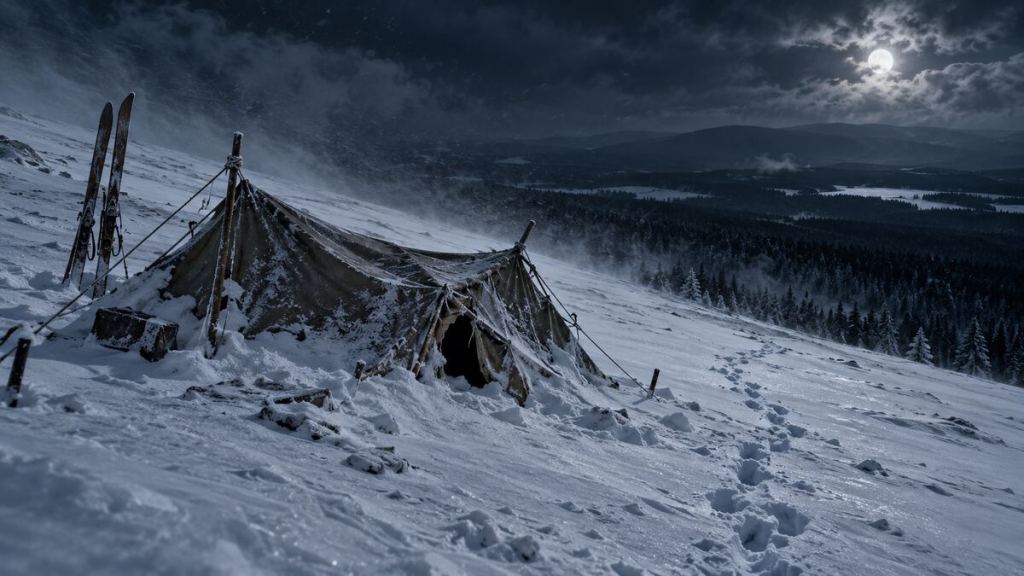
When the group did not come back, search teams went out in February. On 26 February, they found the tent. It was half covered in snow. It had been cut open from the inside. Inside, the hikers’ boots, coats, and supplies were still there. Footprints led away from the tent toward the forest. Some people had only socks on, and some had no shoes at all. The temperature that night was far below freezing.
Near a large tree at the edge of the forest, the searchers found the first two bodies. They wore only underwear. There were the remains of a small fire. Three more bodies were found between the tree and the tent. It looked as if they had been trying to go back.
The other four were found two months later, in May, under the snow in a small ravine. Their injuries were strange. Some had serious chest and skull injuries, yet their bodies had few external wounds. One woman was missing her tongue. Some of the clothes carried small traces of radiation.
A compelling natural force
Why did experienced hikers run into the freezing night without proper clothes? Why did they cut their own tent open? The first official investigation said that “a compelling natural force” caused the deaths. Then the case was closed, and the files remained secret for many years.
Over the years, people have proposed many theories:
- An avalanche. Snow may have slid down and scared the group, forcing them out of the tent.
- Strong wind. Some scientists think unusual wind patterns could have produced frightening sounds and panic.
- Secret tests. Some people believe the army tested weapons nearby.
- An attack by animals or people. Most experts say there is no evidence for this.
- Strange creatures or UFOs. These are popular stories, but there is no proof.
The avalanche explanation
In 2019, Russia opened a new investigation. In 2020, officials said that an avalanche was the most likely cause. Scientists in Switzerland also published computer modelling in 2021. Their work showed that a small slab of snow could have slid down and struck the tent, even on a relatively gentle slope. This could explain both the injuries and the group’s sudden escape.
But questions remain. Why did the hikers go so far from the tent? Why were some injuries so unusual? Not everyone agrees that the avalanche theory tells the whole story.
Today, the pass is called Dyatlov Pass, in memory of the nine hikers. There is a memorial, and visitors continue to make the journey. The mystery still fascinates people around the world. It reminds us how dangerous nature can be—and how some questions may never receive a final answer.
Source
Featured image: AI-generated illustration.
If this mystery stayed with you, share the story with someone who enjoys the unexplained.


Leave a comment