In July 1909, a new ocean liner left Durban with 211 people aboard. Another ship watched her disappear over the horizon. Nobody knows where her journey ended.
Reading time: approximately 6 minutes.
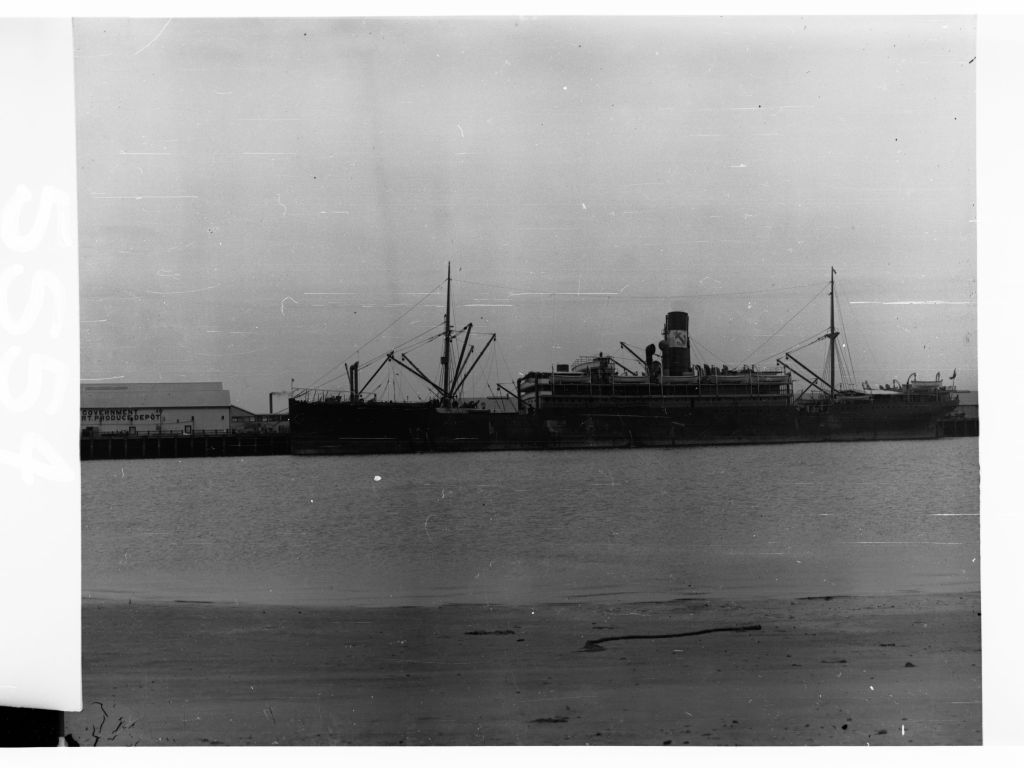
Historical photograph: SS Waratah at Port Adelaide. South Australian government photographer / History Trust of South Australia, GN05554, via Wikimedia Commons. CC0.
At first, a ship that fails to arrive is simply late. A timetable slips. A journey takes longer than expected. There are explanations that leave room for an ordinary ending.
Then another day passes.
The name remains on the list of expected arrivals, but the vessel does not appear. Somewhere beyond the harbour, a journey has stopped producing news. People on land can do nothing except wait for somebody else to see what they cannot.
For the SS Waratah, the waiting never ended in a reunion.
A ship built for the world ahead
Waratah entered service in 1908, carrying passengers and cargo between Britain and Australia by way of southern Africa. She belonged to the Blue Anchor Line. Her steel hull, twin propellers and watertight compartments represented the confidence of a new age of steam travel.
Among the passengers on the final voyage were Agnes Grant Hay and her daughter Helen, known as Dolly. Their names survive in the State Library of South Australia’s account of the disaster.
Names change the meaning of a number. Two hundred and eleven can look like a statistic. A mother and daughter make us remember what that statistic contains.
We do not know what either woman said as the ship left her last port. We do know that neither came home.
The man who stepped ashore
One passenger, Claude Sawyer, disembarked at Durban. He later described concern about the ship’s rolling behaviour, as well as disturbing dreams. That decision has become one of the best-known parts of the Waratah story.
It is tempting to turn it into a warning that nobody else understood. But surviving a later disaster does not prove that a dream predicted it. Sawyer’s unease was testimony to be examined, not a supernatural explanation.
His place in the story is unsettling enough without that addition. He walked away from a ship whose remaining passengers would never be seen again.
The separation between those two outcomes was a gangway.
The last certain sighting
On 26 July 1909, Waratah departed Durban for Cape Town with 211 passengers and crew. She carried no wireless equipment. If trouble came, she could not send a radio distress call.
The following morning, the steamer Clan MacIntyre encountered her off South Africa’s eastern coast. The ships exchanged identifying signals. Waratah overtook the slower vessel and continued southwest.
By about 9:30 that morning, she had passed out of sight near the Mbashe River.
There was nothing remarkable about a ship disappearing over the horizon. It happened whenever two vessels went their separate ways. Only afterwards would this ordinary moment acquire its terrible significance.
That was the last securely identified sighting of Waratah.
The horizon had closed behind her. Everything beyond it would have to be reconstructed.
Lights in the distance
Later reports offered possible glimpses. The Harlow’s captain described a distant vessel, unusual smoke and bright flashes. Another liner, Guelph, reported an incomplete exchange of signals in which the letters “TAH” were read.
Neither account securely identified Waratah. A distant light is not a ship’s name, and the final letters of a signal are not a complete identity. These reports belong to the investigation, but they cannot provide a reliable account of the liner’s final moments.
The truth might have looked entirely different.
The harbour that kept waiting
Waratah was expected in Cape Town on 29 July. She did not arrive. Searches found no confirmed survivors or wreckage.
For those waiting ashore, every possible explanation carried its own kind of hope. A disabled ship could still be afloat. A missed sighting could be corrected. An empty stretch of sea searched today might yield a vessel tomorrow.
But each unsuccessful search enlarged the silence.
The search was a real, sustained undertaking. Royal Museums Greenwich preserves two accounts by S. H. Owen, master of the Sabine, describing his search for the missing liner in 1909. These documents are reminders of the people who went out looking while there was still a chance of finding somebody alive.
No survivor returned to describe the ending. No authenticated fragment supplied the missing location.
A court without the ship
A British inquiry examined the loss in 1910–1911. The ship’s stability became a central question. Witnesses disagreed about her behaviour: some considered her reassuringly steady, while others remembered troubling rolls and a slow return upright.
The inquiry concluded that she had been lost in severe weather, but could not establish exactly how. Without the wreck or survivors, the most important evidence was absent.
Was the ship overwhelmed by the sea? Did her loading or motion contribute? Did a sudden failure leave too little time to escape?
A new map of an old disappearance
In 2025, researcher D. J. Pons published a study in the Journal of Maritime Archaeology. It reconstructed the likely route and examined weather, the Agulhas Current and underwater terrain.
The study proposed that Waratah may have encountered a rogue wave near the edge of the continental shelf off Algoa Bay. It identified possible locations for further investigation.
This is a research hypothesis, not the discovery of the ship. Its value lies in giving searchers a reason to look in particular places, while keeping the assumptions open to scrutiny.
Two hundred and eleven unfinished journeys
Waratah has sometimes been called “Australia’s Titanic”. The comparison communicates the scale of the loss, but it also hides the difference. Titanic left survivors and, eventually, a known wreck. Waratah left no verified account of her end.
There is no final conversation we can honestly recreate. No last order we can confidently place on the bridge. No moment when we can say the passengers understood that their journey would never reach land.
There are photographs of the ship when she was still part of the living world. There are passenger names. There is the record of a departure, an encounter at sea and an arrival that never happened.
Agnes. Dolly. The other passengers. The crew who were working to bring them home.
Somewhere beyond the last certain sighting, all their journeys ended.
The sea has still not shown us where.
Get the next Dark Story
Subscribe for free to receive new stories by email. You can unsubscribe at any time.
If this mystery stayed with you, share it with someone who follows stories of the sea.
More Dark Stories
Hinterkaifeck: The Farm That Fell Silent · Two Shots in Stockholm
Sources and editorial note
This historical narrative contains no invented dialogue. Possible sightings and explanations are identified as uncertain. Sources: State Library of South Australia; Royal Museums Greenwich, Sabine search accounts catalogue record; SS Waratah historical overview and references; D. J. Pons, Seascape Factors in the Loss of the SS Waratah (2025).


.jpg)
Leave a comment