On the evening of 28 February 1986, Olof Palme went to the cinema with his family. A few hours later, Sweden’s prime minister was dead, and the man who had shot him had disappeared into Stockholm.
Forty years later, the central question remains unanswered: who killed Olof Palme?
The evening began with something ordinary. Palme and his wife, Lisbeth, had gone to the Grand cinema with their son Mårten and his girlfriend. There was no official ceremony or motorcade. For a while, the prime minister was simply another person watching a film.
Afterwards, Olof and Lisbeth began walking home along Sveavägen. They had no bodyguards with them.
At 11:21 p.m., near the corner of Tunnelgatan, a man approached from behind and fired at close range. One bullet struck Palme in the back. A second wounded Lisbeth.
People nearby rushed to help. The gunman fled along Tunnelgatan and up the stairs towards Malmskillnadsgatan. Witnesses caught glimpses of his escape, but their observations never led to a secure identification.
Palme was taken to Sabbatsberg Hospital, where he was declared dead.
The attack had taken only seconds. Finding an explanation would occupy Sweden for decades.
News of the murder spread through the night. By morning, flowers were gathering at the street corner. A place people had passed without thinking had become a site of grief—and the centre of an investigation that would grow far beyond anything the country had seen before.
The first hours offered the best chance of catching the killer. They also exposed serious failures.
Communication faltered. The initial cordon around the crime scene was too small. A nationwide alert was delayed. The bullets associated with the shooting were eventually found by members of the public.
Those mistakes did not prove a conspiracy. But they left room for doubt, and doubt soon became one of the investigation’s most enduring features.
Was the gunman waiting for Palme? Had he followed the couple from the cinema? Or had someone carrying a weapon encountered the prime minister by chance and seized the opportunity?
Each possibility suggested a different crime. The surviving evidence never settled which had occurred.
Investigators pursued leads involving the Kurdish organisation PKK, apartheid-era South Africa, and individuals within the Swedish police. These theories offered possible motives and explanations for how the murder might have been organised. None established who had fired the shots.
Then, in December 1988, police arrested Christer Pettersson.
He had a history of violence and substance abuse. Lisbeth Palme identified him, and in 1989 a district court convicted him of the murder. After years of uncertainty, there was a defendant and a verdict. The case appeared to have reached an ending.
It did not last.
The appeal court found the evidence insufficient and acquitted Pettersson. The identification had not provided the certainty needed for a conviction. No murder weapon connected him to the attack.
The investigation continued.
Years became decades. Witnesses aged, memories grew harder to test, and people who might have held useful information died. The files kept expanding: according to Swedish police, the material eventually filled approximately 250 metres of shelving. More than 130 people confessed to the murder and were ruled out.
The scale of the search was extraordinary. Its missing piece remained remarkably simple: reliable evidence connecting a particular person to the two shots on Sveavägen.
Eventually, attention returned to someone who had appeared in the investigation almost from the beginning.
Stig Engström worked at the nearby Skandia insurance company. Known as “the Skandia man,” he said he had arrived at the scene after the shooting and helped in the aftermath. Decades later, investigators questioned his account and examined the possibility that the man presenting himself as a witness had been the killer.
On 10 June 2020, prosecutor Krister Petersson named Engström as the suspect and closed the investigation because he was dead. Engström had died in 2000. There could be no trial in which the allegation was tested and a defence heard.
Sweden had been given a name, but no conviction.
For some, that was an answer. For others, the evidence left the essential question unresolved.
On 18 December 2025, a review changed the official grounds for closing the case. The evidence was judged insufficient to justify identifying Engström as the perpetrator. The investigation remained closed because the available material could not establish who the murderer was, and further investigation was not expected to change the evidence decisively.
That decision left the murder where it had remained for so long: unresolved.
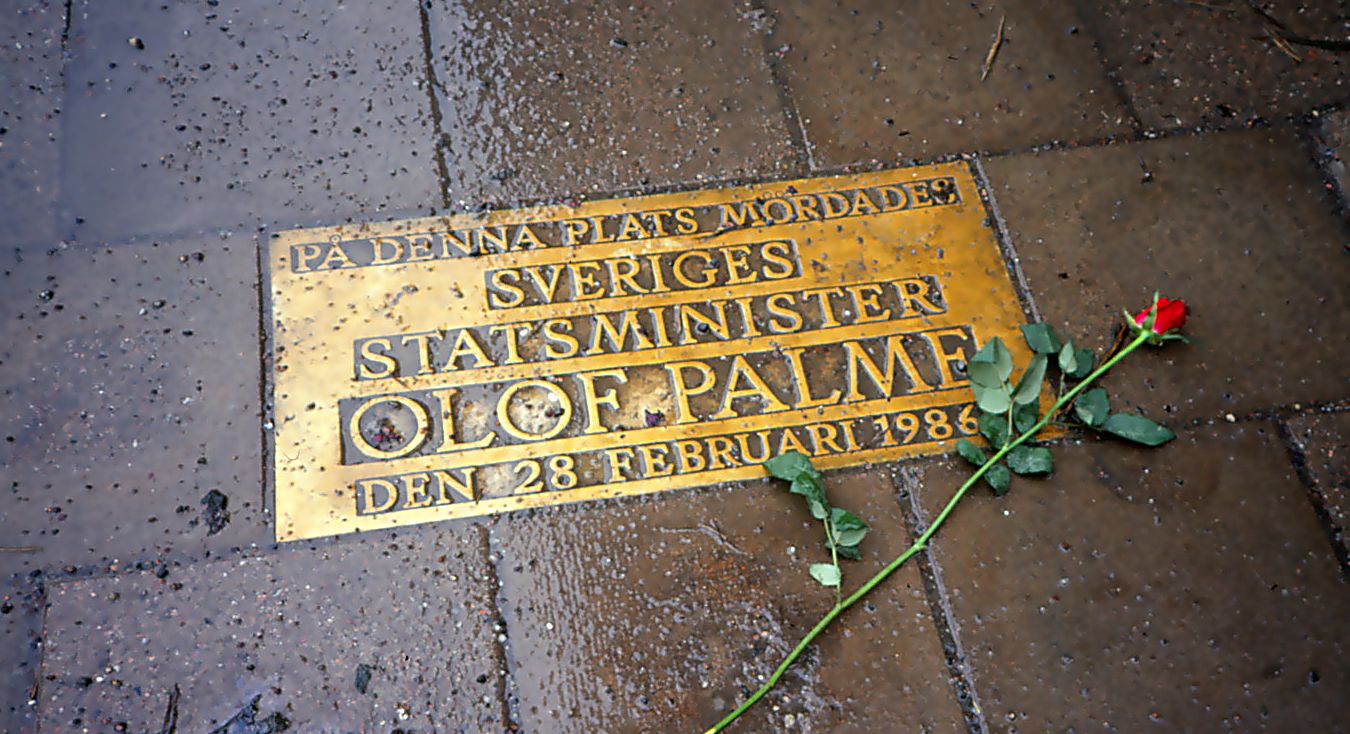
Today, people still walk past the corner of Sveavägen and Tunnelgatan. Some stop at the memorial; others continue through the city. The cinema, the street and the escape route can all be placed on a map.
What cannot be traced with certainty is the person who moved between them that night.
Somebody stood close enough to shoot Sweden’s prime minister. Somebody ran towards the stairs and escaped.
We know where the attack happened and when. We know who died.
We still do not know who pulled the trigger.
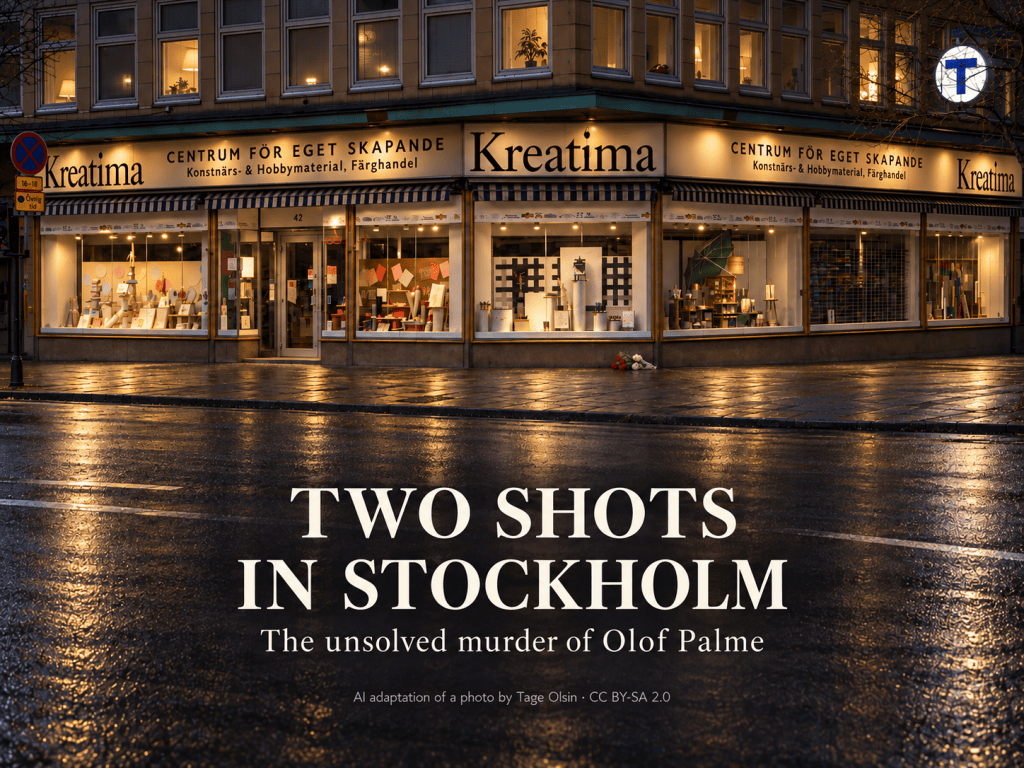
Cover image: AI adaptation of a photograph of the actual Sveavägen–Tunnelgatan murder site by Tage Olsin (2005), CC BY-SA 2.0. Changes: night lighting, removal of pedestrians, added memorial flowers, cropping and title text. Adaptation licensed CC BY-SA 2.0. This is not an archival photograph or an exact reconstruction of the scene in 1986.
Sources: Swedish Police: the Palme investigation; Swedish Prosecution Authority: review decision, 18 December 2025.
More from Dark Stories
If this story stayed with you, explore three more investigations, disappearances and unanswered questions:
- The Yogurt Shop Murders: The Truth Took 34 Years — four teenage victims and a decades-long search for answers in Austin.
- Asha Degree: The Girl Who Walked Into the Night — a child’s disappearance and the questions that remain.
- The Night on Dead Mountain: The Dyatlov Pass Mystery — nine hikers, a freezing night and the evidence behind the mystery.


Leave a comment