A ship passed a lighthouse in December 1900 and saw no light. Eleven days later, the relief vessel reached the island. The lamp was ready. The kitchen was tidy. The three men assigned to keep the light burning had vanished.
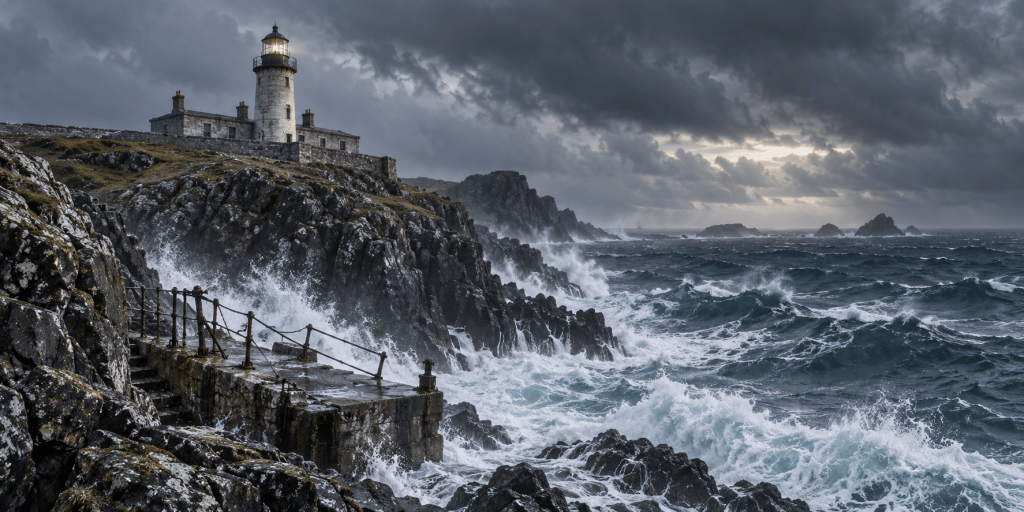
This is a real historical disappearance. The most likely explanation is described below, but nobody witnessed the men’s final moments. The featured image is an AI-generated illustration, not a photograph or a reconstruction of the actual island.
The Flannan Isles lie west of Scotland’s Isle of Lewis. On Eilean Mòr, a lighthouse had been operating for a little over a year when its three keepers disappeared in December 1900. Their names were James Ducat, Thomas Marshall and Donald McArthur. They had a job with no room for mistakes: keep the lamp working, watch the weather and maintain the landing places where supplies arrived.
On 15 December, a passing steamer noted that the light was not burning. The ship reported this when it reached port, but the warning did not reach the lighthouse authorities in time. The men were not discovered missing until the scheduled relief vessel, Hesperus, arrived on 26 December.
There was no welcoming signal. The ship sounded its horn and fired a rocket. No keeper appeared.
Joseph Moore, the relief keeper, was put ashore. He walked up to the station and found it empty. The entrance gate and outer doors were closed. There was no fire. The beds were unoccupied.
Yet the lighthouse did not look as though its keepers had abandoned their work. The lamp had been cleaned and prepared. The lens and machinery were in order. The kitchen was tidy. The contrast was disturbing: the duties had been performed, but the men were gone.
The last trace of an ordinary morning
The surviving records narrow the likely time. The last completed logbook entries were for 13 December. Later weather readings and details through 9 a.m. on 15 December had been written on a slate, ready to be transferred into the log. Work done that morning suggested the men disappeared during the afternoon of the 15th.
There is an important difference between the archive and the legends that followed. An unfinished log is not an account of what the men saw in their final minutes. It gives a limit to the timeline, not a description of the event itself.
Moore noticed that two sets of outdoor clothing were missing. In his report, he identified sea boots and protective clothing associated with Ducat and Marshall. McArthur’s usual coat remained behind. That last detail could suggest haste, but it cannot establish why he followed the others outside.
Was one keeper in trouble and the others trying to help? Did they all go down to secure equipment before the weather worsened? The surviving evidence cannot tell us which step came first.
What the sea left behind
The eastern landing appeared undisturbed. The western side was different. A box for mooring ropes had been washed away. Ropes lay among rocks near the crane. Iron railings were twisted or broken, and a heavy stone had been moved from its position. The sea had reached high above the usual waterline.
Superintendent Robert Muirhead examined the station and the damage. His conclusion was direct: the keepers had probably gone towards the western landing, perhaps to secure gear, and an unexpectedly powerful wave had swept them into the water. The Northern Lighthouse Board still presents that as the likely explanation.
It explains the damaged landing and the outdoor clothes. It also fits the absence of any sign that the men left the island by choice. But it remains an inference from what investigators found afterwards. No witness saw a wave take them. No trace of the three men was recovered.
That is where the mystery survives. The evidence points strongly to a fatal accident at the western landing. It does not let us reconstruct the exact sequence: who went out first, what each man saw, or why all three were exposed at once.
Beyond the legend
The empty lighthouse became a setting for stranger tales. But the archival reports do not need a supernatural explanation to be unsettling. They describe skilled men working on a remote rock, equipment torn apart by the sea and a delay before anyone could reach them.
Moore and volunteers relit the lamp after their arrival. The lighthouse returned to its duty. The families of Ducat, Marshall and McArthur never received a final account of how the three men died.
The sea may have supplied the answer. It left no one who could tell the story.
If you found this historical mystery compelling, please share it. Remember the three keepers behind the legend.
For another disappearance at sea, read The Captain Who Vanished Before Breakfast. For a modern disappearance near the water, see The Man Who Vanished on Muskö.
Research note (23 September 2026): This account draws on the Northern Lighthouse Board’s transcripts of the original reports and National Records of Scotland’s 2026 archival summary. The wave explanation is the investigators’ conclusion, not an eyewitness account.


Leave a comment