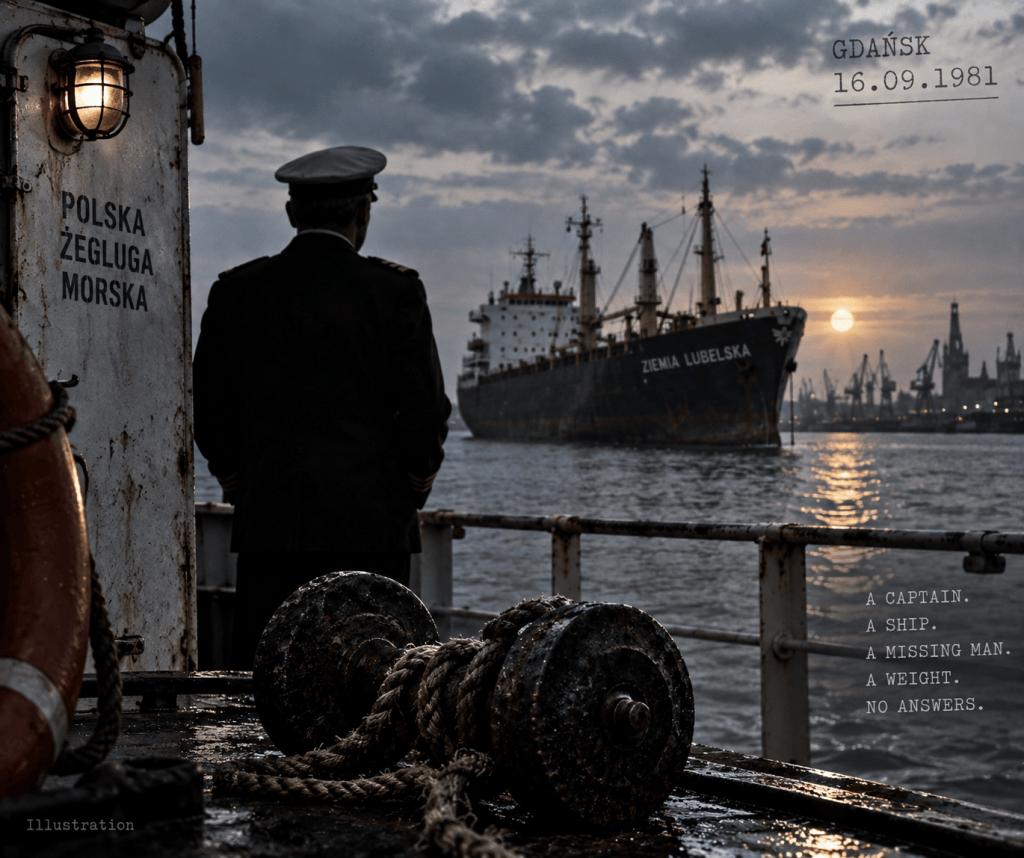
On the morning of September 16, 1981, a Polish cargo ship was waiting outside the port of Gdańsk. Breakfast was served in the officers’ mess. The officers came in as usual.
The captain did not.
At first, there was little reason to panic.
The MS Ziemia Lubelska, a cargo ship belonging to the Polish state shipping company Polska Żegluga Morska, was lying at anchor outside Gdańsk, waiting for permission to enter the harbour.
Its captain, Władysław K., was an experienced seaman.
Perhaps he had overslept. Perhaps he was busy.
But when lunchtime arrived and the captain still had not appeared, the situation became harder to explain.
A search of the ship began.
His cabin was empty.
The decks were searched. The crew checked the places where he might have gone.
There was no sign of him.
The captain of Ziemia Lubelska had apparently disappeared from his own ship.
A strangely clean cabin
The ship’s chief officer informed the shipping company, and the authorities were contacted.
When Ziemia Lubelska finally entered port, officers of the Polish Milicja came aboard.
One detail immediately stood out.
According to the later account of the investigation, the captain’s cabin had been cleaned extremely thoroughly.
Why?
Had someone been trying to remove evidence?
Or was there an innocent explanation?
There was another problem. Nobody seemed to know what had happened.
A man could fall overboard, of course. It had happened many times at sea.
But this ship was not crossing the Atlantic in a storm. It was waiting just outside Gdańsk.
And Władysław K. was not an inexperienced passenger wandering around an unfamiliar deck.
Still, there was no body.
No obvious crime scene.
No suspect.
For more than two weeks, the Baltic kept its secret.
Then, on October 2, 1981, a dock worker near one of the piers at Gdańsk’s Port Północny noticed a body that had been washed ashore.
The police quickly realised this was not an ordinary drowning victim.
It was the missing captain.
And around his neck was a rope.
Attached to it was a heavy exercise weight.
The weight came from his own ship
Investigators established something even more disturbing.
The weight had reportedly come from the exercise room aboard Ziemia Lubelska itself.
In other words, whatever had happened to the captain appeared to have begun on, or at least involved equipment from, his own ship.
Accounts of the case say that no water was found in his lungs and that he had died before entering the sea; the death was described as asphyxiation.
That would seem to point toward murder.
The investigators initially considered homicide.
But there was an extraordinary problem.
Nobody had seen anything.
Crew members said they did not know what had happened. The captain was described as a man who did not create conflicts and was generally liked aboard the ship.
A captain had vanished from a vessel full of people.
A weight from that vessel had apparently ended up tied to his body.
His cabin had been meticulously cleaned.
Yet there was no identified killer and no clear motive.
Then came another possibility
The investigation was also far from perfect.
A later account states that police failed even to question every member of the crew. Investigators apparently did not initially connect the captain’s death with reports of smuggling involving people aboard the ship.
The captain’s wife believed her husband had been murdered.
She also suspected that his death might somehow be connected with smuggling.
But that remained a suspicion — it was never proved.
Then history intervened.
On December 13, 1981, Poland’s communist government imposed martial law.
According to the later account, investigators said that the enormous workload connected with the new security situation slowed the inquiry into the captain’s death.
By the spring of 1982, prosecutors closed the case.
Their conclusion was surprising.
Despite circumstances that appeared deeply suspicious, they said suicide could not be completely excluded. An expert concluded that the length of the rope and the way it had been attached did not make it impossible for the captain to have tied it himself.
His wife appealed.
In August 1982, the higher prosecutor’s office upheld the decision.
The mystery remained.
And he was not the only captain
This is where the story becomes stranger still.
During those years, a disturbing series of unexplained deaths and disappearances affected captains serving aboard Polish merchant ships.
Two captains associated with the ship Jelenia Góra disappeared in separate incidents. After one of those disappearances, investigators uncovered a large smuggling operation involving members of the crew.
In May 1982 — only months after the death of Władysław K. — another Polish captain was found dead aboard MS Kasprowy Wierch while the vessel was anchored near Piraeus in Greece.
He was lying in his bathroom.
A knife was embedded in his chest.
Again, investigators struggled to determine with certainty whether they were dealing with murder or suicide.
Polish maritime journalist Grażyna Murawska eventually began writing about what became known as “Śmierć kapitanów” — “The Death of the Captains.”
There is no proof that all these deaths were connected.
There is no established conspiracy tying them together.
But the case of Ziemia Lubelska remains difficult to forget.
A captain goes to bed aboard his own ship.
By breakfast, he is gone.
His cabin has been carefully cleaned.
Sixteen days later, the sea returns him.
Around his neck is a weight that reportedly came from the very ship on which he disappeared.
And more than four decades later, the simplest question still has no certain answer:
What happened to Captain Władysław K. during the night aboard the Ziemia Lubelska?
If this story intrigued you, share it with someone who enjoys true mysteries. Perhaps somewhere among former Polish sailors, their families, or their memories, there is still a piece of this story that has never been told.
 Dark Stories
Leave a comment