He was supposed to be travelling to northern Norway. Instead, his car was found on a Swedish island. His belongings were still inside. What happened between his departure and the discovery of that car would become a mystery stretching across two countries.
On 30 November 2021, Terje Johansen left his home south of Oslo. He had told people close to him that he was travelling to northern Norway to complete a house purchase. His route would take him through Sweden.
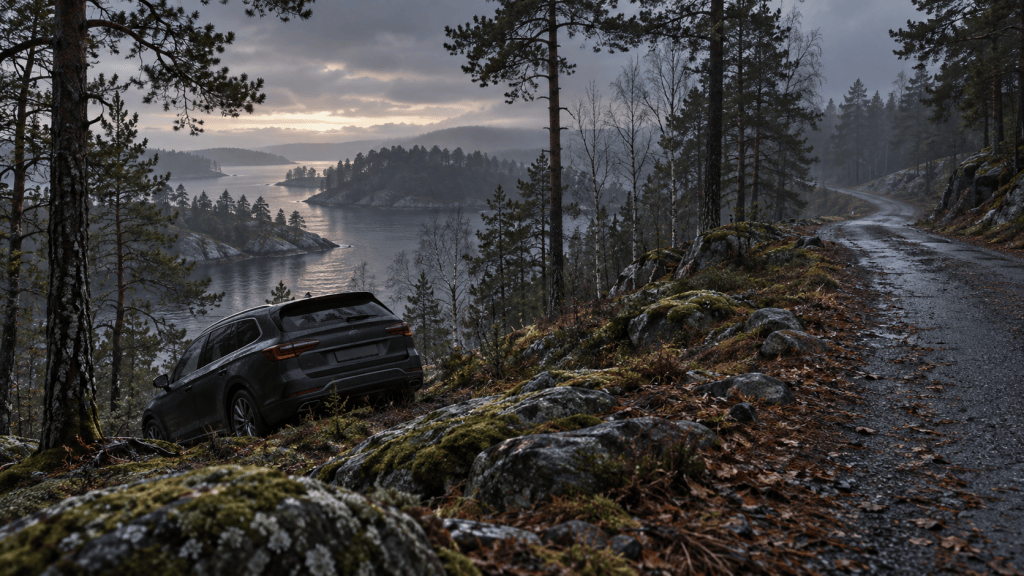
But the journey took him towards Stockholm, and eventually to Muskö, an island in the Stockholm archipelago. His car was later found off the road, down a slope in an area called Kanada.
Terje was nowhere to be found. Musköbladet’s account of the disappearance.
For his friend Helge Martin Haugan, the route was only the beginning of what made the disappearance so difficult to understand.
During a telephone conversation on the journey, Terje had said he was heading to northern Norway, although he was already in the Stockholm area. There was also the tunnel leading to Muskö. According to Helge Martin, Terje disliked driving through tunnels and avoided them whenever he could.
Yet this journey had taken him through one.
His friend also struggled to accept what reportedly happened next: Terje’s car had rammed a locked road barrier. He remembered a practical, resourceful man who cared about his vehicle and carried tools. Why would he damage it to get through?
These were a friend’s observations, but they made the final journey feel increasingly unfamiliar. Aftonbladet’s interview with Helge Martin.
There had been an encounter on the island.
On the evening of 1 December, a guard at Muskö naval base reported speaking to Terje. According to the guard’s account, he was alone in the car and behaved normally. Aftonbladet’s account of the last reported encounter.
Then there was the barrier itself.
Investigators learned that someone had tried entering a code at the entrance to Kanada. Police wanted to compare the attempted numbers with the correct code. Perhaps Terje had been given access instructions and recorded them incorrectly.
It was a possibility worth checking. A code could suggest a destination, and a destination might explain why he had come so far out of his way. Investigators also planned further examination of his phone, hoping to find an address entered into its navigation system.
The question was becoming more precise: had Terje been trying to reach somewhere in particular? SVT’s report on the code and navigation enquiries.
The abandoned car offered more details, without supplying an explanation.
Its rear number plate had been found away from the vehicle. A tree had been sawn down behind it. Police believed Terje himself might have cut the tree, but the reason remained unclear in the reporting. Aftonbladet’s account of the scene.
Inside were his wallet, mobile phone, computer and luggage. The cash he was believed to have brought was missing. Early police information quoted by SVT put the amount at at least 12,000 Norwegian kroner.
The missing money raised questions, but it could not establish what had happened to its owner.
By late December, the case had reached the serious-crime investigators in Stockholm, working with Norwegian police. Interviews with relatives and friends, together with examinations of his devices, had revealed no connection that explained his presence there. Investigators said they had found no communication with anyone in Sweden.
They could trace the journey to an abandoned car. They still could not explain its purpose. SVT’s initial investigation report.
Searches brought another tantalising development. In September 2022, a volunteer handler’s cadaver dog reportedly alerted within roughly 300 metres of the car’s location. Police later searched with their own dogs, which did not reproduce the alert.
The indication offered a place to look. It did not confirm that Terje was there. Aftonbladet’s report on the dog searches.
In 2023, attention turned again to the water.
Missing People planned to use an underwater robot, but the Swedish military refused permission because the equipment could record sensitive seabed information near the naval base. Police had previously been allowed to use sonar; the armed forces explained that police could handle classified information differently from a voluntary organisation.
For the volunteers, it meant an area they wanted to examine remained unfinished. SVT’s July 2023 report on the underwater search.
Then, in June 2024, Terje’s relatives and friends came to Muskö to search for themselves.
More than 900 days had passed. His niece, Janne Amundsen, told SVT how difficult it was to live without knowing what had happened. Despite the searches, Terje was still missing. SVT’s report on the family’s visit.
The details invite us to reconstruct those last movements: a conversation, an attempted code, a damaged barrier, a car beyond the road. Each seems close enough to the next to promise an answer.
Yet the most basic question reaches back before all of them.
What brought Terje Johansen to Muskö?
If you found this story compelling, please share it. Help keep Terje’s story from being forgotten.
Research note: Sources checked on 17 September 2026. The latest substantive news follow-up located was SVT’s June 2024 report. No confirmed resolution was found during this research.
 Dark Stories
Leave a comment