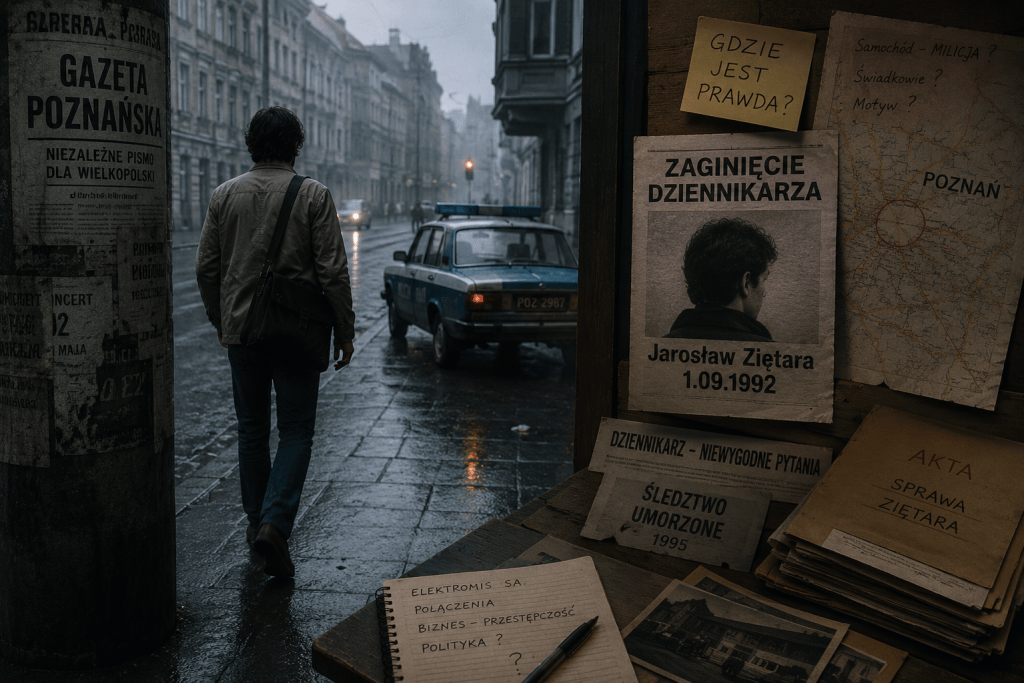
This article describes a real disappearance and presumed murder. The account is based on official prosecution statements, court proceedings and reputable reporting. Some aspects of the case remain disputed or unresolved. AI-generated images are used for illustration and are not authentic photographs or evidence from the investigation.
On the morning of 1 September 1992, twenty-four-year-old journalist Jarosław Ziętara left his apartment on Kolejowa Street in Poznań.
He was expected at the offices of Gazeta Poznańska.
He never arrived.
No confirmed sighting of him was reported afterwards. His body has never been found, and no final judgment has established exactly who killed him or where his remains were hidden.
Polish prosecutors believe Ziętara was abducted and murdered because his reporting had brought him dangerously close to powerful business and criminal interests.
A Young Investigative Reporter
Ziętara was born in Bydgoszcz in 1968 and later studied at Adam Mickiewicz University in Poznań.
He began working in journalism while still a student. He gained experience in university radio and contributed to several publications, including Gazeta Wyborcza, Kurier Codzienny and the weekly magazine Wprost.
At the beginning of 1992, he joined Gazeta Poznańska.
His subjects included politics, economic scandals and the shadowy area where legitimate business met smuggling, corruption and organised crime.
He was young, but he was not inexperienced.
Colleagues remembered an ambitious reporter who treated journalism as more than an occupation. He wanted to uncover how the new fortunes of post-communist Poland were being created—and who was benefiting from activities conducted beyond, or just inside, the law.
The Last Morning
The official prosecution theory is precise but remains an allegation awaiting final resolution in court.
According to prosecutors, Ziętara was intercepted while walking from his home to work. Two men allegedly posed as police officers and persuaded or forced him into a vehicle resembling a police car.
The prosecution says he was then handed over to other people who killed him, destroyed his body and concealed the remains.
The two men accused of participating in the abduction denied the charges. No final conviction has yet confirmed the prosecution’s reconstruction.
The apparent use of a police-style vehicle made the disappearance especially disturbing.
A young journalist walking through his own city would have had little reason to run from men who appeared to represent the law.
If the prosecution is correct, the trap succeeded because it looked official.
What Was He Investigating?
Ziętara did not leave behind a single completed article that clearly explains why someone might have wanted him dead.
That uncertainty became one of the case’s central problems.
Prosecutors say his professional interests included economic scandals in which the worlds of business, crime and politics overlapped. They believe people feared he would publicly reveal illegal—or legally questionable—activities.
The two men accused of helping abduct him had worked as security employees for the Poznań-based Elektromis holding company, whose activities had attracted Ziętara’s journalistic interest.
That connection became an important part of the prosecution’s case.
But it still does not answer the most important question:
What exactly had Ziętara discovered?
Perhaps he had identified a specific criminal operation.
Perhaps he had learned who protected it.
Perhaps he was preparing an article that never reached an editor.
Or perhaps several people feared what he might discover next.
The Lost Years
The early investigation failed to produce a clear answer.
Police initially considered the possibility that Ziętara had disappeared voluntarily or died by suicide. A criminal investigation began in 1993 but was discontinued in 1995.
It was reopened briefly in 1998 and dropped again in 1999.
That year, Ziętara was legally declared dead, although his body had not been recovered.
His family, colleagues and other journalists continued pressing authorities to treat the disappearance as a crime connected to his reporting.
In 2011, prosecutors reopened the case and eventually classified it as a murder investigation.
Nearly two decades had already passed.
Memories had faded. Potential evidence had disappeared. Some people connected to the case had died.
Every lost year made the truth harder to recover.
A Murder Without a Body
Investigators have never publicly identified a confirmed murder location.
They have never recovered Ziętara’s remains.
They have not conclusively established how he died.
In 2018, the National Prosecutor’s Office said a separate investigation was continuing into the direct killers, the location of the hidden remains and their possible identification.
That investigation was distinct from the case against the men accused of helping with the abduction.
A body can reveal the weapon, the time of death and traces left by the killer.
Here, investigators had none of those things.
They had testimony, relationships, possible motives and a reconstruction of events—but no final physical proof showing what happened after Ziętara entered the vehicle.
Trials, Acquittals and Doubt
Two former security employees, identified publicly as Mirosław R. and Dariusz L., were charged with abducting Ziętara, imprisoning him and assisting in his murder.
Their trial began in 2019.
In October 2022, the court acquitted them, finding serious problems in the witness evidence, including inconsistencies and contradictions.
The prosecution appealed.
A separate case concerned a former senator and businessman accused of encouraging the killing. He was acquitted, and that acquittal became final when an appeals court upheld it in January 2024.
That judgment means the allegation against him was not proven.
Then, on 3 December 2025, the Poznań Court of Appeal overturned the acquittal of Mirosław R. and Dariusz L.
According to the Committee to Protect Journalists, the appeals court concluded that the evidence was sufficient to justify a conviction and ordered a new trial. The court also stressed the prosecution’s claim that Ziętara had been targeted because of his reporting.
However, the decision did not itself create a final conviction. The defendants remain entitled to a new judicial examination of the evidence.
The Investigation Continues
On 25 May 2026, a court ordered prosecutors to gather additional evidence before the retrial.
That work was to include reviewing archives and files connected to the former state security services.
As of June 2026, no new hearing dates had been announced.
Prosecutors also said a separate investigation remained open into those who may have ordered the killing, including possible connections involving organised crime, political figures and former security-service personnel. These are investigative directions, not proven conclusions.
More than three decades after Ziętara disappeared, the legal process is therefore still moving.
Slowly.
And without the one discovery that could transform the case: his remains.
The Questions That Remain
Who first decided that Jarosław Ziętara had become dangerous?
Who arranged the vehicle?
Who killed him?
Where was his body taken?
Which investigation—or unpublished article—caused someone to act?
And did any person with official influence help conceal the crime?
The prosecution has offered a broad explanation: Ziętara was murdered because of his journalism.
But the full chain of responsibility has never been established in a final judgment.
The difference matters.
A theory can explain why a crime may have happened.
Only evidence can establish who committed it.
The Reporter Who Never Returned
Ziętara has been commemorated in Poznań and was posthumously awarded the Knight’s Cross of the Order of Polonia Restituta in 2022 for his contribution to independent journalism.
An investigative-journalism award now bears his name.
But memorials cannot answer the questions left by his disappearance.
On 1 September 1992, Jarosław Ziętara left home expecting an ordinary working day.
Somewhere between his apartment and the newsroom, his life was interrupted.
His notes disappeared.
His body disappeared.
And for more than thirty years, the complete truth has remained just beyond the reach of investigators.
Sources
- National Prosecutor’s Office of Poland: indictment concerning the murder of Jarosław Ziętara
- Committee to Protect Journalists: Jarosław Ziętara case profile
- Committee to Protect Journalists: renewed prosecution and retrial developments, June 2026
- Polish Press Agency: reporting on Ziętara’s disappearance and court proceedings
- City of Poznań: biographical information on Jarosław Ziętara
More Unsolved True-Crime Stories
If the disappearance of Jarosław Ziętara intrigued you, continue with these unresolved cases:
The Isdal Woman: The Stranger Who Died Without a Name
An unidentified woman, false names, coded travel notes—and a death that still has no clear explanation.
D.B. Cooper: The Hijacker Who Vanished into the Night
A hijacker collected a ransom, jumped from an aircraft and disappeared without a confirmed trace.
Jack the Ripper: The Killer Who Vanished into Whitechapel
Five women were murdered in Victorian London, but the killer was never identified.
Discover more true-crime mysteries and dark fictional stories at Dark Stories
 Dark Stories
Responses
[…] The Journalist Who Left for Work—and Never ArrivedA Polish investigative reporter vanished on his way to work, leaving behind a murder investigation that continues decades later. […]
LikeLike
[…] The Journalist Who Left for Work—and Never Arrived […]
LikeLike
[…] The Journalist Who Left for Work—and Never Arrived […]
LikeLike