An Axe, a Letter from “Hell”—and a Murderer Who Was Never Found
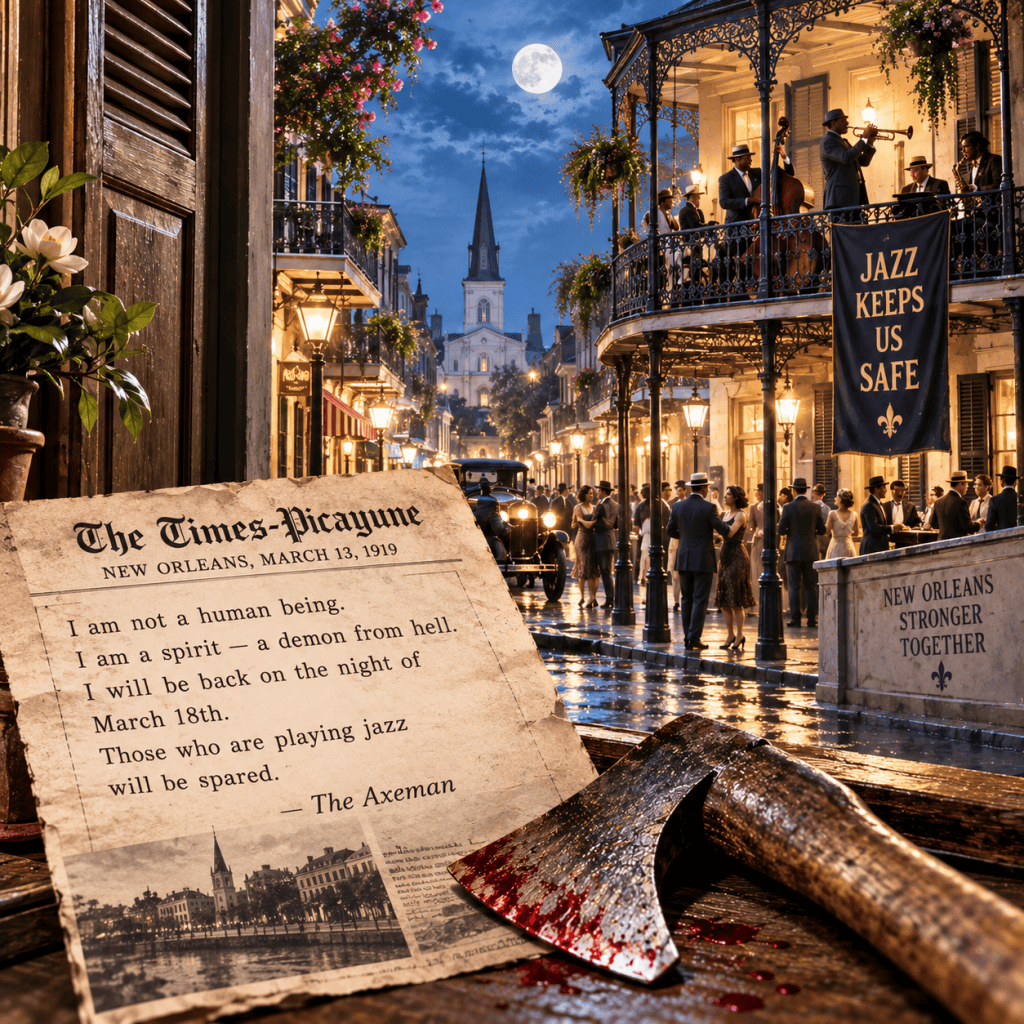
This article describes a real series of unsolved attacks in New Orleans. The killer’s identity was never established. A famous letter attributed to the murderer contained supernatural claims, but there is no evidence that anything paranormal occurred—or even certainty that the killer wrote the letter. AI-generated images may be used for illustration and are not authentic photographs or evidence.
In the spring of 1918, families in New Orleans began locking their doors differently.
Not because of war.
Not because of ordinary thieves.
Someone was entering homes while people slept.
The intruder usually did not bring a weapon.
He did not need to.
He used the family’s own axe.
And when he disappeared before sunrise, valuables were often left untouched.
Police had no name for him.
Newspapers eventually did.
The Axeman.
A Bedroom in the Dark
On May 23, 1918, Italian grocer Joseph Maggio and his wife Catherine were sleeping above their shop.
During the night, someone entered.
The attacker had removed part of a door panel to gain access.
Joseph and Catherine were assaulted in their bed with terrible violence. Both died.
The weapon belonged to the household.
It was found nearby.
Money had not been the obvious motive.
Police searched the neighbourhood.
They questioned suspects.
Nothing led to the killer.
Then another household was attacked.
And another.
The Same Strange Method
A pattern developed.
Many victims were Italian immigrants or Italian-American grocers living with their families above or behind small shops.
The intruder entered at night.
A door panel might be cut or removed.
The family’s own axe or hatchet became the weapon.
Some victims died.
Others survived with terrible injuries.
New Orleans began to understand something frightening:
This was not simply a burglar surprised inside someone’s home.
Someone appeared to be coming specifically to attack people while they slept.
And he kept getting away.
A City Starts Listening
During the months that followed, fear spread.
People stayed awake at night.
Families armed themselves.
Neighbours listened for sounds outside.
Every creak of wood could be a footstep.
Every noise behind a door could mean someone was cutting through it.
Police made arrests, but no suspect could be conclusively connected to the series.
Then, in March 1919, the case became stranger than anything the newspapers could have invented.
A letter arrived.
“I Am Not a Human Being”
On March 13, a New Orleans newspaper published a message purportedly written by the Axeman.
The writer mocked the police.
He claimed they would never catch him.
Then he made an extraordinary declaration.
He described himself not as an ordinary murderer but as a spirit or demon associated with hell.
Whether the actual attacker wrote the letter has never been proven.
But whoever wrote it knew exactly how to terrify the city.
The letter announced that the Axeman would return shortly after midnight on the night of March 18–19.
Then came the condition.
One type of house would be spared.
A house in which jazz was being played.
The Choice
Imagine receiving that newspaper in 1919.
A murderer has already entered bedrooms at night.
Police have failed to catch him.
Now someone claiming to be the killer says he will strike again.
And he offers one bizarre way to survive:
Play jazz.
Ignore the message and perhaps nothing happens.
Or perhaps your house becomes the one silent building on the street.
New Orleans made its decision.
They played.
The Night of Jazz
As midnight approached, music poured into the streets.
Dance halls filled.
Professional musicians performed.
Amateur bands played in private homes.
People who had no band reportedly used whatever instruments they could find.
Jazz drifted from house after house through the warm Louisiana night.
It must have been one of the strangest evenings in the city’s history.
People were playing music because they were frightened to stop.
And then midnight came.
12:15.
The time mentioned in the letter passed.
No Axeman appeared.
No murder attributed to him occurred that night.
The letter’s promise had apparently been kept.
But that raised an even stranger question.
Had the killer really been listening?
Or Was the Letter a Trick?
There is another possibility.
The letter may never have come from the murderer at all.
Historian Miriam Davis, who studied original police and newspaper records, has questioned parts of the mythology surrounding the Axeman. Some researchers have suggested the famous letter might have been a hoax—perhaps even publicity connected somehow with the city’s music scene.
A jazz song about the Axeman was published during the panic.
And what better advertisement for jazz could there possibly be than:
Play it—or die?
But there is no proof of that theory either.
The Child
Only days before the famous jazz night, another attack had demonstrated that the danger was very real.
On March 9, 1919, Charlie and Rosie Cortimiglia were attacked in their home in nearby Gretna.
Their two-year-old daughter Mary was killed.
Authorities initially pursued neighbours after Rosie implicated them.
But the evidence was deeply problematic, and she later withdrew the accusation.
The Axeman mystery remained exactly where it had begun.
With no reliable identity.
Then He Disappeared
Attacks associated with the Axeman continued during 1919.
Then they stopped.
No dramatic arrest.
No body discovered with a confession.
No prisoner admitting responsibility.
The attacker simply vanished from the history of New Orleans.
Historian Miriam Davis has argued, based on police and newspaper records, that similar attacks may have continued elsewhere in Louisiana after the New Orleans crimes. But linking every such murder to one person remains uncertain.
And that uncertainty matters.
Over the decades, legend and fact have become tangled together.
What we know is disturbing enough.
Someone attacked families in their homes.
Several people died.
The murderer was never conclusively identified.
And during the height of the panic, a letter appeared claiming that its author was something more than human.
The Quiet House
Perhaps the strangest way to imagine that night in March 1919 is not to picture the houses filled with music.
Picture instead one house where the music suddenly stopped.
A record ends.
The room becomes quiet.
Outside, jazz can still be heard from neighbouring streets.
Someone walks to the window.
There is nobody there.
Then comes a sound from the back door.
Wood scraping against metal.
Was the famous letter simply a cruel joke?
Did the murderer write it because he enjoyed controlling an entire city?
Or was the person behind the Axeman legend somebody investigators never seriously suspected?
More than a century later, we still do not know.
But for one extraordinary night in 1919, New Orleans behaved as though the warning were true.
And until morning came…
the city kept playing.
What Do You Think?
Was the mysterious letter really written by the Axeman?
Was the killer deliberately targeting Italian families—or was the apparent pattern more complicated?
And most intriguing of all:
Why did the attacks eventually stop?
The Axeman was never conclusively identified.
Share the Mystery
Would you have played jazz that night? Share this story with someone who loves mysteries that sound like fiction—but really happened.
More true mysteries and dark stories at Dark Stories.
Sources
The attacks and their historical context have been reconstructed from contemporary newspapers, police records and later historical research. Smithsonian’s account by historian Miriam Davis emphasizes that several popular details of the Axeman legend are uncertain, while contemporary reporting confirms the extraordinary public reaction to the purported killer’s jazz ultimatum.
 Dark Stories
Leave a comment