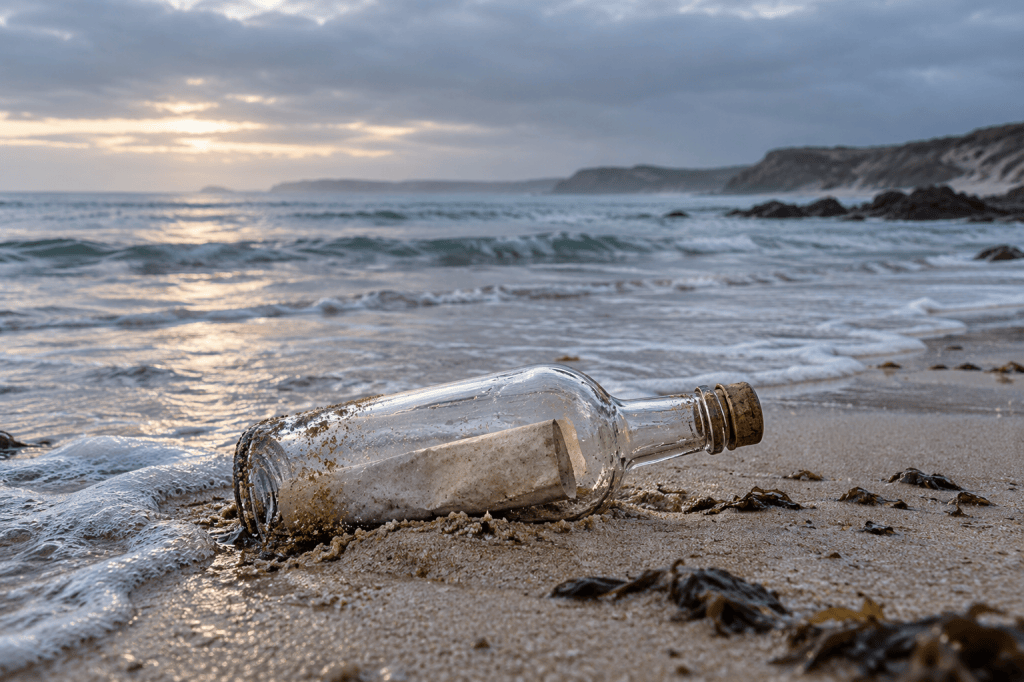
On New Year’s Eve in 2007, Sheryl found a bottle on a remote beach near Eucla, Western Australia. Inside was a sailor’s invitation: find this message, and claim a sailing holiday in the Whitsundays. The young man who wrote it expected a stranger to get in touch. By the time someone did, he had been missing for nineteen years.
His name was John. He was 23. He had vanished with three other people aboard Patanela, a steel schooner whose last radio calls placed her off Sydney. The bottle would bring his family something they had almost stopped expecting: a new piece of their son’s life. It would bring no answer about his death.
Before the silence
John and Michael, 21, were helping deliver Patanela to Queensland, where the yacht was intended to operate as a charter vessel. For them, the voyage held the promise of work and more sailing. Michael wrote to his twin sister, Sue, describing a full moon, wind and the movement of the sea. The letter was dated 26 October 1988.
He also had plans for Christmas: a visit to John’s family in Taree, then back to the boat. In a postscript, he mentioned the message they had put in a bottle. These were ordinary plans, written down while there was still a future to arrange. Sue would never see her brother again.
The delivery skipper was Ken. His wife, Noreen, was aboard too. After others left the voyage along the way, these four remained. Patanela had sailed from Fremantle in October. The NSW Police record places her departure from Portland, Victoria, on 1 November, bound for Airlie Beach.
This was no flimsy pleasure craft. Patanela was a substantial steel schooner, approximately 19 metres long. Decades earlier, she had carried an expedition to remote Heard Island in the Southern Ocean. That history would later make her disappearance seem even harder to accept. Strength, however, cannot tell us what happened on a particular night.
A voice off Sydney
In the early hours of 8 November, Ken contacted Sydney coastal radio. He believed the yacht had run out of fuel. He placed her roughly ten miles east of Botany Bay and said they were sailing. His plan was to tack offshore and return towards Sydney; assistance might be needed in the morning.
The exchange did not sound like a vessel in immediate danger. According to the radio operator’s later account, Ken sounded calm. There was no clear announcement that the yacht was sinking, no description of people abandoning ship.
Then the conversation grew strange. In a later call, Ken asked about Moruya, a town well south of Sydney. Why was that location relevant to a yacht heading north towards Queensland? Another transmission, around two in the morning, was broken by interference and included a puzzled reference to being hundreds of kilometres south.
Fragments are unsettling because they invite completion. A wrong position? A misunderstanding over the radio? Someone trying to work out where they were? The recordings leave questions. They do not establish what was happening on deck. After that, no confirmed communication explained the fate of Patanela or the people aboard.
The search that came too late
Nine’s later investigation reported that a search was not launched until eleven days after the final calls. By then, any debris could have travelled far from the last reported position. A search area drawn around a radio call is only as useful as the position and timing behind it.
Months later, a barnacle-covered lifebuoy marked with the yacht’s name was found near Terrigal, north of Sydney. It was a physical connection to the missing vessel. It was not a wreck site, a survivor’s account or a record of the last minutes. No confirmed discovery of the hull has explained the disappearance.
The Australian Federal Police investigated under Operation Lilac. Its official history describes a three-year inquiry and says the inquest concluded that the vessel sank and the crew perished. The same history calls the disappearance unexplained. An official conclusion that people died is not the same as knowing how they died.
Collision, or something else?
A collision with a larger commercial vessel became a leading explanation. A sudden impact could help explain why an apparently routine radio exchange was followed by silence. Reporting on the 1992 inquest describes an open finding; the former coroner later regarded a collision as the most likely cause. No particular collision has been proved.
Hijacking theories have also circulated. They offer a more dramatic explanation for a strong vessel disappearing without a confirmed wreck. But suspicion is not evidence that someone seized the yacht. Nor does the absence of a wreck establish that she stayed afloat. The evidence available to the public does not justify assigning guilt to a person aboard or inventing a final confrontation.
The handwriting
When the bottle was finally opened, its faded message described a holiday waiting in a place the crew never reached. Sheryl followed the trail back to the missing yacht and contacted John’s family in January 2008. His mother, Marj, recognised the handwriting.
She described it as “a little piece of John we never had”. The note was cheerful, an invitation from a young man enjoying the voyage. It had been written before the disappearance, not as a distress message. It could not reveal what changed off Sydney.
For the families, the mystery was never merely an intriguing ship without a wreck. It was John’s promised return, Michael’s Christmas plans, and Ken and Noreen’s journey ending somewhere beyond the last intelligible words. The bottle preserved a moment when those lives were still moving forward. The people themselves never came home.
More from Lost at Sea: Kaz II: The Last Film Before They Vanished · Joyita: Twenty-Five People, No Answers
Sources
NSW Police missing-person record; Australian Federal Police, The First Thirty Years, p. 93; Nine, Under Investigation (2023); MySailing/Pedestrian, final voyage account (2018); PerthNow, bottle and family interviews (2008); The Sydney Morning Herald, family feature (2008); ABC, Heard Island expedition history (2024).
Cover: AI-generated editorial illustration of a message in a bottle. This is not a photograph of the recovered Patanela bottle or its note.


Leave a Reply