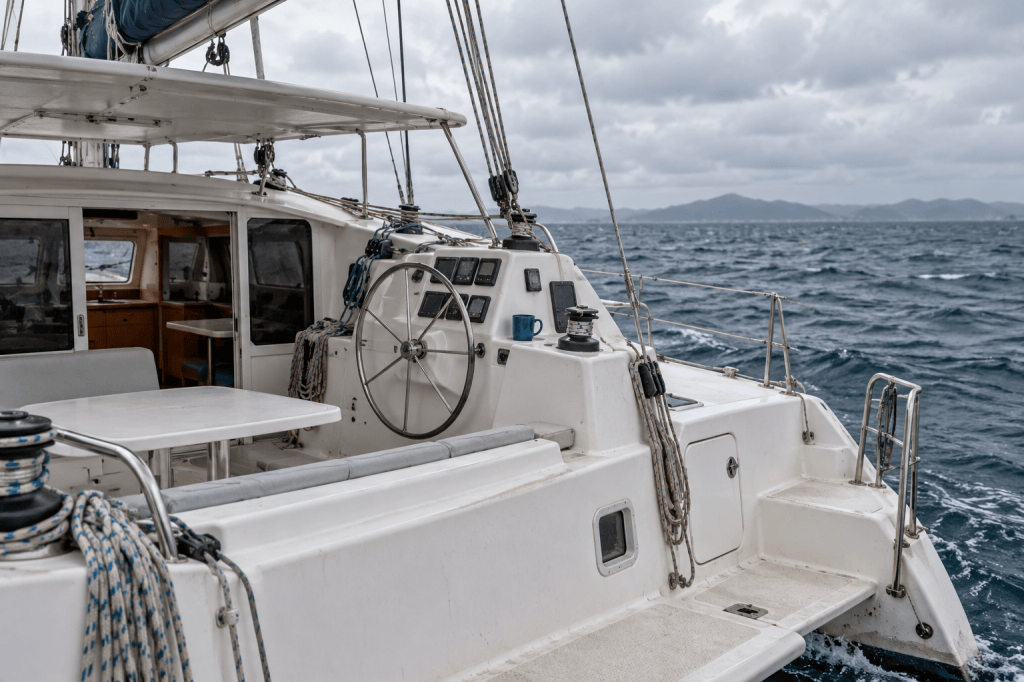
The camera recorded an ordinary morning at sea. Days later, rescuers found the boat, the camera and a half-full coffee cup. The three men were gone.
Cover image: AI-generated editorial illustration, not a photograph of Kaz II.
Peter Tunstead’s daughter Donna knew the sort of man her father was. He planned things. He took safety seriously. He had worked in a marine radio room and would scold her for going crabbing without logging the journey.
When he disappeared, those memories became reasons to keep believing. This was a father who would do everything he could to get home to his wife and daughters.
But the boat came back without him.
Three men, a long way home
On 15 April 2007, Kaz II left Airlie Beach in Queensland. Aboard were her owner, Derek “Des” Batten, his neighbour and close friend Peter Tunstead, and Peter’s brother James, known as Jim.
They were heading towards home in Western Australia, by a long route around the north of the continent. Townsville was to be an early stop. They expected the whole adventure to take six to eight weeks.
Des’s wife Jennifer later told the inquest that the preparations had taken ten weeks. She and Des had already made two trouble-free outings aboard the catamaran. This voyage had been discussed, plotted and anticipated.
The previous owner had met the men the evening before departure and helped plan part of their route. He would later describe the vessel as sound when he sold her.
All those preparations survive in the evidence. What happened after the men sailed does not survive with the same clarity.
The last film
There was a video recorder aboard. The men used it that morning, leaving behind something more intimate than a navigation record: images of their own journey while they were still making it.
At about 10:05 a.m., they were sailing near George Point. Des was at the helm with a blue coffee mug. Peter was fishing. Jim was filming.
Nothing in that glimpse provides the ending. The camera did not record a final explanation. It preserved the morning before it became a mystery.
In 2008, that footage was played in the Townsville courtroom where the men’s wives and children had come for the inquest. Investigators studied the land visible behind them to help establish where the boat had been.
The families had travelled across Australia to hear evidence about men they loved. On the screen were moments from the journey those men had expected to finish.
The boat with nobody to answer
On 18 April, Kaz II was spotted drifting off north Queensland with no one visible aboard. On 20 April, rescue officer Corrie Benson was lowered onto her.
He found the engine running. There were clothes, a fishing rod and a half-full coffee cup. Three beds looked as though they had been slept in.
These were signs of people living aboard a small boat. They offered no account of where those people had gone.
It is tempting to turn every object into a frozen last moment. But a cup left behind does not tell us when it was put down. An engine still running cannot tell us who last touched its controls.
Benson initially wondered about a scuffle after seeing an empty alcohol bottle. At the inquest, he said he had discounted that explanation. The difference between a first impression and a tested conclusion matters in a case like this.
The comparison with Mary Celeste was irresistible: another vessel found without the people who had sailed her. But Kaz II carried a modern cruelty. Her missing men had left moving images of themselves behind.
A brother goes overboard
Queensland State Coroner Michael Barnes delivered his findings in August 2008. He concluded that all three men had died, probably by drowning. He could not establish every step that led to their deaths.
A fishing lure had become caught around the port rudder. His reconstruction suggested that Jim or Peter might have fallen into the water while trying to free it. The other brother could then have gone to help.
That would have left Des alone aboard, trying to recover two men while managing a boat under sail. A swinging boom, Barnes suggested, could have knocked him overboard too.
This was a reconstruction, not an eyewitness account. Nobody survived to confirm who entered the water first or what the others did next.
If the reconstruction was right, it turns the apparent impossibility into a sequence of human emergencies. One man in trouble. Another trying to reach him. A third attempting to bring the boat back.
The boat could move beyond their reach in seconds. Being close enough to see it would not necessarily mean being able to catch it.
As in Joyita, recovering the vessel did not recover the people. What remained afloat could tell investigators only so much.
“They don’t know him”
Before the inquest, the families had kept searching after the official effort was called off. Peter’s wife Fran challenged the assumption that his age meant he could not survive. He had undergone medical checks before leaving.
“They don’t know him,” she told ABC.
Donna spoke about his careful planning and his love for their mother. Her confidence came from knowing her father, rather than from anything investigators could measure aboard the empty boat.
The eventual findings offered Jennifer some help with the unanswered questions. They also rejected the idea that the men had secretly abandoned their families. Barnes found no evidence of a third party causing their disappearance.
There is a likely explanation for Kaz II. There is still no surviving witness to its final moments.
For the families, the mystery concerned a husband, a father, a brother. Somewhere between the last film and the empty cockpit, an ordinary voyage had become a loss from which nobody came home.
The camera returned. The men who had taken it to sea did not.
If this story stayed with you, share it with someone interested in the human lives behind maritime mysteries.


Leave a Reply