In February 1893, a new White Star steamship left Liverpool for New York with seventy-four people aboard. She never arrived. Weeks later, two empty lifeboats were reported in the Atlantic. Then messages began washing ashore—messages that seemed to explain everything, until investigators looked at the names.
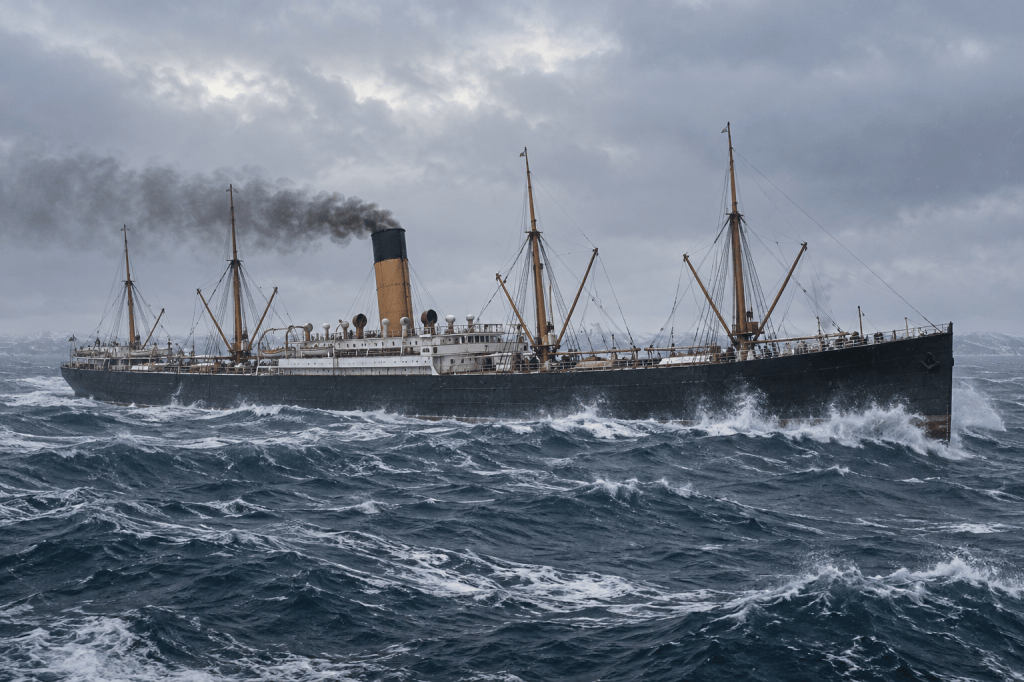
Cover image: AI-generated historical reconstruction inspired by Naronic’s documented design. It is not an archival photograph or a depiction of a known event during her final voyage.
The Ship That Should Have Returned
On 11 February 1893, Naronic sailed from Liverpool under Captain William Roberts. Her destination was New York. After the harbour pilot went ashore at Point Lynas, off the Welsh coast, the ship continued towards the Atlantic.
It was the last confirmed sighting of her.
Naronic belonged to the White Star Line, the company later remembered for Titanic. But this was nineteen years before that disaster. She was a working ship, built for cargo and the transatlantic cattle trade, rather than grand staircases and fashionable dinners.
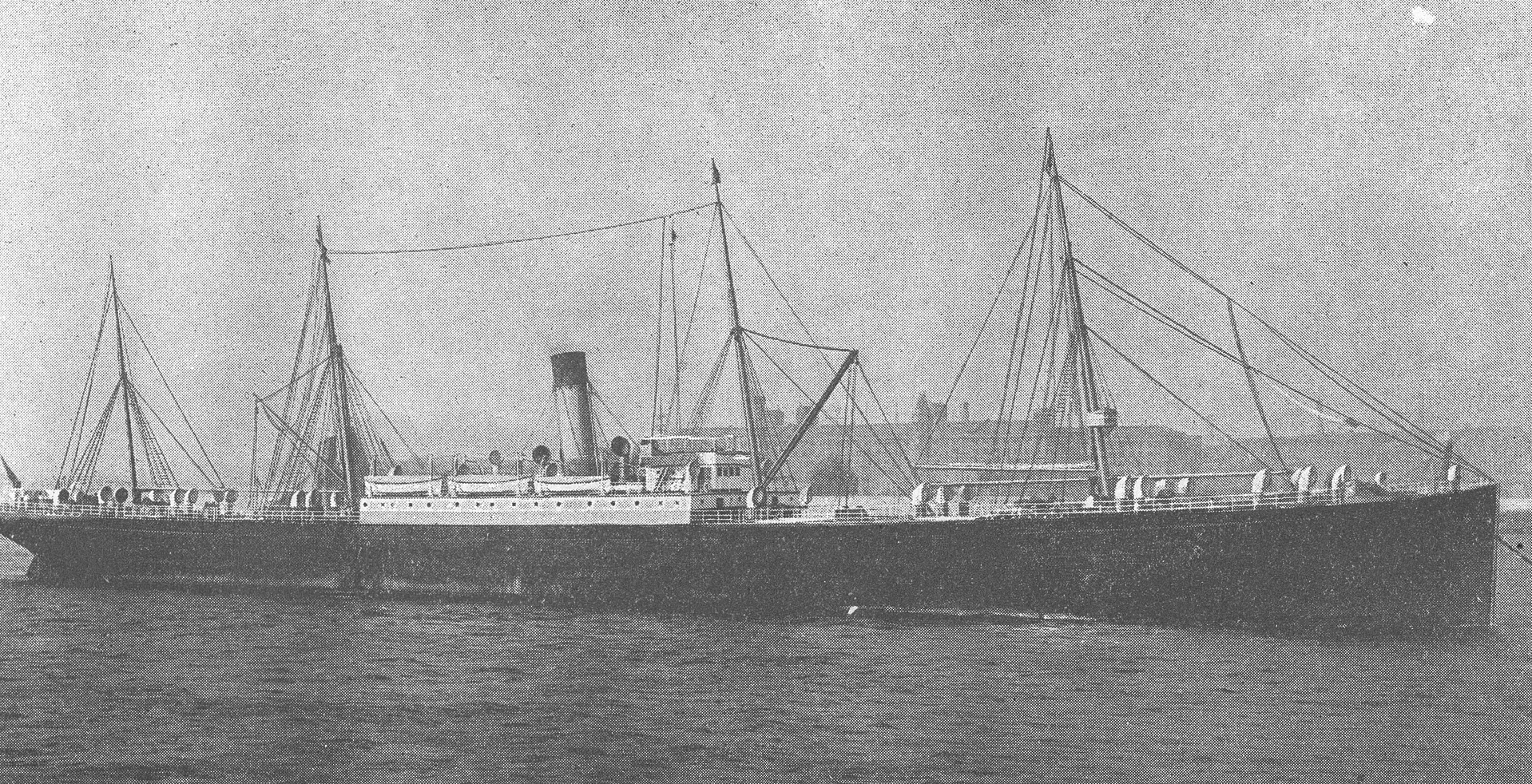
Launched in Belfast in 1892, she was still less than a year old. A long steel hull, four cargo masts and a single funnel made her an impressive addition to the company’s fleet. She had already crossed the ocean successfully. There was every reason to expect another arrival.
That is how a disappearance begins: with an expectation so ordinary that nobody thinks to question it.
The Waiting
There was no radio aboard Naronic. If an engine failed far offshore, the company could not telephone the bridge. If water entered the holds, the captain could not send a wireless distress call. Those waiting on land would learn only what another ship happened to see.
At first, a late arrival could still have an innocent explanation. Winter weather slowed other steamers. Ships reaching port reported gales, heavy seas and snow. Perhaps Naronic was making little headway. Perhaps mechanical trouble had left her drifting.
The uncertainty allowed hope to survive. A delay was not yet a death sentence.
Then Bovic arrived in New York. She was Naronic’s sister ship, built to much the same design, and had left Liverpool six days later. Other overdue vessels reached safety too. None brought a reliable sighting of the missing steamer.
A sister ship had completed the crossing. Naronic had not.
The question was no longer merely when she would arrive. It was whether she could arrive at all.
Two Boats in an Empty Ocean
In early March, the British steamer Coventry encountered two lifeboats in the North Atlantic. The reports associated them with Naronic. One was overturned. The other was upright and empty, with its mast and sail trailing in the water as though arranged to slow its drift.
There was no one inside to explain what had happened.
An empty lifeboat seems, at first, to bring a story closer to an answer. It is something solid where there had been only an absence. But these boats opened questions that nobody could close.
Had the men launched them? Had the boats been torn away by the sea? If people had escaped the steamer, how long had they survived? Were there other boats beyond Coventry’s horizon?
The sightings could not establish the sequence. They could not tell investigators where the ship had gone down, or even exactly when.
For families waiting for news, the difference mattered terribly. A missing ship might still be afloat. A boat might still carry someone. Each possibility was small, but none was easy to surrender.
The Voices in the Bottles
Then came the messages. Bottles found on shore carried notes claiming to have been written aboard the doomed ship. Some described an iceberg, a snowstorm and a vessel sinking while the writer watched the time.
Here, apparently, was the missing final scene. An explanation. A human voice reaching land after the person who wrote it could no longer speak.
But a dramatic message is not necessarily a genuine one.
The names attached to the notes did not match the ship’s crew list. Their authenticity was challenged, and the inquiry did not accept them as reliable evidence. They are generally regarded as hoaxes. They cannot establish an iceberg collision or the hour of the loss.
It is a familiar cruelty in maritime mysteries. In Carroll A. Deering: The Ship That Came Back Empty, a fabricated bottle message also offered a false explanation for missing sailors. A clue can become part of the legend long after it has failed as evidence.
For Naronic, the bottles supplied the words that the real men had never been able to send. Those words were easier to remember than the silence.
A Court Without Witnesses
The Board of Trade held an inquiry in Liverpool in June 1893. Investigators examined the ship’s design, loading and operation. Bovic underwent a stability test, giving them a way to study a vessel closely resembling the one they could no longer inspect.
The investigation did not establish why Naronic had been lost.
A severe storm remains a possible explanation. An encounter with ice has often been suggested. Other theories involve a failure aboard the ship. None provides a proved account of her last hours.
This is where a responsible telling must stop short of the scene a reader most wants: the first alarm, the captain’s decision, the last person on deck. There are no surviving witnesses to supply it. Inventing those moments would make the story more complete and less true.
The uncertainty resembles SS Waratah: The Liner That Never Came Home. There too, an expected arrival became a disappearance, leaving theories without a confirmed wreck to test them against.
The Last Unanswered Question
Naronic’s wreck has never been positively located. No survivor returned to describe the loss. The seventy-four people aboard never came home.
Their story contains no famous rescue, no final photograph of the disaster, no recovered logbook that closes the gap between departure and death.
What remains is a small collection of facts surrounded by a very large ocean.
A ship leaves Liverpool. A pilot steps ashore. Weeks pass. Another ship finds empty boats. On land, strangers read messages that cannot be trusted.
And somewhere beyond the last confirmed sighting, seventy-four lives reach an ending that nobody on shore is ever able to reconstruct.
The Atlantic returned the boats. It kept the answer.
If this story stayed with you, share it with someone interested in maritime mysteries. Subscribe to Dark Stories for more true accounts of ships and people lost at sea.
Sources and image credit
Naronic Archive: ship history and disappearance; White Star History: SS Naronic; Encyclopedia Titanica: When Animals Travelled First Class; SS Naronic: overview and historical bibliography. No dialogue or final sinking scene has been invented. The bottled messages are presented as disputed material, not authenticated testimony.


Leave a Reply