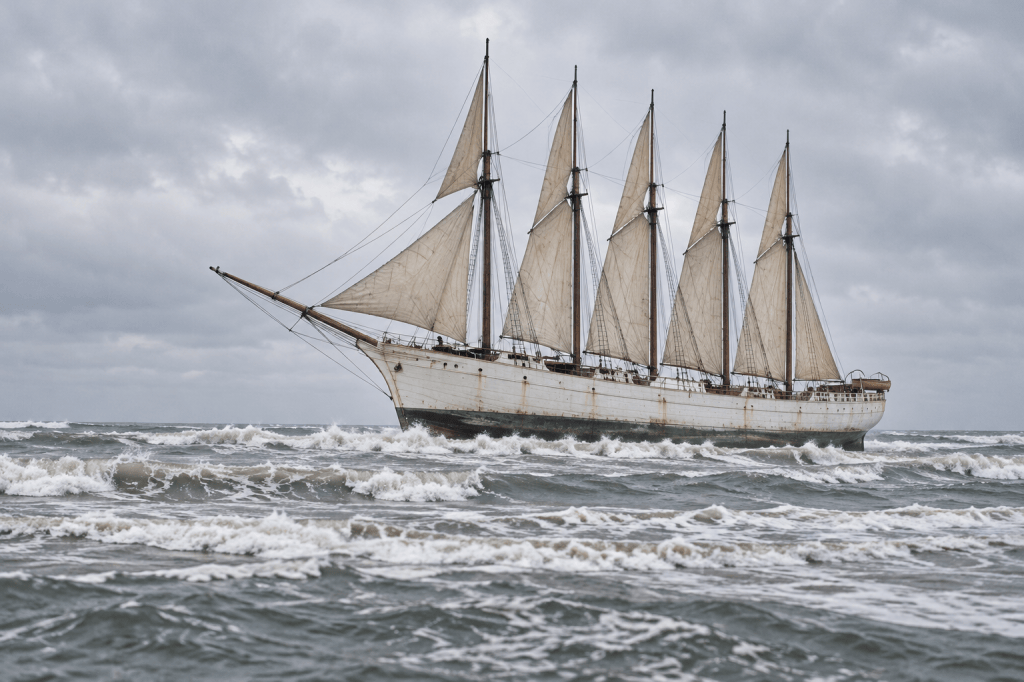
In January 1921, a five-masted schooner came ashore off North Carolina with her sails still set. The ship was there. Her crew was not. More than a century later, nobody has established what happened to them.
Featured image: AI-generated historical illustration, not an archival photograph.
A Ship in the Breaking Water
At about half past six on the morning of January 31, 1921, Coast Guardsman C. P. Brady spotted a large sailing ship on Diamond Shoals, off Cape Hatteras.
This was a dangerous place to find her. The shoals lie beneath moving water, waiting for ships that come too close. Around the stranded vessel, the Atlantic was breaking into white surf.
Her sails remained set. Water washed across her decks. Her boats were missing.
Rescuers tried to reach her, but the sea kept them away. For days, she remained beyond their reach. From shore, there was no way to know whether anyone was still alive inside.
The Last Voyage
The vessel was the Carroll A. Deering, built in Bath, Maine, in 1919. She was a wooden merchant schooner, with five tall masts and a long hull made to carry cargo across the Atlantic.
Her voyage had taken her to Brazil with a cargo of coal. Now she was coming home, sailing north after a stop in Barbados. Captain Willis B. Wormell had taken command after her original captain became ill.
There were later reports of tension between Wormell and his first mate. Such accounts would attract enormous attention once the ship was found. But an unhappy crew is not proof of a mutiny, and an argument cannot tell us what happened out of sight at sea.
For the families waiting at home, this should have been another voyage with an ending: a familiar face walking down a gangway, a letter, a knock at the door.
Instead, the ship returned without them.
A Voice Across the Water
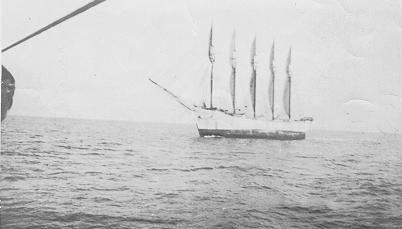
Shortly before the wreck was discovered, the schooner passed the Cape Lookout lightship, a vessel stationed offshore to guide other ships.
A man aboard the Deering called across the water. He reported that the ship had lost her anchors and asked that the owners be informed.
Something about the encounter seemed unusual to the lightship keeper. The man making the request did not appear to be an officer. Other crewmen were visible aboard.
The exchange would later be examined for clues. Was command already slipping away from the captain? Or was a sailor simply passing on a message from a ship that had suffered storm damage?
No one watching from the lightship could know that this ordinary request would become one of the last reported contacts with the people aboard.
The Empty Rooms
On February 4, conditions finally allowed men to board. Captain James Carlson of the wrecking tug Rescue confirmed the ship’s identity.
No crew remained.
The logbook and navigation equipment were missing. So were personal belongings and the ship’s small boats. Food had been prepared for a meal, but the people who should have eaten it were gone.
That detail is haunting without adding anything to it. There is no need to imagine steaming plates or a clock stopped at the exact moment of disaster. The record gives us something simpler: preparations for ordinary life, interrupted.
The missing boats suggested that the men had left the schooner. They did not explain when they left, who ordered it, or whether everyone went willingly.
Had they abandoned her before she grounded? Or had the breaking water driven them from her decks afterward?
The Message That Lied
In April, a man named Christopher Columbus Gray produced a message that he claimed to have found in a bottle. It described the schooner being captured and its crew held prisoner.
For a moment, the silence seemed to have broken. Perhaps someone had survived. Perhaps there was a trail to follow.
But the message was a hoax. Investigators established that Gray had fabricated it.
A false clue can be crueler than no clue at all. It gives a family something to hold, then takes it away.
Five Departments, No Answer
The disappearance drew a federal investigation involving five government departments. Herbert Hoover, then secretary of commerce, assigned his assistant Lawrence Richey to investigate.
Officials considered piracy, mutiny and other explanations. Rumors of organized political attacks on ships added another layer of suspicion. None established the crew’s fate.
There was also a terrible, ordinary possibility: shipwreck followed by an unsuccessful escape. Coast Guard captain R. L. Gaskill argued that the men might have taken to their boats after grounding, only to be overwhelmed by the sea.
Imagine trying to lower a small boat beside a stranded schooner, with waves throwing it against the hull. That is an imagined reconstruction of the danger, not a witnessed account of the crew’s final minutes.
The boats were never found. Neither were the men.
What the Sea Left Behind
The wreck eventually broke up. Salvage workers removed what they could, and parts were destroyed to reduce the hazard to other vessels.
The mystery outlasted the ship. Later retellings drew it into Bermuda Triangle folklore, but a legend cannot replace missing evidence.
We know where the schooner ended. We do not know where her people did.
Somewhere between the last voice calling across the water and the first rescuers stepping aboard, a whole crew disappeared from the record.
The ship came back. The explanation never did.
If this mystery stayed with you, share it with someone who loves stories of the sea. Subscribe to Dark Stories for the next unexplained disappearance.
Sources
National Park Service: The Ghost Ship · National Archives: The Wreck of the Carroll A. Deering · Library of Congress: The Mysterious Disappearance of the Crew · North Carolina DNCR: Carroll A. Deering, Ghost Ship · Dare County: Maritime history.


Leave a Reply