Two explosions tore through the submarine. Deep below the Barents Sea, 23 men were still alive. One of them took out a piece of paper and began to write.
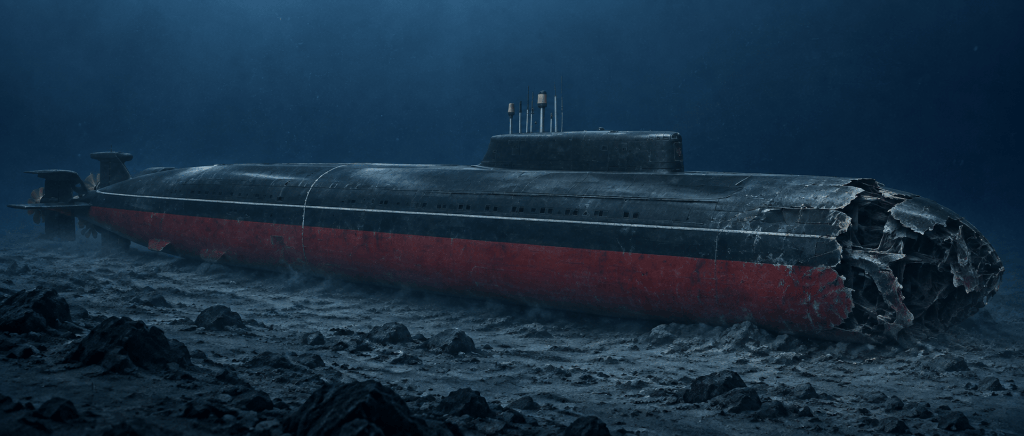
AI-generated editorial illustration based on a photograph of a Kursk museum model. The scene is not a historical photograph or an exact reconstruction.
On 12 August 2000, the Russian nuclear submarine Kursk was taking part in a naval exercise. There were 118 men aboard.
The first explosion struck the bow. A little more than two minutes later came a second, much more powerful blast. The forward compartments were devastated. The submarine settled on the seabed, about 108 metres below the surface.
For most of the crew, the explosions were fatal. But at the stern of the shattered vessel, men were moving through the darkness.
The last compartment
Twenty-three survivors gathered in compartment nine. Among them was Lieutenant Captain Dmitry Kolesnikov. At 1:15 p.m., he wrote down their situation and the names of men who had reached the stern. They had survived the blasts. They had not found a way out.
Above them, the Russian navy was still trying to locate and reach Kursk. Rescue craft later made repeated attempts to connect to its escape hatch, without success. Foreign help was offered, but several days passed before British and Norwegian specialists were allowed to join the operation.
On land, the families waited. Officials gave changing accounts. Was anyone alive inside? How long could the air last? There was no answer that the men below could hear.
Kolesnikov wrote again, this time in darkness. His words would not reach the surface until months later.
The hatch opens
On 21 August, Norwegian divers opened the aft escape hatch. The compartment was flooded. There were no survivors.
For a time, it was possible to imagine that the explosions had killed everyone immediately. Then, during the recovery of the dead in October, divers found Kolesnikov’s note. It established that at least 23 men had lived on after Kursk sank. They had been able to gather, assess their situation and leave a record.
The official investigation concluded that a leak in a torpedo caused the first explosion and ignited the chain of events that destroyed the bow. Early claims about a collision with a foreign submarine had fuelled speculation, but that was not the investigation’s conclusion.
The more painful question remains unanswered: could a faster rescue have reached the men in compartment nine? The delays are documented. Exactly how long the sailors remained alive, and whether a different response could have saved them, cannot be established with certainty.
Kolesnikov did not know who would read his note, or when. He wrote it anyway. In the end, that small piece of paper brought the last survivors’ voices to the surface.
What stays with you most about the fate of the men in compartment nine? Share their story, and remember the crew behind the name Kursk.
For another disaster at sea whose final moments raised painful questions, read Athenian Venture: The Tanker That Burned for Weeks.
Sources and image credit
- Norwegian Radiation Protection Authority — The Kursk Accident
- RFE/RL — Note from Kursk sailor revealed
- Wired — Why Kursk Died (2002 investigation)
- Reference image: photograph of a model of K-141 Kursk at the Estonian Maritime Museum, by Pjotr Mahhonin, CC BY 4.0. The article image is an AI-generated editorial illustration based on the museum model; it is not a historical photograph or an exact reconstruction of the wreck.


Leave a comment