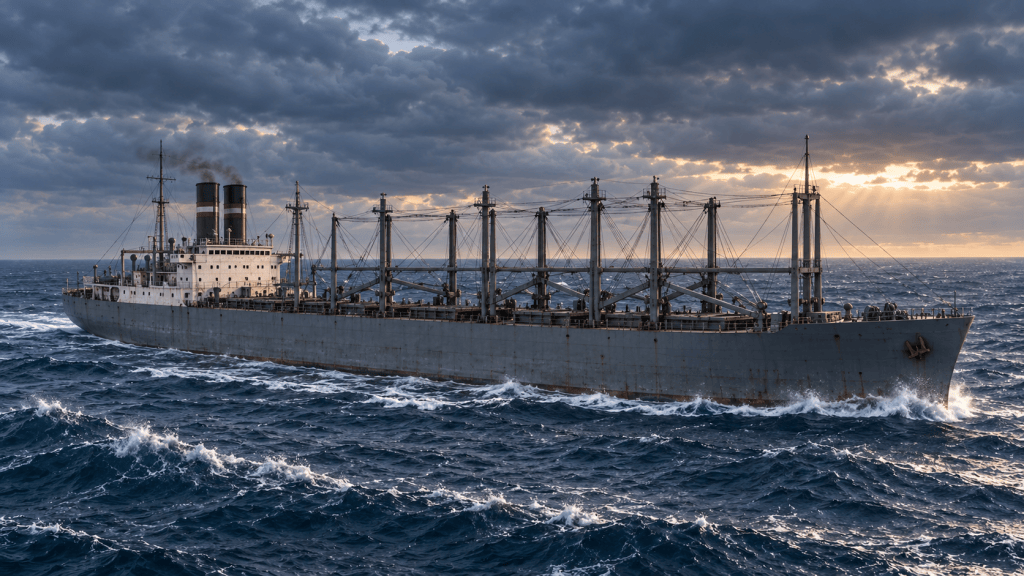
A 165-metre naval ship left Barbados with more than 300 people aboard. No distress call followed. No lifeboat, body or confirmed piece of wreckage was ever recovered. Somewhere between the last port and Baltimore, USS Cyclops simply disappeared.
Editorial note: This article concerns a real maritime disaster. Established facts are separated from later theories. The featured image is an AI-generated editorial reconstruction based on archival U.S. Navy photographs of USS Cyclops; it is not an authentic photograph of the final voyage or evidence of what happened.
On 4 March 1918, USS Cyclops sailed from Barbados and turned north towards Baltimore.
She was enormous for her time: a long, steel U.S. Navy collier built to carry coal and supplies. Her deck was crowded with cargo booms and rigging. Two black funnels rose above the forward superstructure. Below deck lay roughly 11,000 tons of manganese ore, a dense material needed for wartime steel production.
Official Navy accounts place 306 crew members and passengers aboard, although totals vary in later sources.
Not one of them was seen again.
The Final Voyage
The United States had entered the First World War less than a year earlier. Cyclops had carried coal to Brazil and was returning with manganese ore bound for the American war industry.
The voyage was troubled before the ship entered the open Atlantic.
A cracked cylinder had reportedly disabled one of her engines. She was heavily loaded, and concern about her condition followed her from Brazil. After leaving Salvador on 22 February, she made an unscheduled stop at Barbados.
Yet there was no report that the ship was sinking, no order to unload the cargo and no final warning to the people aboard. After inspections and discussions in port, Cyclops continued towards Baltimore.
She left Barbados on 4 March.
Then the wireless went silent.
The Day She Did Not Arrive
The ship was expected in Baltimore around 13 March.
The date passed.
At first, wartime secrecy complicated the response. A large American vessel had vanished during a conflict in which German submarines operated across the Atlantic. Perhaps Cyclops had been attacked. Perhaps she was disabled and drifting. Perhaps a coded message had been missed.
Ships searched the route. Ports checked their records. The Navy waited for wreckage or survivors.
Nothing appeared.
There had been no SOS. No lifeboat reached shore. No identifiable debris was recovered. Post-war examination of German records found no submarine or raider that claimed to have sunk her.
The sea had taken an immense ship without leaving a confirmed trace.
A Cargo Heavier Than Coal
The most persuasive explanation begins inside the cargo holds.
Cyclops was designed primarily as a collier. Manganese ore was far denser than coal. A concentrated load could place severe stress on the centre of the hull, especially if the ore shifted or absorbed water.
The Naval History and Heritage Command considers a combination of the ship’s design and her heavy ore cargo the most likely cause. A structural failure could have happened rapidly, perhaps breaking the hull or producing a fatal list before a distress signal could be transmitted.
The damaged engine would have reduced the captain’s options if the ship encountered heavy seas.
But this remains a reconstruction, not a proven sequence. No wreck has been found to show whether plates failed, cargo shifted or machinery stopped.
The Enemy Theory
Because the disappearance occurred during wartime, suspicion quickly turned towards Germany.
Some wondered whether a U-boat had torpedoed the ship. Others suggested sabotage, capture or betrayal involving the German-born commanding officer, Lieutenant Commander George Worley.
The rumours grew partly because the loss seemed too complete to be accidental.
Yet the evidence did not support an enemy attack. German naval records examined after the war contained no account of sinking Cyclops, and no wreckage showed signs of an explosion or torpedo strike.
Suspicion filled the silence, but it did not solve the case.
Three Sister Ships
The mystery became stranger with time.
Cyclops belonged to a class of four similar colliers. One sister, USS Jupiter, survived and was later converted into the aircraft carrier USS Langley.
The other two—Proteus and Nereus—entered commercial service. Both vanished in the Atlantic in 1941 while carrying heavy metallic ore.
Three related ships disappearing without confirmed wreckage invited supernatural explanations. It also strengthened a colder engineering question: were these vessels vulnerable when dense ore concentrated forces in their long hulls?
No single investigation proved that structural failure destroyed all three. The pattern is unsettling, but it is not proof.
The Bermuda Triangle Came Later
Decades after the loss, Cyclops was absorbed into the legend of the Bermuda Triangle.
The label made the story famous. It also blurred the difference between mystery and magic.
There is no evidence of a supernatural force, a magnetic anomaly or an impossible wave. The ship had known mechanical trouble, a demanding cargo and a design that may have been placed under extreme stress. Those ordinary hazards are more convincing than the later mythology.
They are not, however, a final answer.
Somewhere Below
More than a century has passed since Cyclops left Barbados.
Modern sonar has found countless wrecks once considered lost forever, but no discovery has been confirmed as the missing collier. Her exact route after 4 March is uncertain, and the western Atlantic offers an enormous search area.
If the ship failed suddenly in deep water, she may have reached the seabed largely intact—or in two pieces—before anyone on shore knew she was in danger.
The final minutes remain invisible.
Perhaps the crew heard steel tearing through the centre of the ship. Perhaps the heavy cargo shifted and the deck began to tilt. Perhaps one functioning engine fought uselessly against wind and sea.
Or perhaps the accepted theory is wrong.
All that survives is the departure, the silence and a list of more than 300 names.
What Do You Think?
Did USS Cyclops break apart under the combined strain of dense ore and heavy seas?
Did engine trouble and shifting cargo cause her to capsize before a distress call could be sent?
Or does the Atlantic still conceal a different explanation?
Share the story—and remember the people behind a mystery too often reduced to the words “Bermuda Triangle.”
More Maritime Mysteries from Dark Stories
- Berge Istra and Berge Vanga: Two Giants Lost at Sea
- Athenian Venture: The Tanker That Burned for Weeks
Sources
- Naval History and Heritage Command — H-016-4: World War I—USS Cyclops and Her Sisters
- Naval History and Heritage Command — Lost With All Hands
- National Archives, The Unwritten Record — The Mysterious Disappearance of the USS Cyclops (AC-4)
- U.S. Naval Institute — USS Cyclops: The Deadliest Unsolved Mystery in the Navy


Leave a comment