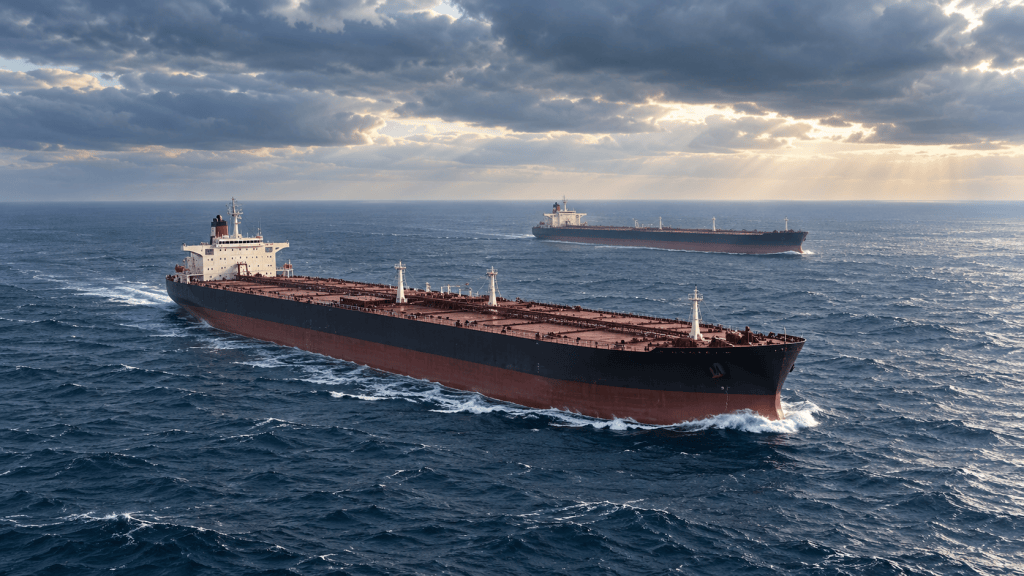
First one giant ship vanished. Four years later, its sister disappeared too. Of 72 people aboard the two vessels, only two survived. What happened in the minutes before they sank?
AI-generated editorial illustration. The vessels and sea conditions are symbolic, not evidence of either sinking.
On 30 December 1975, Berge Istra was crossing the Pacific south of the Philippines with iron ore bound for Japan. There was no distress call. The Norwegian-owned ship, registered in Liberia, simply stopped answering. It was more than 300 metres long. It should not have been easy to lose.
For weeks, families waited. Then, on 18 January, a Japanese fishing boat found two Spanish sailors alive on a raft. They had drifted for about 20 days. Their account ended the mystery of whether the ship had sunk, but opened a darker question: they described violent explosions and a ship that went down within minutes. Thirty shipmates were dead.
A second disappearance
On 29 October 1979, Berge Vanga disappeared in the South Atlantic while also carrying iron ore from Brazil to Japan. It was a sister ship built for the same company. Debris was later reported, but no member of its 40-person crew survived to describe the final moments.
These were not ordinary oil tankers on their last voyages. They were OBO carriers—ships designed to carry oil, bulk cargo or iron ore on different trips. The arrangement made commercial sense: a vessel could carry ore one way and oil on another route. It also meant spaces previously used for oil had to be made safe when carrying ore. Oil residue could leave flammable vapour behind.
Three explanations, very different evidence
Explosion and ship design. The two survivors’ testimony makes an explosion aboard Berge Istra far more than a guess. Store norske leksikon says explosions involving tanks previously used for oil are the presumed cause of the losses. Later accounts by former shipping personnel raised concerns about gas measurement, the inert-gas system and a design that might have allowed an explosion to spread. Exactly where the first ignition occurred remains disputed, and nobody survived Berge Vanga to confirm that it followed the same sequence.
An exceptional wave or structural failure. A large wave can damage a ship, and a structural weakness can make an accident worse. But there is no documented rogue wave at either sinking. For Berge Istra, the survivors’ report of explosions is stronger direct evidence than the wave theory. Design questions deserve attention, but a wave should not be promoted to a proven cause.
Insurance fraud after the oil crisis. The tanker market slumped after the 1973 oil shock; contemporary industry accounts describe a sharp fall in freight rates. Secrecy around the Liberian inquiry and the size of the insurance settlement prompted press speculation. That is not evidence that anyone deliberately sank these ships. The two vessels were carrying paying cargo, and 70 sailors died. No credible source reviewed for this story establishes an insurance-fraud scheme. An accusation of murder demands evidence that the record does not provide.
The closed proceedings and unanswered technical questions helped the rumours survive. They also obscured something more useful than a conspiracy: whether better gas control, safer work practices or changes to the ships’ design could have saved lives.
Berge Istra and Berge Vanga disappeared in 1975 and 1979, before the 1980s. The enduring story is not that the sea swallowed two identical mysteries. One ship left two witnesses; the other left none. Between those two records lie 70 people who never came home.
What do you think the evidence most strongly supports? Share the story, and keep the crew in mind when discussing the theories.
For another disaster at sea with an uncertain final sequence, read Athenian Venture: The Tanker That Burned for Weeks.


Leave a comment