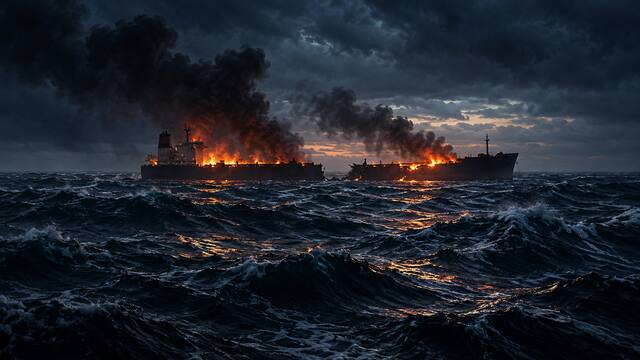
In April 1988, a tanker carrying gasoline was found split in two in the North Atlantic. Twenty-nine people were lost. The fire lasted for weeks—and the exact sequence of events was never established.
AI-generated editorial illustration. Not a historical photograph or evidence from the disaster.
At about 2 a.m. on April 22, 1988, the Canadian research vessel Hudson came upon a glow in the North Atlantic. It was the Athenian Venture: not one intact tanker, but two burning sections, lying about two miles apart.
The Hudson had found the wreck roughly 400 miles southeast of Cape Race, Newfoundland. The tanker had been sailing from Amsterdam to New York with approximately 250,000 barrels of unleaded gasoline on board.
The ship had a Polish history. Built in 1974 for the Polish Steamship Company, it once sailed as the Karkonosze. By 1988 it flew the Cyprus flag, but its crew remained Polish. A memorial account by the Maritime University of Szczecin records 24 crew members and five wives travelling as passengers. All 29 people aboard were lost.
The last signal
Contemporary reporting said the Athenian Venture’s last radio message had arrived on Thursday afternoon. By the time the Hudson reached the scene, the ship had broken apart and was burning. The first reports offered no explanation for what had happened.
One body was recovered, with the ship’s log. Coast Guard officials studied the record for clues, but the public account never established the precise chain of events. No other person aboard was found.
An explosion, but no settled sequence
NOAA’s incident record describes an apparently violent explosion as the tanker broke in two and burned. That description captures what rescuers encountered; it does not prove which event came first. Early Coast Guard reporting said the cause was unknown.
At a memorial ceremony twenty years later, a Szczecin account described a storm, the ship breaking apart, and an explosion in its cargo. Yet the same university page noted that the exact course of the disaster—and why it happened—had never been determined. The storm-and-explosion sequence is part of the memorial account, not a confirmed technical finding.
The fire kept burning
The bow section sank that afternoon. The stern remained afloat and burning for weeks before it finally sank on June 17, about 200 miles from the Azores. NOAA records that the aft section stayed at sea for roughly seven weeks.
The families left behind
The families on shore lived with a different kind of aftermath. At the Szczecin memorial, organizers recalled 43 children left without parents, including 12 who had lost both. The figure comes from a memorial speech, but it gives a measure of the loss that a casualty count cannot.
The record leaves us with a few stark facts: a final radio message, a tanker found in two pieces, one recovered body, and a fire that continued long after the search began. Between those facts is the part no source can settle—the exact final sequence aboard the Athenian Venture.
What do you make of the conflicting accounts? Read the sources below and share your thoughts respectfully. If this story deserves to be remembered, pass it on.
For another carefully researched case, read The Yogurt Shop Murders: The Truth Took 34 Years.


Leave a comment