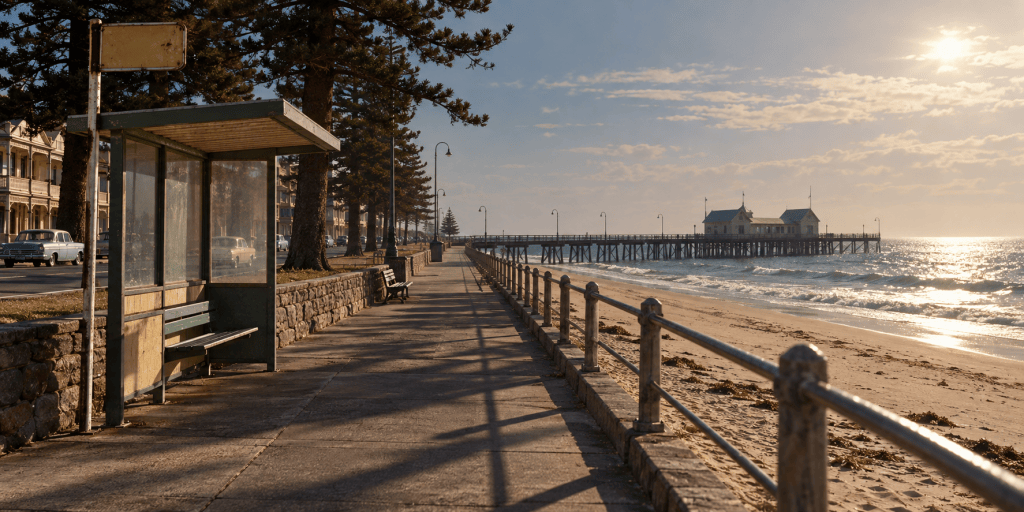
Three children took a bus to the beach on a summer public holiday. They were expected home that afternoon. Sixty years later, the return journey remains the missing part of their story.
This article describes a real unsolved case. Witness accounts and later theories are identified as such. The featured image is an AI-generated illustration, not a photograph of the children or evidence from the investigation.
On the morning of 26 January 1966, Jane Beaumont, nine, her sister Arnna, seven, and their brother Grant, four, left their home in Somerton Park, Adelaide. They caught a bus to nearby Glenelg Beach. It was Australia Day, and a trip like that without an adult was less unusual then than it would be now.
The children were due back in the afternoon. They did not return.
At first, there were places to look and people to ask. The beach. The bus route. Shops near the shore. South Australia Crime Stoppers lists confirmed sightings at Colley Reserve and Wenzels Cake Shop on Moseley Street. These sightings established that the three siblings reached Glenelg. They did not establish what happened after they left those places.
As the afternoon passed, the ordinary explanations began to run out. Their father went to the police that evening. According to a police operational log later reported by ABC, the children were reported missing shortly before 7:20 p.m. Officers and their father searched the beach. Police checked other stretches of coastline, boats and nearby lawns as night fell.
Nothing brought Jane, Arnna or Grant home.
The man in the witness accounts
Some witnesses later said they had seen the children with a man near the beach. They described a tall, tanned man with short blond hair. Police produced a composite image and sought to identify him. The National Film and Sound Archive of Australia notes that investigators never found the man from those accounts.
The reports matter, but they have a limit. A sighting is an account of what someone remembers seeing. It cannot, by itself, tell us who the man was, whether he knew the children, or whether he was involved in their disappearance.
Another detail added to the uncertainty. A shopkeeper recalled Jane paying for food with a one-pound note. The parents’ account of the money the children had taken from home did not match that recollection. Police considered whether someone else had given them the note. It remained a question, rather than proof of an encounter with the man described by witnesses.
There was no confirmed trail from the cake shop to the person responsible. No verified explanation for why all three children disappeared together. Investigators had fragments of a morning, then an empty afternoon.
Hope that led nowhere
Two years later, letters arrived claiming that the children were alive and offering a possible reunion. Their parents travelled to an arranged meeting. Nobody appeared. Later forensic work identified the letters as a cruel hoax. The promise of an answer had only added another injury to a family waiting for news.
Police pursued numerous leads over the decades. Sites were searched; theories gathered attention; names were put forward. None established what happened to Jane, Arnna and Grant. The absence of an answer has sometimes allowed a proposed suspect or location to sound more certain than the evidence permits.
That distinction still matters. In 2025, a private search revisited a former factory site in Adelaide. South Australia Police said the theory behind the excavation was not supported by the evidence available to them. The search found no new evidence. A renewed excavation was an attempt to test a claim, not confirmation that the children had ever been there.
The question left at the beach
In January 2026, on the sixtieth anniversary, a South Australian politician placed three yellow roses into the water at Glenelg and called for a memorial. One rose for each child. Their parents had died without learning what happened.
Crime Stoppers South Australia continues to describe the disappearance as unresolved. Police suspect the children were abducted and murdered, but that conclusion has not supplied the missing sequence of events or identified a convicted offender. A reward of up to one million Australian dollars remains on offer for information leading to a conviction or the recovery of their remains.
There are clues that appear to point somewhere: a shop visit, a witness description, a note of money, a succession of searches. But a clue can survive for sixty years without becoming an answer.
What happened between Glenelg Beach and the journey home that never began?
If this carefully sourced story interested you, please share it. Someone may still hold information that matters.
For another case in which several people vanished together, read The Springfield Three: The House That Kept Their Secrets.
Research note (23 September 2026): The facts above were checked against Crime Stoppers South Australia’s case profile, Australia’s National Film and Sound Archive, ABC’s account of the police timeline and ABC’s 2026 follow-up. No confirmed resolution was found in these sources.


Leave a comment