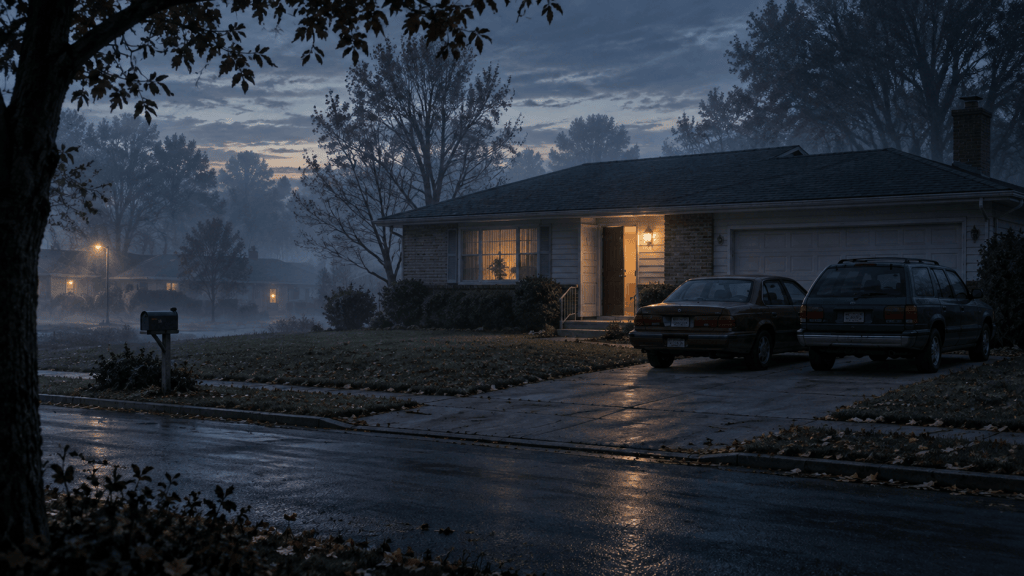
On a June night in 1992, two young women returned home after celebrating their graduation. By morning, they—and Suzie’s mother—had disappeared. Their cars, keys and personal belongings were still inside the house.
At around 2:15 in the morning on June 7, 1992, two young women left a graduation party in Springfield, Missouri.
Suzie Streeter was nineteen years old. Her friend Stacy McCall was eighteen. They had just finished high school and, like many young people that summer, had spent the evening moving between parties, talking, laughing and making plans for the next day.
They were expected to meet friends at White Water, a local water park.
Instead, Suzie and Stacy went to Suzie’s home on East Delmar Street. Suzie’s mother, Sherrill Levitt, was there. Sherrill was forty-seven years old and worked as a cosmetologist.
That was the last night anyone can place the three women with certainty.
By the time the morning was over, Suzie, Stacy and Sherrill had disappeared.
The morning after
At first, their friends assumed they had simply overslept.
The young women had made plans for the following day. But as the morning passed, they did not arrive. They did not call. They did not answer messages.
Eventually, friends went to the house to find out what had happened.
The front door was open.
Inside, the house did not look like the scene of a normal departure. The three women were gone, but almost everything they might have taken with them remained behind.
Their cars were still there.
Their purses, money, keys, clothing and other personal belongings had not been taken. The family dog was inside the house. There was no packed suitcase, no clear message and no obvious reason for the three women to leave.
There were also no apparent signs of a struggle.
The home seemed strangely ordinary—except that the people who belonged there had vanished.
For investigators, this created an impossible problem. If the women had left voluntarily, why had they left their cars and personal items behind? If they had been taken, how had three people disappeared from the same house without leaving a clearer trail?
Somewhere between approximately 2:15 a.m. and 7:30 a.m., the explanation disappeared with them.
The search begins
News of the disappearance spread quickly through Springfield.
Friends, relatives, neighbours and strangers joined the search. Investigators examined rural roads, wooded areas and locations around the city. Search efforts extended to places including Lake Springfield, Forsyth, Joplin and Stockton.
Posters were distributed. Photographs of the three women appeared in shop windows and on telephone poles.
But the search produced no answer.
There was no confirmed sighting after the early morning hours. No reliable explanation for why the women had left. No discovery of their bodies or remains.
The case was not simply about finding three missing people. Investigators also had to reconstruct a few hours inside a house where almost nothing appeared to have happened.
And sometimes, the smallest details seemed important.
Why had the front door been left open?
Why had the women left their keys and cars behind?
Had they known the person who came to the house—or had someone forced their way inside?
No theory could be proved.
Leads that led nowhere
Over the years, investigators followed thousands of tips.
In 1993, police searched land in Webster County. In 2002, cadaver dogs led investigators to several locations connected to a possible green van. Bones were found, but testing showed they were far too old to belong to the missing women.
The following year, investigators searched farmland south of Cassville. Possible blood and part of a green vehicle were recovered, but laboratory testing of the blood was inconclusive.
Then came one of the strangest leads.
In 2007, a consulting engineer used ground-penetrating radar to examine part of a hospital parking garage. The equipment appeared to show three objects beneath the concrete—objects that some believed might be graves.
The theory attracted attention, but Springfield police did not consider it credible. The parking garage was never demolished, and the search produced no evidence that solved the case.
Every lead seemed to open a door.
Behind it was another locked room.
A disturbing claim
One man connected to the case later made a chilling statement.
Robert Craig Cox, a convicted killer who had been in Springfield around the time of the disappearance, claimed that he knew the women were dead. He never provided evidence that proved his claim.
In 1996, a grand jury examined the case, but no charges were brought against anyone.
Cox’s words added another layer of darkness to the mystery, but they did not reveal where the women were—or what had happened inside the house that morning.
The claim remained only a claim.
The unanswered question
More than three decades later, the Springfield Three remain missing.
Sherrill Levitt, Suzie Streeter and Stacy McCall have never been found. Authorities have not established a confirmed motive, a confirmed perpetrator or a reliable explanation for how the three women disappeared.
The case remains disturbing because the final scene is so ordinary.
There is no abandoned car on a lonely road. No suitcase left at a railway station. No confirmed sighting in another town.
There is only a house, an open door and the belongings of three people who never came back.
Perhaps the answer lies in something that was overlooked during the first hours of the investigation. Perhaps someone knows what happened but has never spoken. Or perhaps the truth is hidden somewhere beneath the ordinary details of that summer morning.
The Springfield Three disappeared between 2:15 a.m. and 7:30 a.m.
Since then, the question has remained the same:
How can three people vanish from one house—and leave almost everything behind?
What do you think happened to the Springfield Three?
If you found this story interesting, share it with someone who enjoys unsolved mysteries. Then continue with another Dark Stories case, such as The Isdal Woman or D. B. Cooper.
 Dark Stories
Leave a comment