In the early hours of 17 July 2010, a 19-year-old woman walked home from Sopot along the Polish coast. Cameras recorded part of her journey. Then the trail ended, and Iwona Wieczorek did not return.
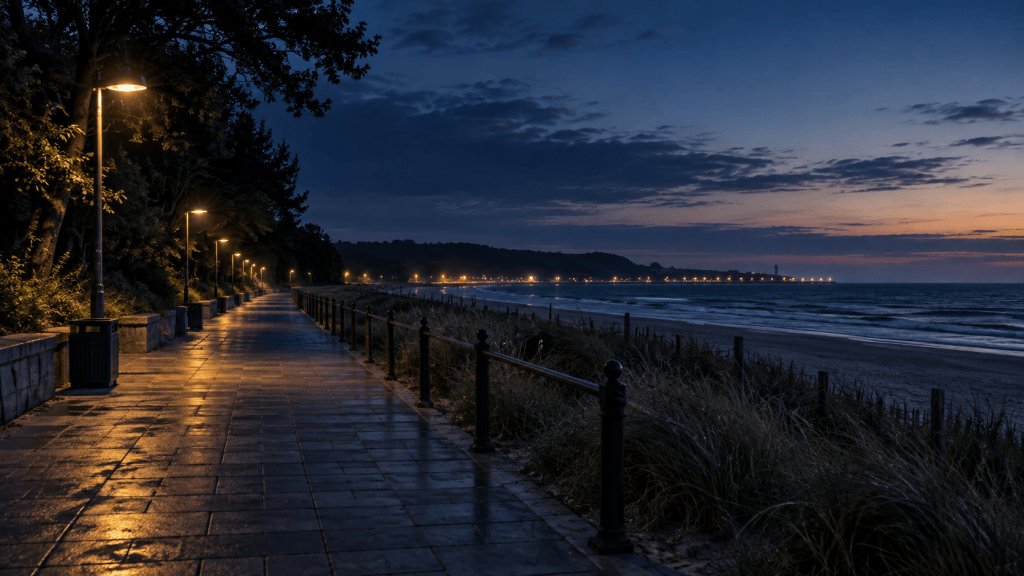
This is a real, unresolved disappearance. The people and places are real; the featured image is an AI-generated illustration, not a photograph of Iwona or an exact reconstruction of the route.
Iwona lived in Gdańsk. After a night out in nearby Sopot, she set off on foot in the direction of home. The route beside the sea, through Gdańsk’s Jelitkowo area, has become central to the case. What should have been an ordinary walk in a familiar place became one of Poland’s most closely followed missing-person investigations.
The early camera footage offered investigators a sequence of glimpses, but not an ending. It placed Iwona on the route after 4 a.m. A man visible some distance behind her drew public attention. Police sought him as a potential witness. The footage alone did not establish that he knew Iwona, followed her with criminal intent, or had any role in her disappearance.
Where the record stops
A camera can show where somebody was at one moment. It cannot show every stretch of the road or what happened after its field of view ended. Searches and witness appeals followed. Despite years of investigation, police have not publicly established how Iwona vanished.
There is another reason to be careful with confident reconstructions. In 2015, Poland’s Supreme Audit Office criticised the early handling of this case. Its review said police had assigned too low a priority to the disappearance and had not promptly secured recordings from private cameras. Some hotel footage was overwritten before it could be collected. Missing evidence cannot be recreated by repeatedly watching the surviving clips.
That finding does not, by itself, prove a particular theory. It does show why the public record has gaps. A supposed sighting, a person appearing in a frame, and an investigative lead have different meanings. None should be turned into an accusation without evidence.
A new appeal, sixteen years on
In January 2026, Warsaw police appealed for information about the driver of a white Fiat Cinquecento seen near Gdańsk’s Reagan Park at 5:07 a.m. on the morning Iwona disappeared. Police described the car’s later route towards Rumia, Reda and Puck and said its driver may have information relevant to the case.
That was an appeal for information, not a declaration that the driver was involved. The precise relationship between the car and Iwona’s disappearance remains unknown in the public material. The fact that investigators are still seeking a witness illustrates both the persistence of the inquiry and its uncertainty.
The walk no camera could finish
Iwona’s case invites an easy but misleading kind of storytelling: one grainy image becomes the answer to a mystery. The documented story is more difficult. A young woman left Sopot, travelled towards home, appeared on cameras along the way, and disappeared. An official audit later identified lost opportunities to preserve evidence. Investigators still ask people who may know something to come forward.
For anyone who has information, the Polish police appeal gives the contact number 573 934 910. A family has lived with the absence of an answer since that July morning.
The cameras recorded the walk. They did not record what happened at its end.
If this careful account helped you understand the case, please share it without naming an unproven suspect.
For another disappearance with a camera clue, read The Car That Came Back Without Jennifer Kesse. For a Scandinavian case involving a journey home, see The Man Who Vanished on Muskö.
Research note (23 September 2026): This account draws on the Polish police’s 2010 statement and witness appeal, the account of the Supreme Audit Office’s findings, and the 2026 police appeal. The car is an investigative lead, not proof of a crime by its driver.


Leave a comment