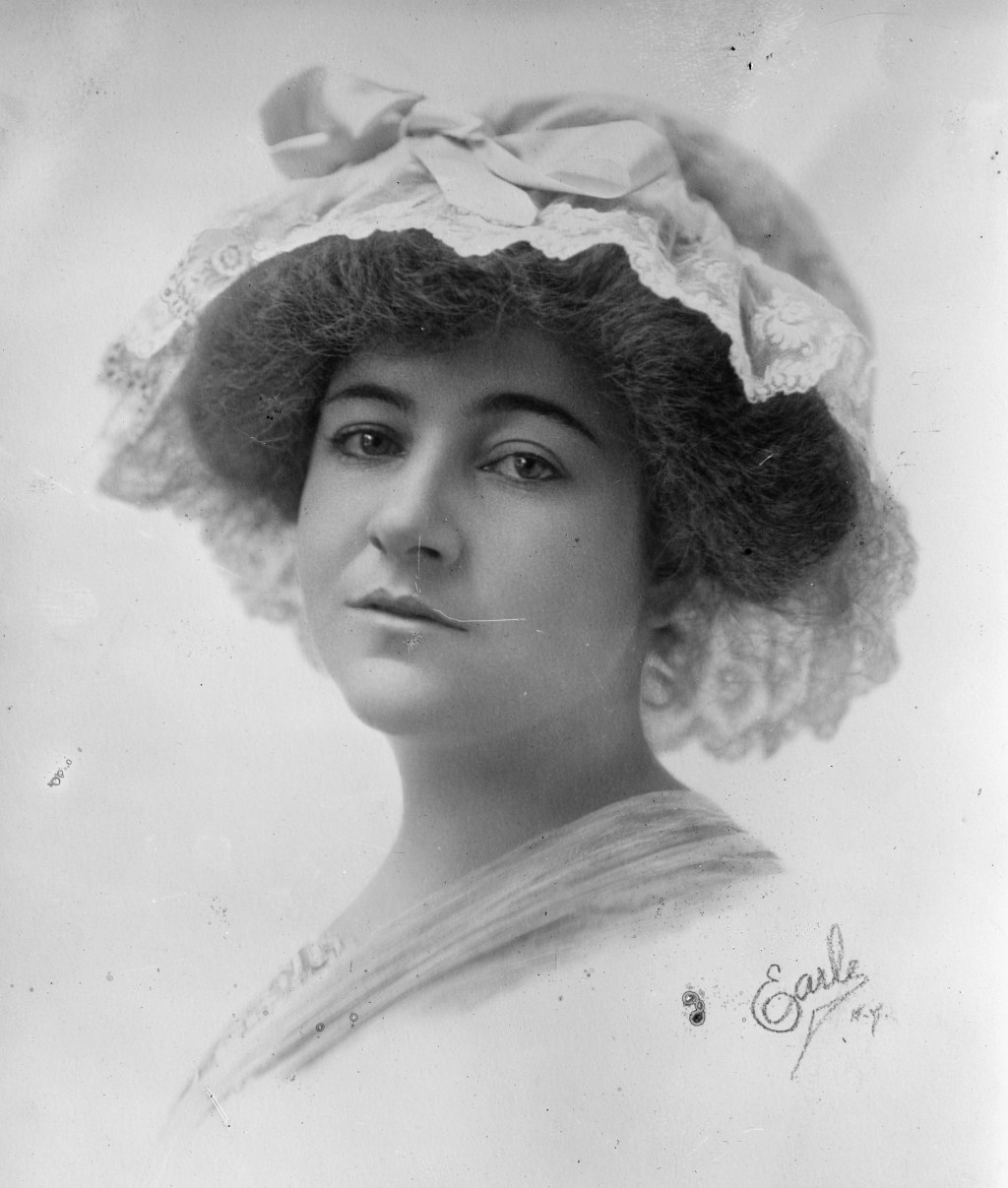
She bought chocolates, chose a book and stopped to talk to a friend. Then Dorothy Arnold walked away into Manhattan. More than a century later, nobody can say with certainty where she went.
Archival portrait: Dorothy Arnold, circa 1910. George Grantham Bain Collection, Library of Congress, via Wikimedia Commons. No known copyright restrictions. This is an archival image, not an AI illustration.
On 12 December 1910, Dorothy left her family’s home on East 79th Street in New York. She was twenty-five. The explanation she gave her mother was ordinary: she wanted a dress for her younger sister’s approaching party.
What followed was ordinary too. A purchase of chocolates. A visit to Brentano’s bookshop. The sort of errands that leave small, dependable traces in someone else’s day.
Near the bookshop, Dorothy met her friend Gladys. They chatted. According to the later account in American Heritage, Gladys handed over her acceptance of the party invitation, saving herself the postage. Dorothy laughed.
That detail is almost unbearable in retrospect. An invitation accepted. A party still ahead. Neither woman had any reason to treat the conversation as a farewell.
Dorothy said she intended to return home through Central Park. Gladys went on her way.
There is no confirmed account of what happened next.
The life behind the photograph
The newspapers would turn Dorothy into an heiress who had vanished. But she was also a Bryn Mawr graduate who wanted to become a writer. She had submitted fiction for publication and received rejection rather than the independence she hoped for.
She had asked to live in Greenwich Village, where she could write away from the family home. Her father refused.
Dorothy also had a relationship with George Griscom Jr., an older man from Pittsburgh. Months before her disappearance, she had spent time with him in Boston while her family understood she was visiting a college friend.
George was in Italy when she vanished. He denied knowing what had happened and later helped search for her. Their relationship offered investigators a possible explanation for secrecy. It did not establish where Dorothy had gone.
These fragments matter because they reveal a person with ambitions and a private life. They are not a confession, a farewell note or proof that she chose to disappear.
Six weeks of silence
Her family’s first response was to search quietly, using a lawyer and private investigators, including the Pinkerton agency. They feared publicity. The search extended beyond New York, but failed to bring Dorothy home.
Only on 25 January 1911 did her father face reporters. More than six weeks had passed since the shopping trip.
The delay left a painful question hanging over everything: might someone have remembered seeing her if they had been asked sooner? There is no way to measure what was lost.
Once the story became public, restraint gave way to a flood of attention. Newspapers printed Dorothy’s face. Sightings arrived from distant places. Women who resembled her were mistaken for her. Messages promised information; others offered false hope.
For a family waiting for one reliable answer, every new report could reopen the same uncertainty. Was this finally Dorothy—or another stranger’s story attached to her name?
A route without an ending
Her father believed she had been attacked while passing through Central Park and that her body had been concealed in the water. Searches did not establish that explanation.
Other theories grew around the gaps: a deliberate escape, suicide, or death following a clandestine medical procedure. None has been proved. Even her stated intention to walk through the park does not prove she ever entered it.
Accounts also differ on details of the early investigation. That is a reason to be careful, not an invitation to choose whichever version makes the darkest story.
The Charley Project still records Dorothy’s disappearance as unsolved. There is no verified later life to describe and no established final moment to reconstruct.
What remains is the photograph, the purchases and the conversation outside the bookshop. A young woman wanted to write stories of her own. Instead, strangers spent generations writing endings for her.
None of them could show that their ending was true.
Another walk home, another unanswered disappearance: read Iwona Wieczorek’s story.
If this story stayed with you, share it—and help keep the person behind the mystery in view.
Sources
The Charley Project: Dorothy Harriet Camille Arnold; Allen Churchill, “The Girl Who Never Came Back,” American Heritage (1960); A&E: A New York Heiress Disappeared in 1910. Historical accounts disagree on some dates and minor details; unproved theories are identified as such.


Leave a Reply