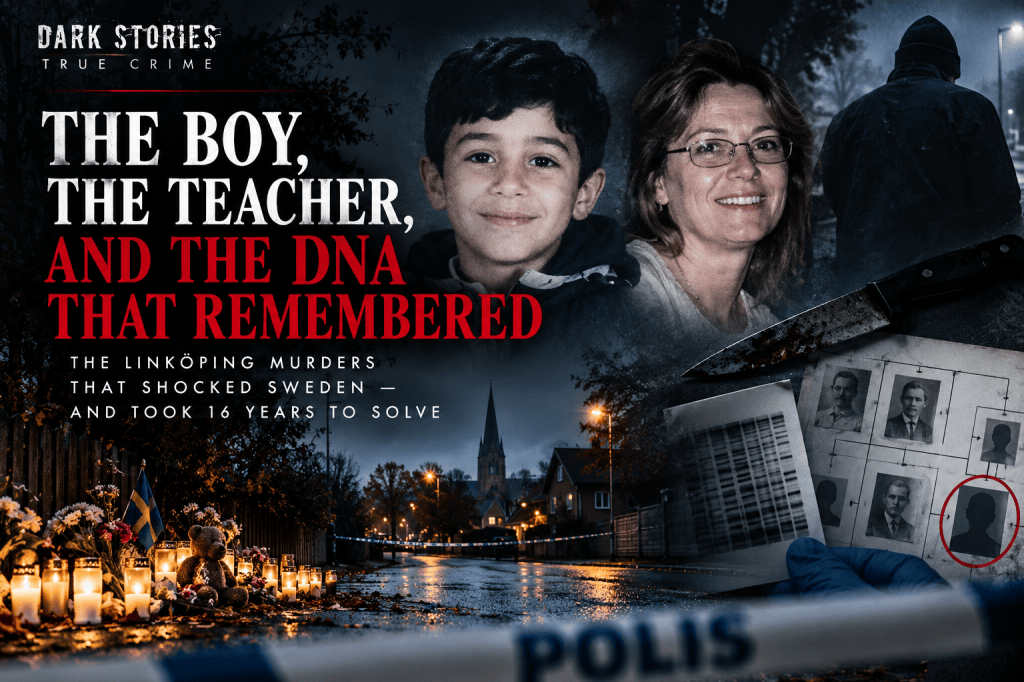
Linköping, Sweden. October 19, 2004. An eight-year-old boy walked to school. A woman left home for work. Neither would return. Their killer would remain free for almost sixteen years — until genetic genealogy uncovered his identity.
A Tuesday Morning
Shortly before eight, eight-year-old Mohammed Ammouri was walking to school along Åsgatan in Linköping. A young man attacked him with a knife. Nearby, 56-year-old language teacher Anna-Lena Svensson encountered the violence and was also stabbed. Mohammed died at the scene; Anna-Lena died from her injuries. The attacker fled.
The Man Who Left His DNA Behind
Police recovered a knife and a cap, and obtained the perpetrator’s DNA. But it matched nobody in the police databases. Investigators pursued thousands of leads and samples, without finding the man who had killed two strangers in broad daylight.
Sixteen Years of Silence
Mohammed’s classmates grew up. His family and Anna-Lena’s loved ones continued to live with their loss. The murderer remained unidentified as the case became one of Sweden’s most extensive investigations.
The Family Tree
In 2020 investigators turned to investigative genetic genealogy. Unlike conventional DNA matching, it can identify distant relatives through shared genetic segments. Genealogist Peter Sjölund worked through historical records and family trees, narrowing the possibilities until investigators focused on two brothers.
The Knock on the Door
On June 9, 2020, police arrested 37-year-old Daniel Nyqvist. His DNA matched the forensic evidence, and he confessed. He had been 21 when the murders occurred. The breakthrough came not from a witness, but from biological connections across generations.
Why Did He Kill Them?
Daniel had no known personal connection to the victims. The court concluded that he suffered from a serious mental disorder, and in October 2020 sentenced him to forensic psychiatric care with special discharge review. The identity of the murderer was finally known, but the loss remained irreversible.
The Evidence That Waited
For nearly sixteen years, the answer had existed in forensic evidence that investigators could not connect to a name. Genetic genealogy finally made that connection. Behind the landmark forensic breakthrough are two people: a boy who never reached school, and a teacher who never reached work.
Sources: Swedish Police Authority; SVT Nyheter’s 2020 reporting on the investigation and trial; reporting on Peter Sjölund’s genetic genealogy work.
Explore more true mysteries at Dark Stories.


Leave a Reply