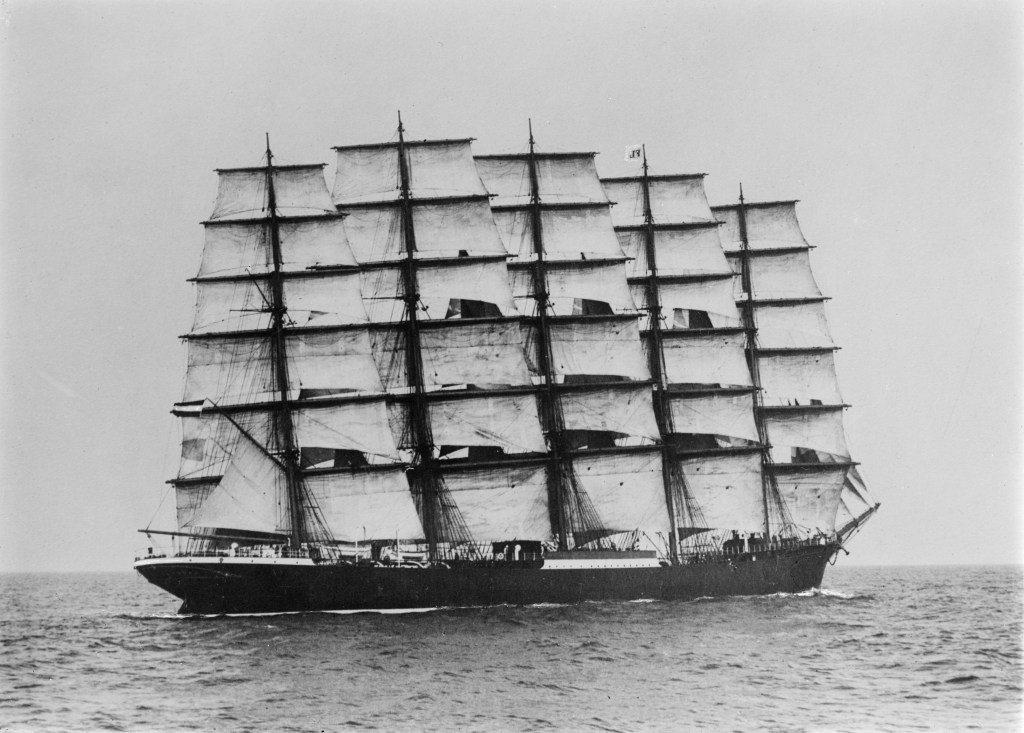
She had been built for Cape Horn. In November 1910, Preussen was wrecked beneath the white cliffs of England—close enough for people on shore to watch the struggle. Among the men aboard was a young sailor who would spend the rest of his life remembering where she lay.
A young man’s ship
Christian was twenty, from a seafaring family on the Flensburg Fjord. His father had built and commanded small vessels. Christian wanted to go further: across oceans, aboard the great sailing ships leaving Hamburg.
He joined Preussen in October 1910. He was an able seaman, working towards the experience he needed for navigation school. The voyage would take him towards Chile.
For a young sailor with ambitions, she was an extraordinary ship to find beneath his feet.
Built in Germany in 1902, Preussen carried square sails on all five masts. Above her deck rose thirty square sails, six to each mast, with additional canvas between and beyond them. A crew of roughly forty-five handled this enormous structure.
She belonged to the Flying P Line, carrying cargo between Europe and the west coast of South America. She had made repeated voyages to Chile and could reach speeds that challenged the easy assumption that a sailing ship must be slow.
That assumption would help destroy her.
The crossing
Late on 5 November, Preussen was in the English Channel, outward bound on her fourteenth voyage. Ahead lay the Atlantic and the long passage south.
Another vessel was crossing the Channel: the British steamer Brighton, on the Newhaven–Dieppe route.
The two ships were closing on one another.
Brighton tried to cross ahead of the sailing ship. The accepted account is that her speed had been underestimated. Preussen was coming on faster than expected.
The margin disappeared.
The collision tore into Preussen’s forward rigging. Her bowsprit and other gear were damaged. The carefully balanced arrangement of hull, sails and rigging that allowed her crew to control her had been disrupted.
Brighton was damaged too, but could return to Newhaven.
Preussen remained at sea.
She had survived the first blow. Now her men had to bring a crippled sailing ship to safety while the weather worsened.
Something had to hold
Assistance came. Tugs offered a way towards shelter, but a rising November gale turned the rescue into a struggle against forces that neither crew could command.
The damaged ship took water. Pumps bought time; they could not repair the hull.
Off Dungeness, the anchors offered another chance. For the men aboard, the question had become brutally simple: would the next thing hold?
An anchor cable parted. Then the other went.
There was no longer a fixed point between the ship and the seabed.
Tugs took her in tow towards Dover. The harbour promised protection, but reaching it meant keeping the great hull under control in heavy seas.
The towlines failed.
Every broken connection left fewer choices. The ship could still float, the men could still work, and help could still be visible nearby. None of that meant they could prevent the coast from coming closer.
On 6 November, Preussen struck the rocks beneath the cliffs east of Dover.
Christian was at the helm when she grounded.
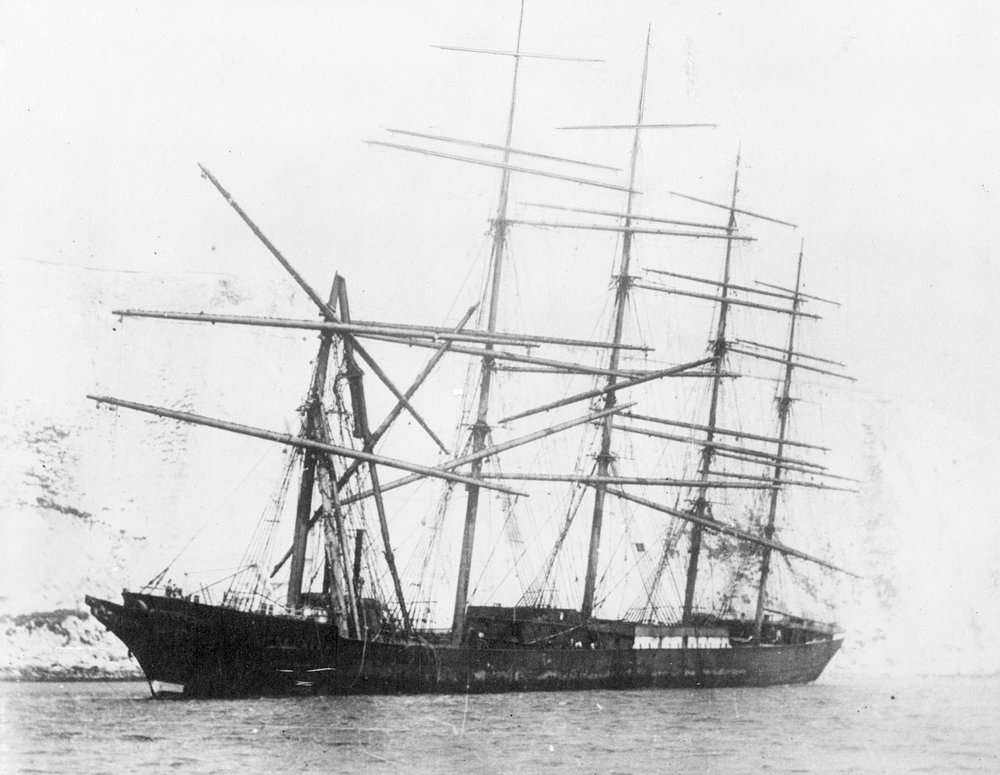
The shore could see them
Ashore, rescuers faced a different nightmare: a wreck plainly in sight, with breaking seas between the men who needed help and those trying to reach them.
The Dover lifeboat went out. Near Preussen, the sea threw the small craft about so violently that it risked capsizing. The attempt had to be abandoned.
Coastguards worked along the foot of the cliffs and managed to send a line into the ship’s rigging.
On board, the crew gathered around the midship deckhouse in cork lifejackets. Some waved towards the spectators on land.
Those watching could see living men. They could not simply bring them home.
The danger was also above the deck. The damaged foremast collapsed, bringing steel and rigging down near men working forward. They escaped.
Still, the crew continued trying to save the ship.
There is a terrible uncertainty in a stranded vessel. Staying may preserve the chance of salvage. Leaving may be necessary to stay alive. The weather can settle that argument before anyone has finished making it.
The ship they left behind
As conditions improved, those aboard could be brought ashore. The people survived. Preussen did not.
Cargo and equipment were recovered, but the damaged hull could not be saved. Subsequent storms finished what the collision and grounding had begun.
There would be no final voyage to Chile, no repaired ship slipping back into the trade.
Responsibility was later placed on Brighton. A legal finding could establish blame. It could not lift Preussen from the rocks.
Christian went on with his career. He became a captain himself.
Years later, when passing Dover, he would keep close enough to the coast to look for his old ship beneath the chalk cliffs. Over time, less and less remained visible.
That is the quiet ending to Preussen’s story: a man on the bridge of another vessel, looking towards a place he remembered.
He had once stood at the wheel of the great ship as she ran aground.
Now he could only sail past.
If this story stayed with you, share it with someone who knows what a ship can mean to the people who sail her.
Historical narrative based on documented events. No invented dialogue. Christian is Christian Friedrich Warming; his memoir was translated by Rolf Christian Warming and Barry Bradley-Young. Accounts differ on some details of the rescue sequence; the collision is dated here to late 5 November, followed by the grounding on 6 November 1910.


Leave a Reply