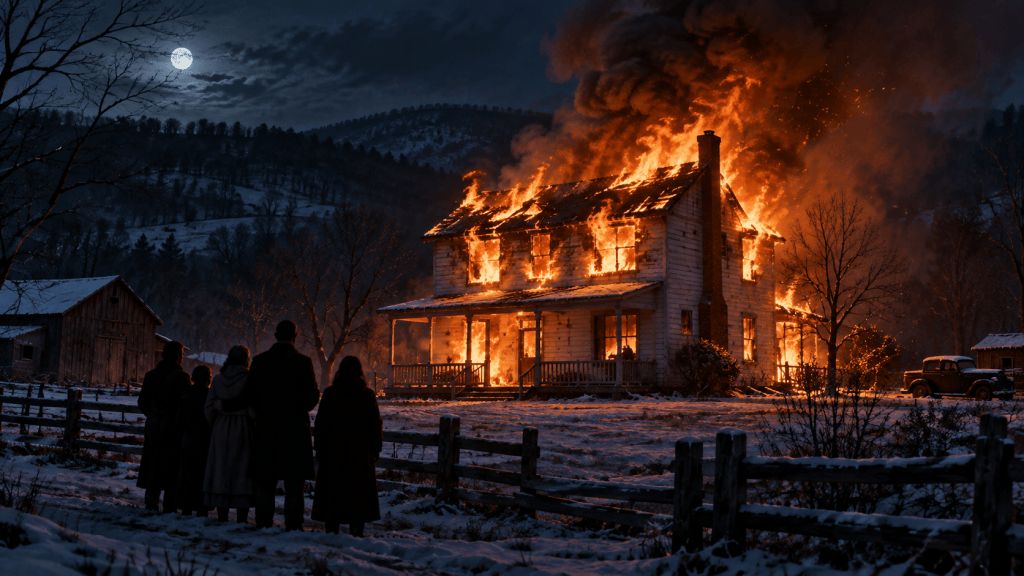
A house burned on Christmas morning. Five children were believed
to be inside. When daylight came, investigators found no confirmed
remains—and the fire became the beginning of a mystery rather than its
end.
Editorial note: This article describes a real
historical disappearance involving children. Established facts are
separated from later claims and theories. The featured image is an
AI-generated editorial illustration, not an authentic photograph or
evidence.
At 12:30 a.m. on Christmas morning, 1945, the telephone rang inside
the Sodder family home near Fayetteville, West Virginia.
Jennie Sodder answered. A woman asked for a name Jennie did not
recognize. There was laughter in the background. Jennie said the caller
had the wrong number and returned to bed.
The house was quiet again.
About an hour later, Jennie woke to smoke.
The House on Fire
George and Jennie Sodder lived in the two-storey house with nine of
their ten children. One son was away in the army. As fire spread through
the ground floor, the parents and four children escaped.
Five others—Maurice, 14; Martha, 12; Louis, 9; Jennie, 8; and Betty,
5—were believed to be upstairs.
George tried to go back inside, breaking a window and cutting his
arm, but flames and smoke blocked the staircase. He ran for the ladder
normally kept against the house.
It was gone.
He then tried to move one of his coal trucks beneath an upstairs
window. Neither truck would start, although both had reportedly worked
the day before. The water in a nearby barrel was frozen.
The family called for help from a neighbour’s home because their own
telephone line was dead. Fayetteville relied on a telephone tree to
summon volunteer firefighters. The fire department, only a few miles
away, did not arrive until around 8 a.m.
By then, the house had collapsed into a smoking ruin.
Five Children, No Confirmed
Remains
The first explanation was devastating but simple: the five children
had died in the fire.
A brief search did not recover confirmed remains belonging to them.
Officials suggested the heat had destroyed the bodies. A state police
inspector attributed the blaze to faulty wiring, and death certificates
were issued before the end of December.
George and Jennie initially accepted that their children were
dead.
Then the doubts began.
The family’s wiring had reportedly been inspected not long before the
fire. Some lights had remained on as the house burned. The missing
ladder was later found away from the house. Investigators also learned
that the telephone line had been cut; a local man admitted stealing
equipment and cutting the line but denied starting the fire.
None of those facts proves that the children escaped. Together,
however, they gave the parents a reason to question the official
story.
The Evidence Beneath the
House
The scene was never preserved in the way a modern investigation would
require. Less than a week after the fire, George used a bulldozer to
cover the ruins with several feet of soil, intending to create a
memorial.
That decision may have buried evidence forever.
In 1949, the site was excavated again. A small number of vertebral
fragments were found, but an examination associated with the Smithsonian
Institution concluded that they probably came from an older person and
may have arrived with the soil used to cover the ruins. They did not
identify any of the five children.
The absence of confirmed remains became the centre of the
mystery.
But absence is not proof of survival. Later reporting noted that
gasoline stored in the basement could have intensified the fire, while
the disturbed and buried scene made a reliable reconstruction almost
impossible.
The Sightings
As news spread, witnesses began reporting possible encounters with
the missing children.
A woman working at a hotel in Charleston said she had seen children
resembling them accompanied by adults after the fire. Another woman
claimed she had served the children breakfast at a tourist stop the
following morning.
The reports were dramatic. They were also never independently
verified.
Years later, the family received a photograph of a young man whom
they thought might be Louis as an adult. On the back were cryptic words
and numbers. The sender was never conclusively identified, and the
photograph did not prove that Louis had survived.
Each new clue offered hope.
Each ended without an answer.
A Threat Before the Fire
The family’s suspicion of foul play also reached backward.
George Sodder, an Italian immigrant, was openly critical of Benito
Mussolini. According to later accounts, an insurance salesman angered by
George’s views had warned that the house would burn and the children
would be destroyed.
The statement was sinister. The man was later reported to have served
on the coroner’s jury that ruled the fire accidental.
Still, no reliable evidence established that he set the fire,
arranged an abduction or belonged to a criminal conspiracy. The theory
that organized crime took the children grew from the threat, George’s
political arguments and the strange circumstances—not from proof
identifying kidnappers.
The Billboard
George and Jennie refused to let the case disappear.
In the early 1950s, they placed a billboard beside Route 16. It
displayed the children’s photographs and asked a question that drivers
would see for decades:
Were they kidnapped, murdered—or still alive?
The parents followed leads across the United States. None brought
Maurice, Martha, Louis, Jennie or Betty home. George died in 1969.
Jennie kept the billboard standing until her death in 1989.
The official explanation remained death in the fire.
The family’s belief remained kidnapping.
Neither side produced the evidence needed to close the case.
What Happened That Night?
The simplest explanation is that the five children died in the house
and that the chaotic search, extreme heat and later disturbance of the
site prevented their remains from being identified.
The darker possibility is that someone removed them before or during
the fire, then used the blaze to hide the crime.
But that theory creates its own questions.
How could five children be taken without any of the surviving family
seeing them leave?
Why was no verified trace of them ever found?
And if the fire was only a distraction, who planned an operation so
elaborate that it remained secret for generations?
The facts do not provide a final answer. They leave only a sequence
of failures and uncertainties: a late-night call, a severed telephone
line, a missing ladder, trucks that would not start, a delayed fire
response and a ruined scene that could never be examined properly
again.
Five children entered Christmas Eve inside their family home.
By sunrise, they had vanished from the record.
What Do You Think?
Did Maurice, Martha, Louis, Jennie and Betty die in the fire?
Or did the flames conceal an abduction?
Share the story—and remember that behind the mystery were five
children and a family that spent the rest of their lives waiting for an
answer.
More Unsolved Stories
from Dark Stories
Sources
- Smithsonian
Magazine — What Happened to the Sodder Children, the Siblings Who
Went Up in Smoke in a West Virginia House Fire? (updated 21
August 2024) - ABC
News Australia — The mystery of the vanished Sodder children has
never been solved (25 December 2023) - NPR
— Mystery of Missing Children Haunts W.Va. Town (23
December 2005)

