Two Murders, No Conviction—and Footsteps That Visitors Still Claim to Hear
This article describes a real unsolved double murder from 1892. Reports of paranormal activity are presented as claims and folklore, not as established fact. AI-generated images may be used for illustration and are not authentic photographs or evidence.
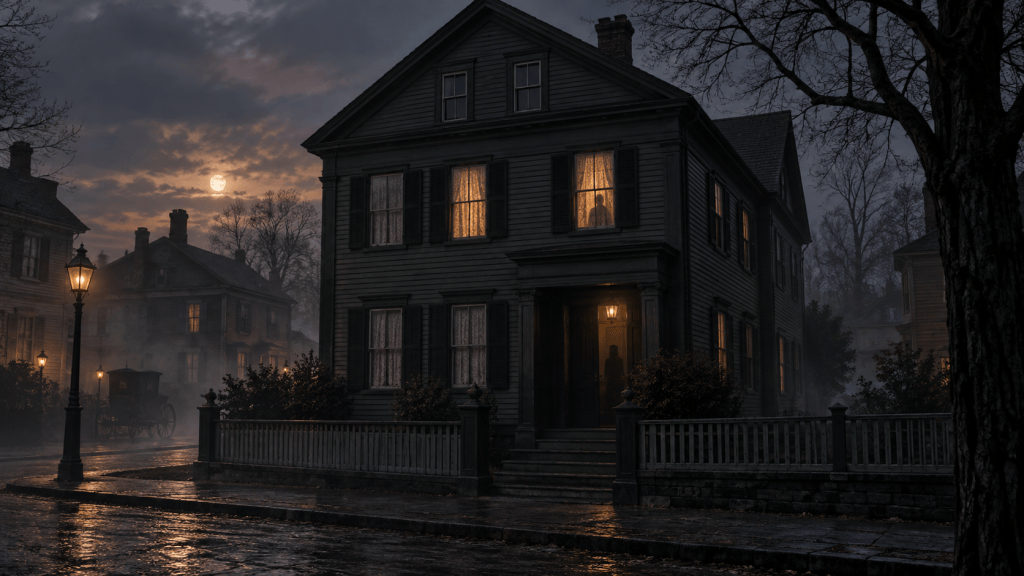
At 92 Second Street in Fall River, Massachusetts, nothing looked unusual from the outside.
It was a hot Thursday morning in August 1892.
People walked past the house.
Horses and carriages moved along the street.
Nobody reported hearing screams.
Nobody saw a killer enter.
Nobody saw one leave.
Yet before noon, two people inside the house had been brutally murdered.
And more than 130 years later, nobody has proved who killed them.
The First Body
The first victim was Abby Borden, wife of wealthy businessman Andrew Borden.
She was upstairs in the guest room.
At some point during the morning of August 4, someone entered and attacked her repeatedly with a sharp, heavy weapon.
She fell beside the bed.
Then the house became quiet again.
Downstairs, the day continued.
The family maid, Bridget Sullivan, was doing household work.
Andrew Borden was away on business.
And Andrew’s 32-year-old daughter, Lizzie Borden, was somewhere on the property.
For roughly an hour or more, Abby lay dead upstairs while life continued below.
Then Andrew came home.
The Second Murder
Andrew entered the house at around 10:45 in the morning.
He settled onto the sofa in the sitting room.
Shortly afterwards, Bridget went upstairs to rest.
Then came silence.
At approximately 11:15, Lizzie called for her.
Her father was dead.
Andrew had been attacked while lying on the sofa.
His face and head had been struck repeatedly.
The killer had now murdered two people inside the same house—at different times.
And apparently nobody had seen the attacker come or go.
That was the first great mystery.
The second was worse.
Who could move around inside the Borden house without attracting attention?
Suspicion Turns Toward Lizzie
The police questioned everyone.
Bridget Sullivan said she had not seen blood on Lizzie’s face, hands or clothing. She could not place Lizzie in the room with either victim at the time of the murders. Investigators found axes and hatchets in the house, but none provided a simple physical link to Lizzie.
Still, suspicion grew.
Lizzie had been at home.
Her relationship with her stepmother Abby was known to be strained.
Some of Lizzie’s explanations about her movements that morning raised questions.
And the murder seemed astonishingly difficult for an outsider to have committed unnoticed.
On August 11, one week after the killings, Lizzie Borden was arrested.
America became obsessed with the case.
The Trial
The trial began in June 1893.
The prosecution faced a serious problem.
There was no eyewitness.
No murder weapon had been conclusively identified.
There was no blood-covered clothing linking Lizzie to the attacks.
And despite enormous public interest, much of the case depended on circumstances rather than direct physical evidence.
After deliberating for about ninety minutes, the jury returned.
Not guilty.
Lizzie Borden was acquitted on June 20, 1893.
She walked free.
No one else was ever convicted.
The murders remained unsolved.
But Something Stayed Behind
That should have been the end of the story.
It wasn’t.
The house survived.
It still stands in Fall River today, its address now 230 Second Street.
And over the years, visitors began telling another kind of story.
A story the police could never investigate.
People staying in the house have claimed to hear footsteps where nobody was walking.
Voices from empty rooms.
Doors moving.
Objects changing position.
Some visitors say they have felt someone touch them during the night.
Others claim to have seen human figures that disappeared when approached.
The house’s present operators openly market it as a haunted destination and say guests regularly report unusual experiences. They also acknowledge that not everybody experiences anything at all.
There is no scientific evidence establishing that Andrew or Abby Borden—or anyone else—haunts the house.
But the stories persist.
The Guest Room
One room attracts particular attention.
It is the upstairs guest room.
The room where Abby Borden died.
Today, visitors can enter it.
Some even spend the night there.
The furniture is arranged to evoke the house as it appeared in 1892, and the building has been restored as both an inn and a historical attraction.
Imagine waking at three in the morning.
You know exactly where Abby’s body was found.
The house is silent.
Then you hear a floorboard outside your room.
One step.
Then another.
You open the door.
Nobody is there.
Is that supernatural?
An old wooden building settling during the night?
Your imagination reacting to a famous murder story?
Any of those explanations is possible.
And that uncertainty may be exactly why people keep returning.
The Strange Problem With Ghost Stories
There is something psychologically powerful about places where violent deaths occurred.
Once people know what happened in a room, ordinary sounds can become unsettling.
Pipes knock.
Old boards expand.
Wind moves doors.
A half-awake mind turns shadows into figures.
But occasionally someone reports something harder for them to explain.
A voice.
A touch.
A shape standing beside a bed.
Such testimony does not prove ghosts exist.
But it creates another mystery layered on top of the first one.
And in the Borden house, the first mystery has never been solved.
One House. Three People. Two Bodies.
That is what makes this story endure.
Remove the ghosts completely and the puzzle remains extraordinary.
Two people were murdered in daylight.
Inside their own home.
On a busy street.
At different times.
A suspect was arrested.
A jury acquitted her.
And the killer was never conclusively identified.
Then came the stories of footsteps.
Voices.
Movement in empty rooms.
Perhaps they mean nothing.
Perhaps an old house remembers nothing at all.
But there is one uncomfortable thought visitors sometimes carry upstairs with them:
Someone inside that house knew exactly what happened on August 4, 1892.
That person took the answer to the grave.
And according to some who have spent the night there…
the house itself has never become completely quiet.
What Do You Think?
Did Lizzie Borden know more than she ever admitted?
Could an outsider really have entered, committed two murders and disappeared unseen?
And when visitors hear footsteps today—is it simply an old house and an active imagination?
Or something else?
Share the Mystery
Did this story keep you reading? Share it with someone who enjoys true mysteries where history ends—but the questions don’t.
More unsolved mysteries and dark stories at Dark Stories.
Sources
The historical chronology and trial are documented by the Library of Congress and surviving contemporary newspaper records. Smithsonian has reviewed the evidence and enduring questions surrounding the murders. Claims about present-day paranormal experiences come from visitors and the current operators of the historic Borden house and should be treated as anecdotal rather than established fact.
 Dark Stories
Leave a comment