Six Murders, an Isolated Farm—and Someone Who May Have Stayed Behind
This article describes a real unsolved murder case. Some details surrounding the crime have become mixed with legend over the past century; the account below focuses on documented events. AI-generated images may be used for illustration and are not authentic photographs or evidence.
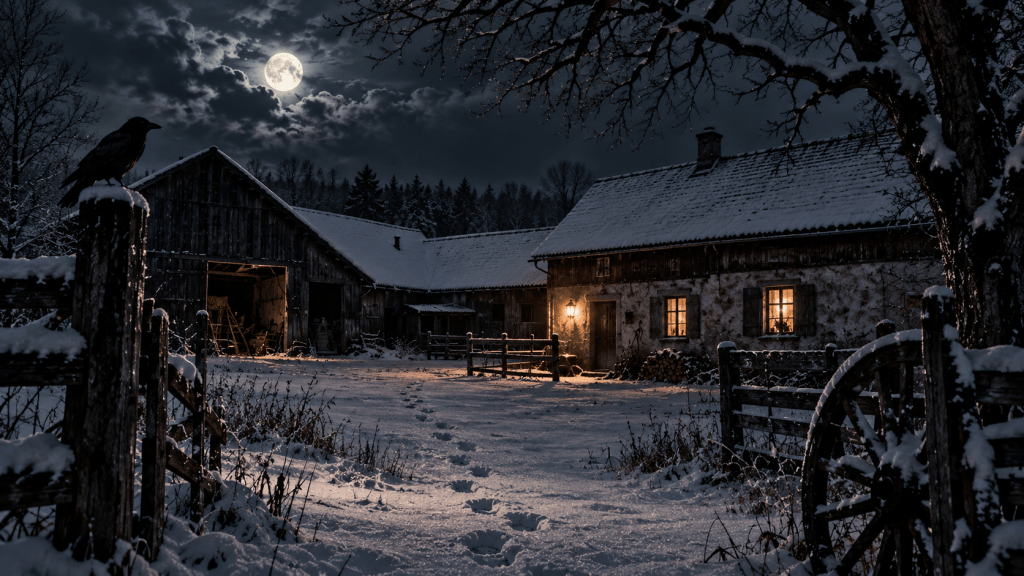
A few days before his entire family was murdered, farmer Andreas Gruber noticed something strange in the snow.
Footprints.
They came from the forest toward his isolated farm.
But he could find no tracks leading back.
Gruber told neighbours about them.
He also said someone had apparently tried to break into one of the farm buildings.
Yet he did not call the police.
Two days later, everyone at Hinterkaifeck was dead.
The Farm
Hinterkaifeck stood alone in the Bavarian countryside, northeast of Schrobenhausen, Germany.
In March 1922, six people lived there:
Andreas Gruber and his wife Cäzilia; their widowed daughter Viktoria Gabriel; Viktoria’s two children, seven-year-old Cäzilia and two-year-old Josef; and a newly hired maid, Maria Baumgartner.
Maria arrived on the afternoon of 31 March 1922.
It was her first day at Hinterkaifeck.
It would also be her last.
Friday Evening
Exactly what happened that night has never been established.
Investigators later concluded that four members of the family were killed in or near the barn.
The killer then entered the house.
Maria Baumgartner was killed in her room.
Two-year-old Josef was killed inside the living quarters.
All six were dead.
But nobody outside the farm knew it.
And that is when the story becomes truly unsettling.
Saturday
The following day, two travelling salesmen arrived at Hinterkaifeck.
Nobody answered.
They left.
Later that night, a man passing the property noticed activity around the farm.
The family still did not appear.
But nothing looked sufficiently alarming for anyone to force their way inside.
The animals were quiet.
The farm did not appear abandoned.
Sunday
The Gruber family failed to attend church.
That was unusual.
Still, nobody immediately assumed something terrible had happened.
Perhaps the family was visiting relatives.
Perhaps they were away.
Inside Hinterkaifeck, six bodies remained undiscovered.
Monday
Seven-year-old Cäzilia had now missed school.
A mechanic arrived at the farm to repair an engine.
Nobody greeted him.
He waited.
Then, assuming Andreas Gruber was somewhere nearby, he simply carried out the repair.
For hours, the mechanic worked at Hinterkaifeck while the murdered family lay only a short distance away.
And there was another disturbing detail.
The livestock had apparently been cared for.
Someone had fed the animals.
Someone may even have milked the cows.
If the family was already dead…
who was looking after the farm?
Tuesday
By 4 April, neighbours finally decided something was seriously wrong.
Three men entered the property.
In the barn, they discovered four bodies.
Andreas.
His wife.
Viktoria.
And little Cäzilia.
Inside the house they found Maria and two-year-old Josef.
The entire household had been murdered.
Four days had passed since anyone had seen them alive.
The Killer Knew the Farm
Robbery seemed like an obvious explanation.
But money and valuables remained at the property.
There were no convincing signs that a thief had simply broken in, murdered six people and fled with whatever he could carry.
The weapon itself made the case stranger.
Investigators believed the killer had used a heavy farm tool belonging to the household.
It was not initially found.
Months later, when Hinterkaifeck was being demolished, a bloodstained mattock was discovered hidden inside the building.
The murderer may have taken a weapon already available at the farm…
used it…
and then hidden it there.
Someone They Knew?
Investigators considered many suspects.
One name returned repeatedly: Lorenz Schlittenbauer, a neighbour who had previously had a relationship with Viktoria.
He had also claimed paternity of her young son Josef for a time.
The relationships surrounding the family were complicated, bitter and sometimes hostile.
Schlittenbauer was among the men who discovered the bodies.
He was questioned and remained the subject of suspicion and rumours for years.
But he was never convicted.
And suspicion—no matter how strong—is not proof.
More than one hundred people would eventually be suspected or discussed in connection with the crime.
None could be conclusively identified as the killer.
The Most Disturbing Possibility
The murders themselves were horrifying.
But perhaps the most disturbing part came afterwards.
The animals were apparently fed.
The farm continued to show signs of activity.
A fire may have been burning.
People approached the property without realizing anything was wrong.
That creates an extraordinary possibility:
The murderer may not have fled immediately.
He may have remained at Hinterkaifeck.
Perhaps for hours.
Perhaps for days.
Eating.
Moving through the rooms.
Feeding the livestock.
All while six dead people remained inside the farm.
And the Footprints?
Then we return to where the mystery began.
Two days before the murders, Andreas Gruber told neighbours about footprints in the snow.
They led from the forest toward Hinterkaifeck.
According to the surviving testimony, he could see tracks approaching the property.
But none returning.
Perhaps the tracks had an innocent explanation.
Perhaps Gruber was mistaken.
Or perhaps somebody had already reached the farm…
and never left.
More Than a Century Later
The farm was demolished in 1923.
Many original investigation files were later lost, including material destroyed during the Second World War.
German investigators officially ended the active investigation decades ago, although the murders have continued to be studied by researchers and even by police students using modern investigative methods.
No murderer has ever been proven.
The University of Augsburg still describes Hinterkaifeck as one of Bavaria’s most famous unsolved crimes.
Six people entered the night of 31 March 1922 alive.
By morning, all six were dead.
The killer left no confession.
No certain motive.
No explanation.
Only a weapon hidden inside the house…
and footprints that seemed to lead in.
But not out.
What Do You Think?
Was the killer someone the family knew?
Had someone secretly entered the farm before the murders?
And after killing six people, did that person really remain at Hinterkaifeck and continue living there for days?
More than a century later, nobody can answer those questions with certainty.
Share the Mystery
Did this story keep you reading to the end? Share it with someone who loves a mystery that still has no answer.
Sometimes the best clue is the one nobody understood at the time.
More true mysteries and dark stories at Dark Stories.
Sources
The key facts are documented by Bayerischer Rundfunk, which reviewed the crime for its 100th anniversary, and by research at the University of Augsburg into the history and mythology surrounding the still-unsolved case. Surviving historical testimony concerning the footprints and events immediately before the murders is preserved in the Hinterkaifeck case archive.
 Dark Stories
Leave a comment