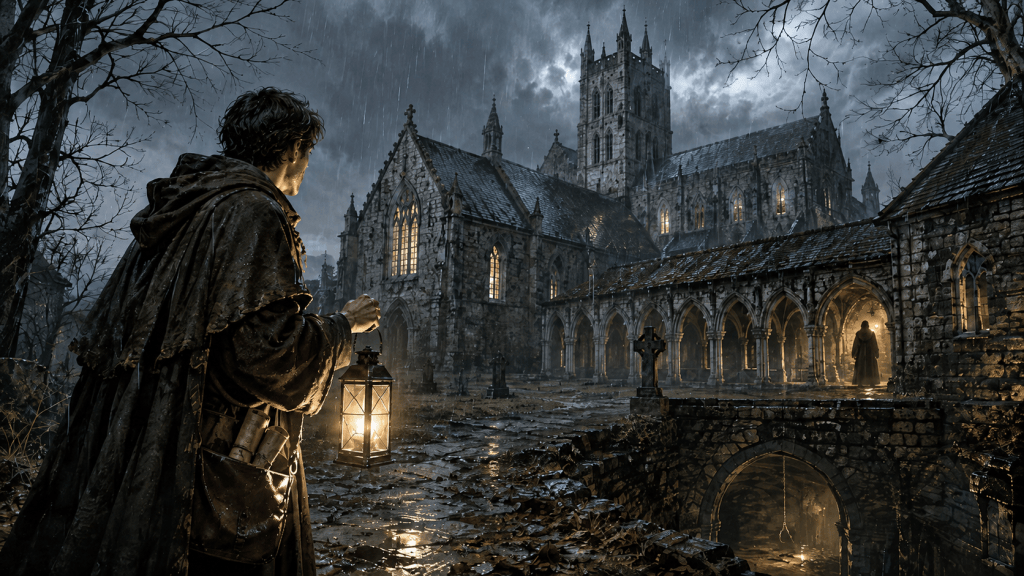
This is a work of fiction. All characters, places and events are imaginary. Any resemblance to real people or historical events is purely coincidental. The featured image is AI-generated for illustration.
The winter rain had fallen for nine days when the king’s tax collector arrived at Saint Ormund’s Abbey.
Master Ralf Dacre came after sunset with two armed riders, a quiet clerk named Simon Vale and a black chest secured by three iron locks.
Before the brothers had finished opening the gate, Dacre announced that he carried authority from the Crown to inspect the abbey’s accounts and seize any property hidden from the king.
By sunrise, one man would be dead.
A bell would ring beneath the ground.
And the abbey’s youngest scribe would discover that the dead man was not who everyone believed him to be.
The Collector at the Gate
Saint Ormund’s stood above the village of Hollowmere, surrounded by flooded fields and bare winter trees.
The plague had not yet reached the abbey, but travellers brought rumours of empty villages and locked town gates. The brothers had hidden part of their grain supply for families whose crops had failed.
Dacre entered the great hall in a dark red cloak. A silver chain bearing the king’s seal hung around his neck.
“I have been told,” he said, “that this abbey owns more grain and silver than its accounts declare.”
“Our records are open to lawful inspection,” Abbot Godric replied.
Dacre placed the black chest on the table.
“Then you have nothing to fear.”
Edmund Grey, the abbey’s nineteen-year-old assistant scribe, watched from the end of the hall.
He noticed the clerk’s fingers were stained with ink.
Dacre’s hands were clean.
The Missing Charter
For hours, Dacre examined ledgers and questioned the brothers. At last, he demanded the original royal charter granting Saint Ormund’s certain exemptions from taxation.
Edmund found only a copy.
“Where is the original?” Dacre asked.
Abbot Godric hesitated.
“In the founder’s chest, inside the crypt.”
Brother Anselm, keeper of the keys, shook his head.
“The crypt is opened only for burials and holy days.”
Dacre touched the king’s seal.
“Tonight it will be opened for the Crown.”
The crypt lay beneath the northern chapel. Inside stood three tombs, a stone altar and an iron-bound chest.
Brother Anselm unlocked the door. Dacre entered with Simon, the abbot and Edmund.
Inside the chest, Dacre found a parchment sealed with dark green wax.
The charter protected the abbey from several taxes. More importantly, it allowed the village to keep grain during famine or disease.
Dacre had no lawful right to seize Hollowmere’s hidden stores.
He rolled up the charter and placed it inside his cloak.
“You cannot remove it,” Edmund said.
Dacre looked at him coldly.
“Ink stains are not armour, boy.”
When they left, Dacre kept the crypt key.
Three Rings in the Darkness
Shortly before midnight, Edmund worked alone in the scriptorium.
Wind pressed against the shutters. Candle flames trembled.
Then a bell rang beneath the floor.
One deep note.
A second.
A third.
Brother Anselm appeared in the doorway, pale and breathless.
“The crypt bell,” he whispered.
“There is no bell in the crypt.”
“There was once.”
Long ago, a small bell had been installed beneath the chapel so trapped monks could summon help. Its rope had rotted away decades earlier.
No one living had ever heard it ring.
The brothers hurried to the crypt.
The door was locked, and Brother Anselm’s spare key would not turn. Something blocked it from inside.
They forced the door open.
Master Dacre lay beside the founder’s tomb. Blood darkened the side of his head. The crypt key rested in his hand.
The founder’s chest stood open.
The charter was gone.
There were no windows and no visible second door.
Brother Anselm crossed himself.
“The bell warned us.”
Edmund knelt beside the body.
The dead man wore Dacre’s cloak, boots and silver chain.
But the ring on his finger was too large.
And beneath his fingernails was black ink.
The Man in the Red Cloak
Edmund ordered more candles.
In stronger light, the truth became clear.
The dead man’s face had been damaged, but his hands were unmistakable. The middle finger of his right hand bore the hard ridge of a man who had held a quill for years.
The corpse was not Master Ralf Dacre.
It was Simon Vale.
Someone had dressed the clerk in Dacre’s clothes.
The two armed riders were found asleep in the guest quarters. They claimed Dacre had ordered them not to disturb him until morning.
His horse remained in the stable.
But his travelling clothes were missing.
So was the black chest.
The Secret Behind the Bell
At dawn, Edmund returned to the crypt.
Near the founder’s tomb, he found a crescent of fresh brass. Behind a stone carving was a narrow lever.
When he pulled it, the forgotten bell rang.
The tomb shifted several inches, revealing a dark passage.
Edmund followed it through the wall. It ended behind a cupboard in the scriptorium.
The bell was connected to the secret door by a chain and counterweight. Whenever the passage opened, the bell rang.
The three notes had not been a warning from the dead.
They were the sound of someone escaping.
Edmund understood the plan.
Dacre had discovered the passage and learned that the charter prevented him from seizing the grain. He decided to steal the document and disappear with taxes collected from other towns.
But first, he needed the Crown to believe he was dead.
He lured Simon into the crypt, killed him, dressed the body in his own clothes and escaped through the hidden passage.
By morning, everyone would believe Dacre had been murdered in a locked room.
There was only one problem.
The storm had flooded the northern road.
He had not yet left the abbey.
The Pilgrim with Clean Hands
Edmund ordered the gatekeeper to assemble everyone who had entered or tried to leave since sunset.
Among them stood a hooded pilgrim with mud on his cloak and linen across his face. He claimed to fear the plague.
Edmund looked at his hands.
They were smooth and clean.
Not the hands of a labourer.
Not the hands of a pilgrim who had walked for weeks.
“Remove your boots,” Edmund said.
The man refused.
Two brothers seized him.
Inside one boot they found the king’s silver seal.
Inside the other was a small iron key.
It opened the black chest, hidden beneath firewood near the abbey wall.
The chest contained coins, tax records and the missing charter.
The pilgrim pulled away his face covering.
Master Ralf Dacre stared at them.
The Bell Beneath the Ground
Dacre denied murder.
“Simon attacked me. I defended myself.”
“Then why dress him in your clothes?” Edmund asked.
Dacre had no answer.
Two days later, the sheriff arrived. He examined the body, the secret passage and the stolen seal.
Before being taken away, Dacre accused the abbey of hiding grain belonging to the Crown.
Abbot Godric said nothing.
Edmund produced the original charter.
“The grain was never the Crown’s to take.”
The sheriff studied the green seal and closed the account book.
“The matter is settled.”
Simon Vale was buried under his true name. The secret passage was sealed, and the charter returned to an iron box.
The old bell remained beneath the chapel.
Years later, visitors were told that it had revealed a murderer.
Edmund knew that was not quite true.
The bell had revealed an escape route.
Ink on a dead man’s fingers had revealed the murder.
And a stolen charter had exposed the man behind both.
Yet on stormy nights, when Saint Ormund’s was silent, Edmund sometimes thought he heard a faint metallic sound below the stones.
One note.
Then another.
As though someone beneath the abbey were still searching for a way out.
 Dark Stories