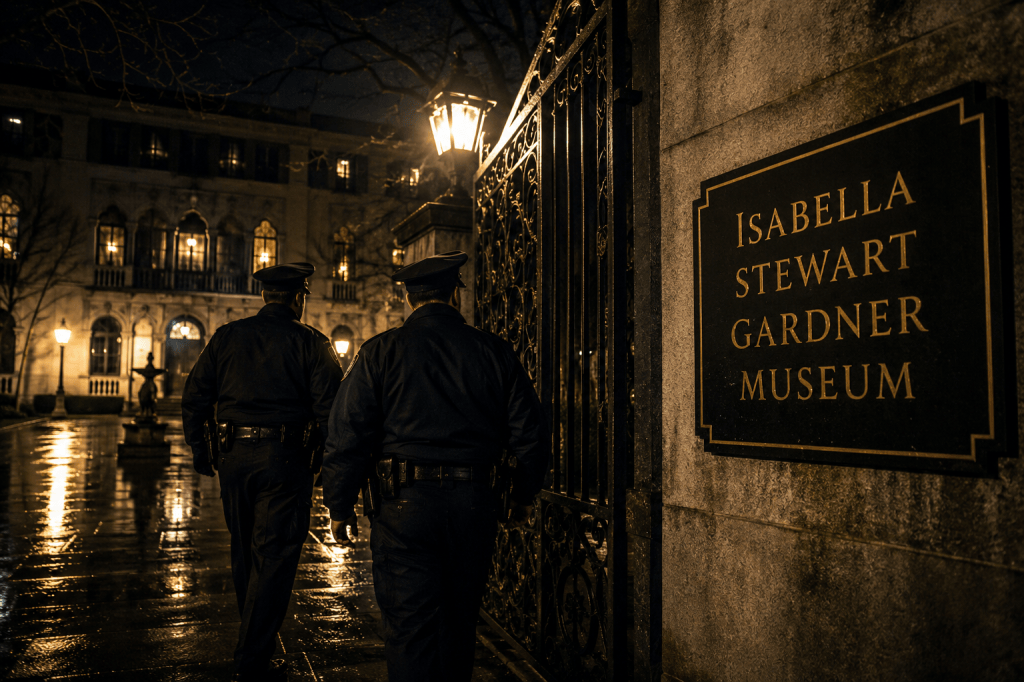
This article describes a real criminal case. The account is based on publicly available sources. The featured image is AI-generated for illustration and is not an authentic photograph or evidence from the investigation.
Shortly after midnight on March 18, 1990, two men wearing police uniforms approached the employee entrance of the Isabella Stewart Gardner Museum in Boston.
They pressed the intercom and claimed they were responding to a disturbance.
The guard on duty made a decision that would become part of criminal history.
He let them inside.
By the time the real police arrived the following morning, thirteen works of art had disappeared. Their combined value has been estimated at more than $500 million.
The paintings and objects have never been recovered. (Isabella Stewart Gardner Museum)
A Knock at the Museum Door
The Isabella Stewart Gardner Museum was unlike most museums.
Its founder had arranged paintings, sculptures, furniture and decorative objects throughout a building designed to resemble a Venetian palace. The collection was intended to remain as she had created it.
During the early hours of March 18, the museum was closed and two security guards were on duty.
At approximately 1:24 a.m., two men dressed as Boston police officers rang the night bell. They said they had received a report of a disturbance.
The guard allowed them through the employee entrance, breaking museum protocol. (Isabella Stewart Gardner Museum)
Once inside, one of the men told the guard that he appeared to resemble someone with an outstanding arrest warrant.
The guard was ordered to step away from the security desk.
He was handcuffed.
The thieves then called the second guard to the desk and restrained him as well.
Both guards were taken to the basement, where they were separated and secured.
The men in police uniforms now controlled the museum.
Eighty-One Minutes
The robbery was not a quick smash-and-grab operation.
Motion detectors recorded the thieves moving through the galleries for approximately 81 minutes.
They entered the Dutch Room on the second floor, which contained several of the museum’s most important paintings.
They removed some works from their frames. Others were cut directly from their canvases.
Five empty frames later became permanent reminders of the theft. The museum continues to display them in the places where the missing paintings once hung. (FBI)
At 2:45 a.m., the thieves left the museum.
They made two separate trips to their vehicle while carrying the stolen objects.
The guards remained restrained in the basement until police arrived at approximately 8:15 that morning. (Isabella Stewart Gardner Museum)
The Thirteen Missing Works
The thieves took paintings, drawings and decorative objects created over several centuries.
Among the missing works were:
- Johannes Vermeer’s The Concert
- Rembrandt’s Christ in the Storm on the Sea of Galilee
- Rembrandt’s A Lady and Gentleman in Black
- Rembrandt’s small self-portrait etching, Portrait of the Artist as a Young Man
- Govaert Flinck’s Landscape with an Obelisk
- Édouard Manet’s Chez Tortoni
- Five works on paper by Edgar Degas
- An ancient Chinese bronze vessel known as a gu
- A bronze Napoleonic eagle finial
Vermeer’s The Concert is particularly important because only about three dozen paintings by the artist are known to exist.
Rembrandt’s Christ in the Storm on the Sea of Galilee is his only known seascape.
Both works are considered among the most valuable missing artworks in the world. (Isabella Stewart Gardner Museum)
Strange Choices
Some of the thieves’ decisions remain difficult to explain.
They stole internationally famous masterpieces that would be almost impossible to sell openly.
At the same time, they ignored other extremely valuable works displayed nearby.
They also took comparatively modest objects, including the Chinese bronze vessel and the eagle finial.
The selection has produced decades of speculation.
Were the thieves acting on instructions from a collector?
Did they know exactly what they wanted?
Or were they choosing objects quickly without fully understanding their value?
No theory has been conclusively proven.
The Empty Frames
Isabella Stewart Gardner’s will required that the arrangement of her collection remain unchanged.
Because of this, the museum did not simply replace the stolen paintings with other works.
The empty frames remain hanging in the galleries.
They are not merely decorations or memorials.
They mark the exact spaces where the missing paintings belong and express the museum’s continued expectation that the works may one day return. (Isabella Stewart Gardner Museum)
Visitors therefore encounter both the collection and its absence.
The empty frames have become among the museum’s most recognisable features.
An Enormous Investigation
The FBI began an extensive investigation into the robbery.
Investigators examined the museum, interviewed witnesses and followed leads involving organised crime, art dealers and possible intermediaries.
No one has ever been convicted of stealing the works.
The FBI has stated that the thirteen objects were probably separated after the robbery and could now be located anywhere in the world. Investigators believe that some may have moved along the eastern United States after the theft. (FBI)
Over the years, investigators and journalists have proposed numerous suspects.
Some were connected to organised crime. Others had knowledge of stolen art or previous robberies.
However, the museum and the FBI have not publicly established who entered the building that night, who ordered the theft or where the artworks are now.
Why Steal Art That Cannot Be Sold?
Famous stolen art creates a particular problem for criminals.
A masterpiece such as The Concert cannot simply be taken to an auction house. Its identity is known internationally, and any attempt to sell it publicly would attract immediate attention.
Stolen masterpieces may instead be hidden, exchanged within criminal networks or used as leverage in negotiations.
But without the recovery of the Gardner works, their exact purpose remains unknown.
It is possible that the thieves expected a buyer.
It is also possible that the value of the paintings was misunderstood by the people involved.
The art may have spent decades hidden in a private building, warehouse or container.
It may have changed hands several times.
There is also the disturbing possibility that one or more works have been damaged or destroyed.
The Reward
The Isabella Stewart Gardner Museum continues to describe the investigation as active and ongoing.
The museum offers a reward of up to $10 million for information leading to the safe return of all thirteen works in good condition.
A share of the reward may be paid for information leading to the return of an individual work or group of works.
An additional reward of $100,000 is offered for information leading to the recovery of the Napoleonic eagle finial. (Isabella Stewart Gardner Museum)
The reward reflects both the financial value of the stolen art and its cultural importance.
These objects were not simply possessions.
They formed part of a carefully constructed museum that was meant to remain intact for the public.
A Crime Without an Ending
More than three decades have passed since the two men walked through the employee entrance.
The stolen paintings have not appeared at auction.
No secret collection containing the thirteen works has been discovered.
No person has publicly produced evidence that solves the case.
Yet the investigation continues.
The museum still displays the empty frames.
The FBI still asks for information.
And somewhere—perhaps in a basement, a private room or a forgotten storage space—some of the missing objects may still exist.
The central questions remain unanswered:
Who were the two men dressed as police officers?
Why did they choose those particular works?
Who helped them?
And where is the stolen art today?
Until the paintings return, the empty frames will remain exactly where Isabella Stewart Gardner placed them—a silent reminder of one of the greatest unsolved art crimes in history.
Sources
- Isabella Stewart Gardner Museum: Isabella Stewart Gardner Museum Theft
- Federal Bureau of Investigation: Isabella Stewart Gardner Museum Heist
- Federal Bureau of Investigation: Stolen Museum Artwork
- Isabella Stewart Gardner Museum: The Five Frames Left Behind
- Isabella Stewart Gardner Museum: Stolen
 Dark Stories